

























































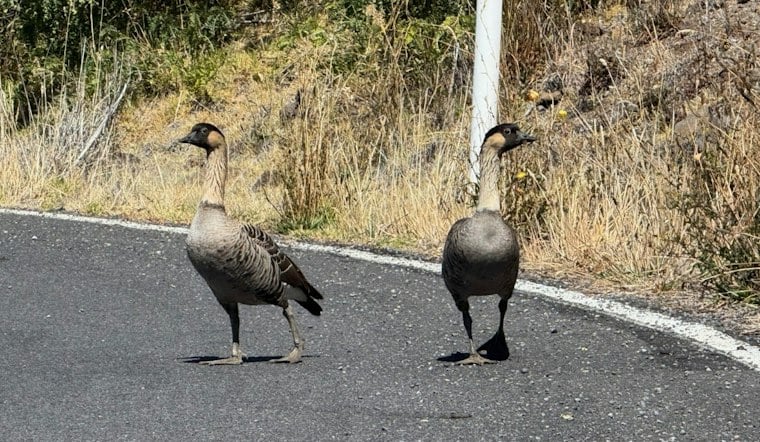
An adult male nēnē was found dead on Kamehameha V Highway on Molokaʻi on Sept. 8, struck by a vehicle. The next day, a male and female nēnē were found deceased near that same spot on the highway. Leg bands later confirmed what made the loss especially painful for conservationists: the two younger birds were the adult male's own offspring, meaning an entire family of endangered geese was wiped out in the span of 24 hours.
The deaths were reported by Kauai Now, which detailed how the Hawaiʻi Department of Land and Natural Resources Division of Forestry and Wildlife is using the incident to remind drivers that nēnē road deaths are preventable. The agency is asking motorists to watch for the birds near roads and highways and to slow down when they spot one.
A Family Wiped Out on One Stretch of Highway
Nēnē form strong social and family bonds, and the loss of one bird can ripple outward to claim others in the same family, according to the state agency's reminder relayed by the same Kauai Now report. That appears to be exactly what happened on Kamehameha V Highway, where the deaths of the adult male's two offspring came just a day after his own death nearby.
Jeff Bagshaw, a Maui district forestry specialist, told the outlet that nēnē hold deep cultural significance in Hawaiʻi and are part of many people's ʻohana. He added that people should be aware of nēnē in neighborhoods and on roads every day, not just during designated awareness periods, and said drivers should slow down and be ready to brake when kūpuna or keiki are near a roadway.
Why the Birds Struggle to Get Out of the Way
Part of the danger comes down to biology. Nēnē are skilled fliers, but their large size makes it hard for them to lift off quickly when a fast-moving car bears down on them, a vulnerability the state has flagged in urging caution near roadways. The timing of the Molokaʻi deaths is notable too, arriving just ahead of Nēnē Awareness Day, set for Saturday in Hawaiʻi.
Nēnē are endangered geese found only in Hawaiʻi, according to The Maui News. A 2017 report from that outlet put the Molokaʻi population at 74 birds and rising, with more than 1,300 nēnē statewide at the time, including roughly 450 on Maui and 250 to 300 within Haleakalā National Park. Current population figures for Molokaʻi were not available. The National Park Service has said more broadly that nēnē populations are on the rebound but remain critically low.
Not an Isolated Problem Across the Islands
Vehicle strikes on nēnē are a recurring issue well beyond Molokaʻi. At Haleakalā National Park on Maui, a nēnē and a native ʻuaʻu seabird were struck and killed by vehicles on July 12, according to Spectrum News. The park has advised both visitors and residents to drive at or below the speed limit while watching for native wildlife on park roads, per the same report.
Spectrum News noted that 11 nēnē and 13 ʻuaʻu have been killed by motorists in the park over just the past four years. The Maui News previously reported that Haleakalā has installed traffic-calming devices, signs, radar devices and fences to try to protect the birds, and has urged extra caution on Crater Road during nēnē breeding season.
What Officials Want Drivers to Do
State wildlife officials are asking anyone who witnesses an injury to a nēnē or other wildlife to report it to the Division of Conservation and Resources Enforcement at 808-643-DLNR (3567). Anonymous tips about wildlife violations can also be submitted through the DLNRTip app, by text message or online.
Losses like the ones on Molokaʻi carry weight beyond a single family of birds. Officials have said these lethal incidents impede broader conservation efforts and threaten the overall recovery of a species found nowhere else on Earth. With Nēnē Awareness Day arriving this week, the message from state wildlife officials is straightforward: slow down, look for the birds, and give them room to get out of the way.





