

























































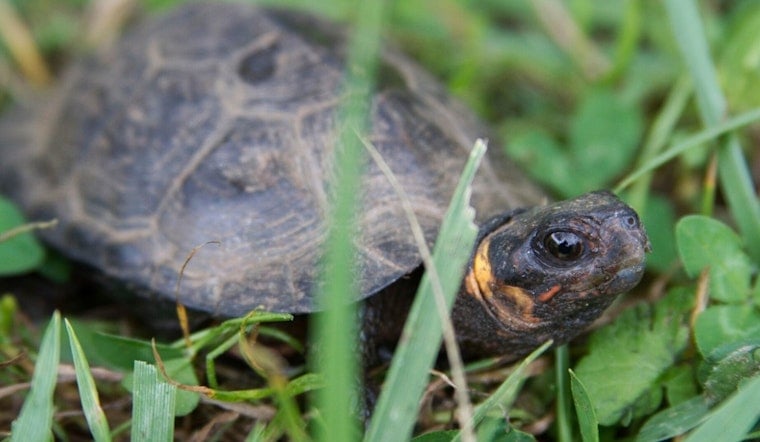
A new wildlife crossing built into a stretch of road in northwestern North Carolina is giving one of the smallest and least visible animals in the state a fighting chance against traffic: the bog turtle. The subterranean passage is designed to let the state-listed threatened species move safely beneath the roadway instead of risking a fatal trip across the pavement.
The project, announced by the North Carolina Department of Transportation, was built in partnership with the NC Wildlife Resources Commission, the U.S. Fish and Wildlife Service, and The Nature Conservancy. NCDOT says the crossing provides a safe subterrain option for nearby bog turtle populations to cross the road, and notes that other four-legged animals have also been spotted making use of the tunnel.
Why a Turtle This Small Needs a Tunnel of Its Own
The bog turtle is North America's smallest turtle species, reaching an adult length of just 3 to 5 inches, according to the NC Wildlife Resources Commission. Fewer than 100 documented wild populations remain in the state, and the species spends most of its life buried in wetland mud, which makes tracking its numbers notoriously difficult. Roads that cut through wetland complexes are considered the single most detrimental threat bog turtles face, according to Project Bog Turtle, causing high vehicle mortality and splintering populations into isolated, fragmented pockets that struggle to maintain genetic diversity.
That isolation carries real regulatory weight. Northern bog turtle populations have held federal threatened status since 1997, but southern bog turtles in North Carolina were only designated under a similarity-of-appearance rule, according to the Center for Biological Diversity. The U.S. Fish and Wildlife Service opened a review in October 2022 to consider full Endangered Species Act protection for the southern population after documenting a 50% drop over two decades, with fewer than 2,000 southern bog turtles left across four states. Whether that review results in full endangered status remains an open question.
From Roadkill Counts to Subterranean Passages
NCDOT's push to build small-animal crossings in western North Carolina traces back to field biologists who noticed heavy reptile and amphibian roadkill along a highway slicing through wetland habitat, according to the U.S. Fish and Wildlife Service. Those observations pushed state and federal agencies to design specialized subterrain passages built for reptiles and amphibians rather than the deer and bears that had traditionally driven road mitigation planning.
Conservationists are also working the problem from the other direction. The Nature Conservancy uses a technique called head-starting, raising bog turtle hatchlings in captivity through their first year before releasing them into protected mountain bogs. Those bogs require active clearing of encroaching trees, since the slow-moving turtles cannot easily migrate to new sites on their own once existing habitat closes in.
Part of a Much Bigger Push Across the State
The turtle tunnel is a small piece of a much larger shift in how North Carolina approaches wildlife infrastructure. In July, the North Carolina General Assembly approved $10.2 million in recurring annual funding for the NCDOT Wildlife Highway Crossing and Mitigation Strategies Program, establishing the state's first permanent budget dedicated specifically to wildlife crossings, according to the Wildlands Network. That funding embeds wildlife connectivity as an ongoing priority in state transportation planning rather than a one-off project.
Elsewhere in the mountains, NCDOT and the NC Wildlife Resources Commission broke ground in October 2022 on the state's first land bridge, a $10 million overpass along NC-143 at Stecoah Gap that uses a mirrored design to keep Appalachian Trail hikers separated from crossing wildlife, with completion expected by late this year. On the coast, the two agencies are working with the U.S. Fish and Wildlife Service on a $31.25 million project along U.S. 64 in Dare County to install 2.5 miles of underpasses and fencing protecting black bears, deer, and endangered Red Wolves along a road that also serves as a key hurricane evacuation route through the Alligator River National Wildlife Refuge.
That coastal corridor has history behind it. North Carolina's first comprehensive wildlife underpasses were completed in 2006 along a newly built section of U.S. 64 in Washington County, designed by the Wildlife Resources Commission specifically to protect Red Wolves, according to NC Wildlife Corridor. Twenty years later, regional planners are extending that same connectivity thinking into fast-growing suburban counties: the Capital Area Metropolitan Planning Organization launched a Wildlife Crossing Study across Chatham and Wake counties this year, working with NCDOT and the Wildlife Resources Commission to map habitat fragmentation and high-collision roadways as urban growth accelerates.
Whether the new bog turtle crossing and similar small-species structures are actually working long-term is still being sorted out. Camera trapping and ongoing monitoring will be needed to confirm how consistently animals use these subterranean passages across the state's fragmented mountain bogs, a question that remains unresolved even as the infrastructure expands.





.jpg)