

























































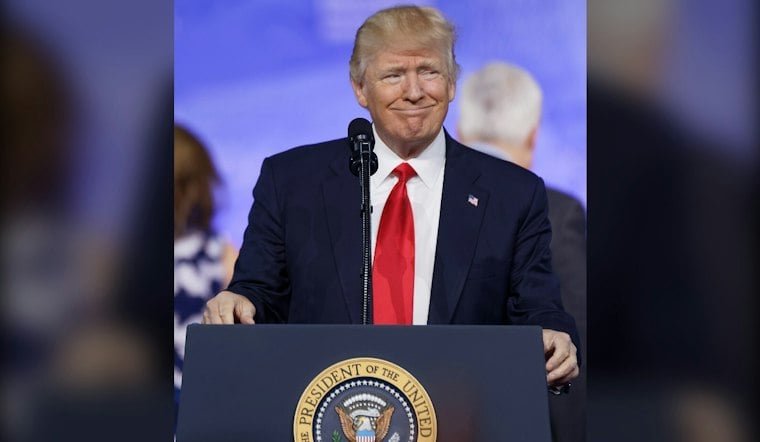
President Trump announced Friday that CNN, MS NOW and Politico are banned from the White House, effective immediately. The move, posted to Truth Social, marks the latest escalation in a yearslong standoff between the administration and major news organizations over access to the president and his staff.
According to CNBC, Trump said he was banning the three outlets from the White House, with CNBC's Megan Cassella reporting on the announcement. In the same post, Trump singled out MS NOW by name, criticizing the network's decision to change its name from MSNBC and attributing the rebrand to a “lack of viewership and credibility,” as reported by The Jerusalem Post. He also accused Politico of corruption, pointing to what he called an “illegal and ridiculous $8 Million Dollar subscription” the outlet received from the Biden administration.
What remains unclear is exactly how the ban will be enforced. Trump's announcement did not specify whether it revokes the outlets' reporters' individual hard passes, bars them from White House briefings and events, or simply removes them from the official press pool rotation, according to NewscastStudio. That distinction matters enormously for how the ban might hold up if challenged in court.
A Press Pool Built on Cooperation
Excluding CNN and MS NOW in particular threatens to disrupt the traditional five-network television pool arrangement that rotates coverage responsibilities among major broadcasters to track the president's movements, per the San Antonio Express-News. That system depends on cooperation among the networks sharing footage and access, and removing two of them from the rotation complicates how the pool functions day to day.
CNBC is a division of Versant Media, as is MS NOW, according to the same CNBC report on the announcement.
Legal Precedent Cuts Both Ways
The legal terrain here isn't new. The 1977 D.C. Circuit ruling in Sherrill v. Knight established that White House press credentials carry First and Fifth Amendment liberty interests, meaning the government must provide published standards, notice, and a chance to respond before denying a press pass, the same NewscastStudio report notes. That precedent was reinforced in 2020, when the D.C. Circuit ruled in Karem v. Trump that suspending a journalist's hard pass over vague decorum standards violated due process rights, upholding an injunction that restored reporter Brian Karem's credentials, according to Justia Law's account of the case.
Trump's first term produced an earlier test case: in November 2018, CNN sued Trump and senior White House officials after correspondent Jim Acosta's hard pass was revoked, and secured a preliminary court order compelling the administration to restore it, as reported by PBS News.
More recent rulings complicate the picture, however. In February 2025, the administration barred Associated Press journalists from Oval Office and Air Force One pool coverage after the wire service declined to adopt the administration's mandated Gulf of America designation, a dispute that produced an ongoing lawsuit, according to the Express-News. A June 2025 ruling from a divided D.C. Circuit panel found the First Amendment does not require the president to grant every press pool member access to tightly controlled, nonpublic spaces like the Oval Office or Air Force One, per JURIST.
Part of a Broader Pattern
Friday's ban fits into a wider pattern of pressure the administration has applied to news organizations since Trump returned to office in 2025. He has filed defamation lawsuits against The New York Times, The Wall Street Journal, and the BBC, the Express-News reports. He has also repeatedly called on the Federal Communications Commission throughout 2025 and 2026 to revoke the broadcast licenses of networks whose news or comedy programming criticizes his administration, according to CTV News.
Whether Friday's ban survives a legal challenge will likely hinge on exactly how it's carried out. Complete revocation of hard passes or removal from the briefing room faces steep precedent in D.C. federal courts, while selective exclusion from smaller press pools or invitation-only events aligns more closely with the executive discretion courts have recognized in the AP litigation, the NewscastStudio analysis notes. Politico, CNN and MS NOW have not detailed their response to the ban as of Friday.





