

























































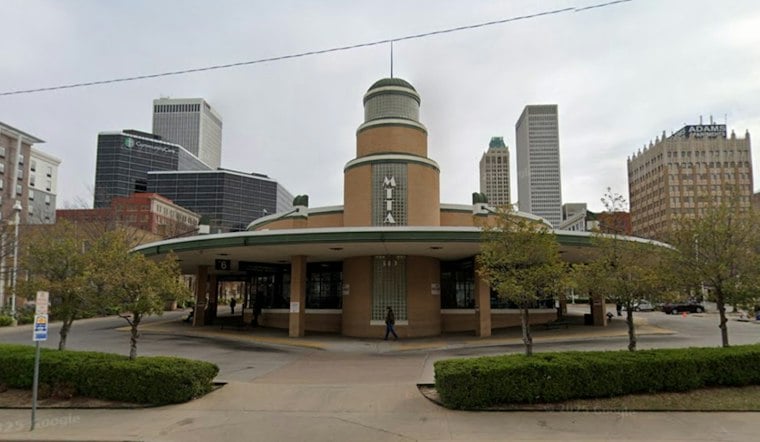
Sale signs are going up Thursday on MetroLink Tulsa's Denver Avenue Station, the transit agency's busiest hub, and officials still haven't said where downtown bus riders will go once it's gone. A real estate firm will post the signs on the building at 319 South Denver, kicking off a sealed bid process that opens for offers on October 1.
Sealed Bids Open Next Week
MetroLink Tulsa CEO Scott Marr said the bidding period could run as long as 30 days once it begins, according to News On 6. The station sits on half a city block downtown, with the rest of the property used as a parking lot, and it remains the busiest of MetroLink's two main hubs even though it's no longer near the Peoria BRT line, now the system's busiest route. Marr said another location could ultimately serve riders better, though the agency has not decided whether it even needs a dedicated downtown transit hub going forward.
The move follows a unanimous vote by the Metropolitan Tulsa Transit Authority Board of Trustees in June, which authorized Marr to begin negotiations to sell the station, citing public safety concerns and ongoing loitering near the facility, according to KGOU. Those concerns weren't new. The City of Tulsa had installed large landscape boulders along the Fourth Street sidewalk next to the station in the summer of 2025 specifically to curb loitering, after nearby downtown business owners complained, per the City of Tulsa. The city agreed this past June to remove and repurpose those boulders at stormwater facilities ahead of property appraisals.
A Station Built for a Different Era of Transit
Denver Avenue Station opened in May 1998 at a construction cost of roughly $5.4 million, built on the site of the former Cimarron Ballroom with an Art Deco-inspired design, an indoor waiting terminal, and 10 bus bays, according to Wikipedia. The transit authority itself dates back further still: it was founded by the City of Tulsa in August 1968 as a public trust to replace a striking private bus operator, operating for decades as Tulsa Transit before officially rebranding to MetroLink Tulsa in March 2024.
Today's ridership pattern looks nothing like it did when the station opened. MetroLink's traffic is concentrated largely on the Peoria line and Route 130, which runs along Admiral, and a second Route 66 BRT line is set to launch in 2027. Marr said MetroLink may reduce the number of routes entering Denver Avenue Station while still maintaining or improving downtown service. The agency's 2023 ridership across fixed routes, microtransit zones, and its LinkAssist paratransit system totaled 1,991,867 passengers, averaging 6,491 weekday boardings, per Wikipedia's entry on the transit authority.
Decentralized Routes Have Reshaped the System
Much of that shift traces back to Tulsa's first Bus Rapid Transit corridor, the AERO Peoria BRT, which launched in late 2019 using voter-approved Vision Tulsa sales tax funding and established rapid service that runs outside the traditional downtown terminal, according to MetroLink Tulsa. The agency also introduced its MicroLink on-demand microtransit service in 2023, expanding app-based, hailed service zones across Tulsa and Broken Arrow to connect riders directly to fixed routes or neighborhood destinations. MetroLink's second primary hub, the Memorial Midtown Station at 33rd Street and Memorial Drive, originally opened in 2001 and got a grand reopening with staffed customer service attendants in March 2024, offering free park-and-ride options for airport bus service.
MetroLink Tulsa says it will continue to have some form of public transportation downtown, but is still weighing whether that means keeping a dedicated downtown bus station or simply focusing resources on the Memorial Midtown hub. Meanwhile, the property itself has long been eyed for something else entirely. The City of Tulsa's 2019 Arena District Master Plan identified the Denver Avenue Station site for redevelopment into a mixed-use commercial and entertainment space, calling for more entertainment and hospitality options around the BOK Center and Arvest Convention Center, according to a Public Radio Tulsa report on the 30-block downtown blueprint.
Streetscape Work Already Underway Nearby
The city has also scheduled a Denver Avenue Streetscape Project for 2025 and 2026, using 2019 Improve Our Tulsa II bond funds to upgrade sidewalks, lighting, and public art along the corridor, according to the Downtown Tulsa Partnership. That streetscaping is aimed at turning Denver Avenue into a major entrance corridor for the Arena District — work that's moving forward even as the fate of the bus station itself, and the riders who depend on it, remains unresolved.



