

























































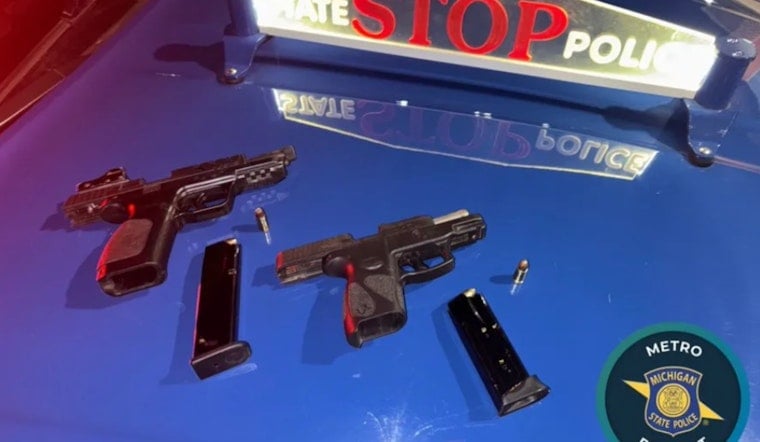
Two drivers were arrested on Sunday morning in Hazel Park after Michigan State Police said they were caught driving drunk with loaded handguns during separate but nearly simultaneous stops on eastbound 8 Mile Road near I-75. Neither driver had a valid Concealed Pistol License, according to police, and both were determined to be operating while intoxicated.
The first stop began when a Michigan State Police trooper and sergeant pulled over a Hyundai on eastbound 8 Mile Road near I-75 for speeding and impeding traffic, according to The Oakland Press. The Hyundai had stopped in the right lane, blocking traffic, police said. While dealing with that driver, troopers found a loaded handgun underneath the Hyundai driver's seat.
As that stop was unfolding, a second vehicle, a Dodge Durango, pulled up behind the patrol car with its hazard lights on, blocking traffic further. A Michigan State Police sergeant reportedly saw a handgun sitting in the Durango driver's lap, with the driver's hands near the firearm. Troopers detained the Durango driver and secured that loaded handgun as well, according to the same report.
Two Arrests, Two Confiscated Firearms
Michigan State Police confirmed the arrests of both drivers for operating while intoxicated and possessing loaded handguns. Firearms were confiscated from both drivers in Hazel Park, per a Michigan State Police post on X. The Oakland Press asked state police for the drivers' ages, genders, cities of residence, and blood-alcohol concentrations, but police said that information was unavailable as of Tuesday.
Because neither driver held a CPL, Michigan law treats the handguns as concealed weapons under MCL 750.227, a felony punishable by up to five years in prison and a fine of up to $2,500, according to Barone Defense Firm. Michigan law also requires drivers carrying a concealed pistol to immediately disclose it to officers during a stop, and failing to do so carries its own civil infraction and a $500 fine, the firm notes.
Alcohol and Firearms Carry Separate Charges Under Michigan Law
Beyond the concealed weapon exposure, both drivers face potential misdemeanor charges under MCL 750.237 for possessing a firearm while intoxicated, a charge that can escalate to a felony if a firearm is discharged and causes serious injury, according to Garmo & Kiste PLC. Michigan sets an unusually strict threshold for armed motorists specifically — it is illegal to carry a concealed firearm with a bodily alcohol content as low as 0.02%, far below the standard 0.08% limit for driving alone, per the Davis Law Group.
On top of the firearm-related charges, a standard first-offense OWI in Michigan carries up to 93 days in jail, fines between $100 and $500, up to 360 hours of community service, six points on a driving record, and a 30-day license suspension followed by restrictions, according to Mark Caldwell, an attorney who outlines Michigan's impaired-driving statute. If BAC testing eventually shows a level of 0.17% or higher, Michigan's “Super Drunk” provision would push maximum jail time up to 180 days. It remains unresolved whether either driver's BAC crossed that threshold, since Michigan State Police had not released those figures as of the Oakland Press report.
A Pattern Along Metro Detroit's Border Corridors
This is not the only recent case in the region pairing guns with impaired driving. In late August, Michigan State Police troopers arrested a speeding driver on I-75 in Oakland County near Sashabaw Road who was caught with two loaded handguns and no CPL, facing felony weapons charges alongside a third OWI offense, per Hoodline. And in February, a Detroit driver was sentenced to 3 to 15 years in prison after a jury convicted him of driving drunk the wrong way on I-75 near Hazel Park in 2023, killing a 27-year-old Hazel Park resident.
State figures released by the Michigan State Police Criminal Justice Information Center in July show drunk-driving arrests statewide fell to 24,690 in 2025, continuing a decade-long decline from more than 35,000 arrests in 2014. Even so, impaired driving was blamed for 447 fatalities on Michigan roads in 2024 — nearly 41 percent of all traffic deaths statewide, according to state police audit figures.
Oakland County courts are known among defense attorneys for imposing strict pretrial supervision in OWI cases, often ordering daily breathalyzer testing, alcohol tethers, and random drug screening as bond conditions, according to Fraiberg & Pernie. Whether either Hazel Park driver will face those conditions, or what additional charges the Oakland County Prosecutor's Office may file for impeding traffic, remains to be determined as the case moves through formal review.



