

























































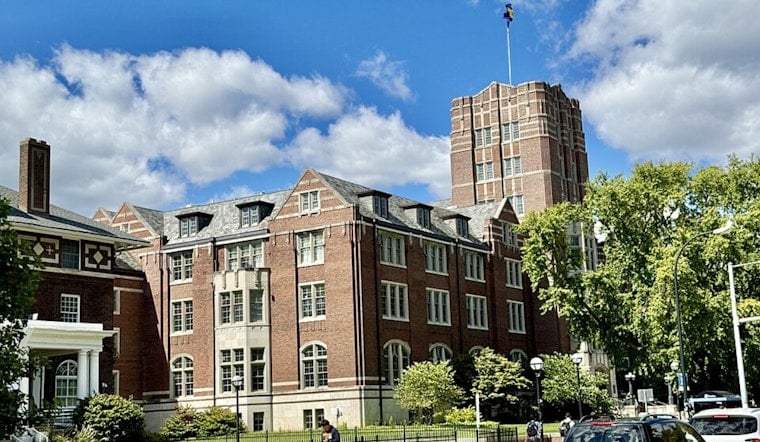
The University of Michigan says it does not give free football or basketball tickets to state lawmakers, a policy the school spelled out Thursday after reporting revealed Michigan State University offered game tickets to more than 100 lawmakers, legislative staffers, budget analysts and other state officials throughout 2025.
U-M spokesman Paul Corliss said the university has not provided complimentary football or basketball tickets to Michigan lawmakers, and that the policy aligns with an interpretive statement issued by Secretary of State Jocelyn Benson's office. According to The Detroit News, Corliss made the statement on Thursday, days after the newspaper's own examination of MSU's ticket giveaways became public. U-M and MSU are Michigan's two largest universities, and the contrast between their approaches has put a spotlight on how state institutions are interpreting the same gift-limit rules very differently.
The Detroit News reported that it obtained MSU's ticket-offer email address and filed an open records request to examine the university's practices. That reporting found MSU offered tickets to at least three lawmakers for a December 6, 2025 basketball game against Duke University, a matchup in which both teams were ranked in the national top 10 at the time. The paper tracked 87 state lawmakers, legislative staffers, or employees of Governor Gretchen Whitmer's administration who accepted MSU football and basketball tickets in 2025, and found the school made basketball tickets available to lawmakers for free in most of the instances examined, usually without requesting payment.
How MSU Defends Its Ticket Values
MSU spokeswoman Amber McCann contended that a basketball ticket given to a lawmaker cost $55, and said the university assesses value based on what it would cost a member of the public to purchase the same ticket through the MSU athletics ticket office. When no price is printed on a ticket, McCann said, the value is based on what a member of the public would pay through that same ticket office. By that measure, MSU has claimed the fair market value of its free basketball tickets fell below the state's $79 monthly gift limit for lobbyists, and university policy bars registered lobbyists from giving gifts with a fair market value above that threshold.
But the resale market told a different story for at least one of the tickets in question: a resale ticket for the MSU-Duke game started at $119, more than double the $55 figure MSU cited. The Detroit News reported that Benson's office has said lobbyist-provided gifts should be valued at fair market value rather than face value, a standard that would appear to conflict with MSU's face-value accounting method. MSU did request payment for football tickets, according to the newspaper's findings, even as it usually gave basketball tickets away without asking lawmakers to pay.
The Rule Benson's Office Set in 2024
The valuation dispute traces back to an August 2024 interpretive statement from Benson's office, issued in response to a petition from retired attorney Bob LaBrant, which ruled that lobbyists cannot bypass gift limits by handing over face-value tickets worth more than the monthly cap and then accepting deferred reimbursement later, according to Dykema. Michigan's Department of State clarified that arrangement as an illegal lobbyist loan, and established that to lawfully accept a ticket exceeding the monthly gift cap, a public official must pay the difference at or before the time the ticket is accepted, per the Michigan Department of State. Before that ruling, lobbyists had for decades relied on unwritten practices around ticket distribution, with the state's lobbyist gift limit having operated under a $25 base set in 1978 and adjusted only once, in 1989, before Benson's office formally addressed ticket reimbursement schemes, according to background reported by The Ballenger Report.
The monthly gift cap itself has climbed with inflation, moving from $76 in 2023 and 2024 to $79 for 2025 and 2026 under adjustments tied to the Detroit Consumer Price Index, as detailed by State and Federal Communications. Other lobbying thresholds shifted for 2026 as well: the food and beverage reporting threshold rose from $475 to $500, while individual lobbyist compensation thresholds and single-official employer expenditure caps held steady at $800.
Why Lawmaker Gift Disclosure Exists At All
None of this scrutiny would be possible without a relatively recent change to Michigan law. Voters approved Proposal 1 in November 2022 with 66.45% of the vote, making Michigan's mandatory financial disclosure requirements for state officials take effect under Public Act 282 of 2023, according to Ballotpedia. Before that amendment, Michigan was one of only two states in the country without personal financial disclosure requirements for state lawmakers.
Attorney General Dana Nessel further expanded that transparency in June 2024, issuing a binding legal opinion requiring public officials to disclose all lobbyist-provided gifts on their personal financial reports, closing a loophole in the 2023 law that had only required reporting if the lobbyist also reported the gift, per The Ballenger Report. The Michigan Department of State had already launched the public Michigan Transparency Network portal in March 2024, giving citizens and journalists a way to search lawmakers' personal financial disclosures. Lawmakers filing 2024 disclosures later got a temporary reprieve when the Michigan Legislature passed Senate Bills 99 and 100 in May 2025, pushing the filing deadline to June 13, 2025, while the state refined its electronic disclosure system.
An MSU spokeswoman did not immediately respond to a request for comment on U-M's statement, The Detroit News reported. It remains unclear whether state election or ethics officials will formally review MSU's method of valuing high-demand athletic tickets, or whether future rules will standardize how public institutions across Michigan value tickets offered to state officials.





