

























































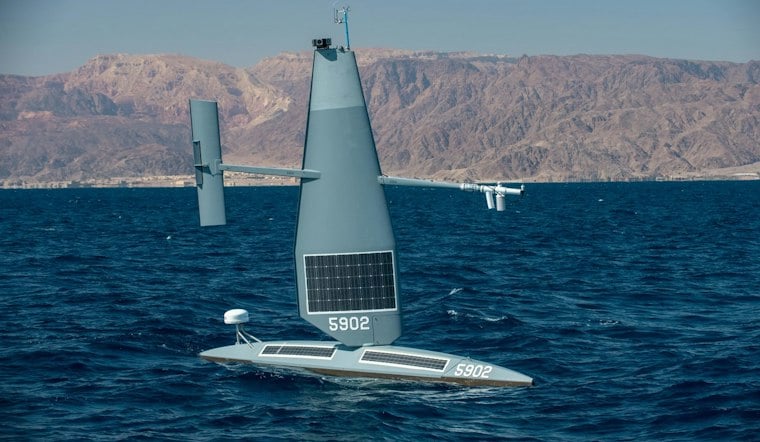
U.S. forces destroyed two small Iranian boats after their crews tried to seize a Navy unmanned surface vessel near the Strait of Hormuz, the military said, in the latest flashpoint of a war that has now stretched past six months. U.S. Central Command confirmed its forces opened fire on the boats after the Iranian craft attempted to take possession of the drone, known as a Saildrone, a small, roughly 25-foot unmanned surface vessel that operates on its own to monitor maritime traffic.
Central Command spokesman Tim Hawkins confirmed the incident, according to a report from KTAR News 92.3 FM, which cited Associated Press reporting on the strike. Iranian state media, for its part, reported that a pair of fishing boats came under attack in Hormozgan province, on Iran's southern coast, and said several fishermen were missing — a version of events that stands in contrast to the Pentagon's characterization of the vessels as boats attempting to seize U.S. military equipment. The dossier does not resolve which characterization is accurate, and both accounts are presented here as reported by their respective sources.
The Saildrone itself uses commercially available technology that CENTCOM has repeatedly stressed is not sensitive in nature. As Naval News has detailed, the Saildrone Explorer is a wind-propelled and solar-powered craft designed to remain at sea for up to a year while collecting data to sharpen U.S. maritime awareness in the region.
A Pattern That Predates This War
A Pattern That Predates This War The incident also fits a broader pattern of disputes over surveillance craft. U.S. Navy officials have said at the time that the Saildrone's commercial technology carried no classified equipment — the same point CENTCOM has emphasized this week.
Central Command has used Saildrones in the region for several years as part of its maritime operations, according to Navy.mil. Autonomous vessels have also served as surveillance tools.
A Week of Drone Losses and Disputed Claims
A Week of Drone Losses and Disputed Claims The boat destruction came about a week after an Iranian state television report that Iran's navy had captured an Anduril Dive-LD autonomous underwater vehicle in the strait after it malfunctioned while surveying waters. Iranian state television reported on September 8 that its navy had captured a U.S. military underwater drone at the entrance to the strait, and the Pentagon, located in Washington, was among those responding to the claim that day.
CENTCOM described the Dive-LD as an older, defective model that carried no classified sonar or radar equipment and had not collected sensitive data. The Dive-LD is a 19-foot vehicle rated to operate at depths of up to 6,000 meters, built as an “attritable” system meant to accept the risk of loss in contested waters while mapping the seabed and hunting mines to keep sailors out of harm's way.
Days later, the propaganda war intensified further. Iran claimed that its naval forces struck a U.S.-operated surface drone near the strait — a claim U.S. military officials disputed, with Central Command confirming that all of its surface drones remained fully accounted for and operational.
Oil Markets and Sanctions Feel the Strain
The broader war has already pushed oil and gasoline prices higher, and it has posed political problems for President Donald Trump and the Republican Party as the conflict grinds past six months, according to the KTAR report on the AP account. The stakes tied to the strait are enormous.
Tehran has also moved to tighten its grip on the corridor. The Statesman reported that Iran announced a new prohibited maritime zone and threatened sanctions for violations. That announcement came alongside a widening U.S. economic campaign.
The U.S. military has said it seeks to keep the strait open, describing its recent strikes as efforts to loosen Iran's grip on the energy shipping corridor even as both sides trade competing claims about who controls, and who is losing, drones in the contested waterway.



