

























































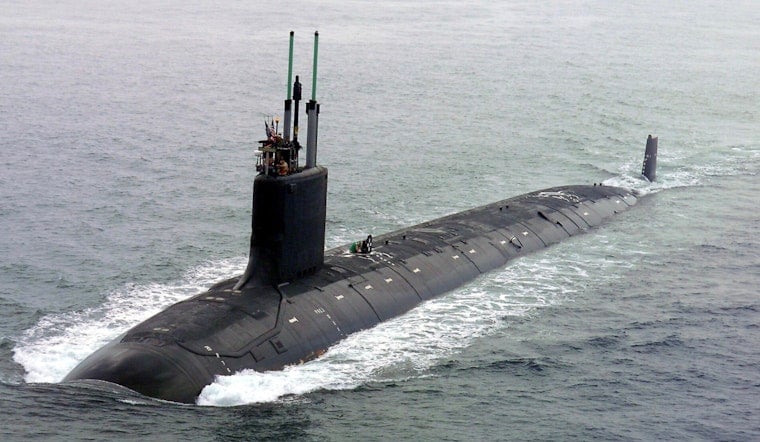
Australia and the United States announced plans to deepen their defense partnership this week, with US defense personnel already working at HMAS Stirling naval base on Australia's west coast ahead of a 2027 buildup that will bring four US-commanded Virginia-class submarines to the site. The announcement comes as China continues to expand its influence across the Pacific through grants, infrastructure projects, and aid, prompting the allies to widen their own military and financial footprint in the region.
Australian Defence Minister Richard Marles met with US Defense Secretary Pete Hegseth to discuss the two countries' defense cooperation, according to Reuters.
The cooperation includes the AUKUS defense pact among the United States, Britain, and Australia. Australian and US defense ministers are expected to provide further details on their cooperation at their next meeting later this year.
Submarine Buildout Accelerates at HMAS Stirling
The submarine plans represent one of the most concrete pieces of the expanding partnership. Beginning in late 2027, the Submarine Rotational Force – West will rotate one British Astute-class submarine and up to four US Virginia-class submarines through HMAS Stirling in Western Australia, backed by A$8 billion in committed base infrastructure upgrades, according to the Australian Department of Defence. HMAS Stirling sits on Garden Island near Perth.
The US Navy has already taken concrete administrative steps to prepare for that buildup. On May 30, 2026, the Navy formally established Naval Support Activity Stirling in Western Australia to provide administrative support, family services, and logistics for American service members and contractors assigned to the rotational force, as reported by Defense News. That new support command operates under Navy Region Japan. The groundwork was further tested in February 2026, when the British Royal Navy's Astute-class submarine HMS Anson docked at HMAS Stirling for maintenance work, marking the first time a UK nuclear-powered submarine underwent maintenance in Australia as part of AUKUS preparations, according to the Australian Submarine Agency, with Australian and British personnel working together on maintenance in February and March 2026.
Australia's broader acquisition of nuclear-powered attack submarines under AUKUS Pillar 1 carries a far larger price tag. The program is budgeted between A$268 billion and A$368 billion through 2055, a figure that includes a 50 percent, or A$122.9 billion, contingency reserve to absorb long-term cost uncertainties, per ABC News. That plan includes purchasing at least three US Virginia-class submarines in the early 2030s. The AUKUS pact is part of the broader regional defense discussion.
Ground and Air Forces Already Rotating Through the North
Submarines are only one piece of an expanding footprint that already spans northern Australia. The Marine Rotational Force – Darwin also sends US Marines and sailors to Australia's Northern Territory, according to the US Marine Corps. The rotations are part of the two countries' broader defense cooperation.
Hundreds of millions of dollars in US defense funding have also gone into RAAF Base Tindal in northern Australia, according to the EurAsian Times. The United States and Australia have a Force Posture Agreement, according to the US Department of State.
Pacific Islands Forum Overshadowed by Absences and a Funding Push
The defense announcements landed as the Pacific Islands Forum summit headed into its final day in Palau, a gathering Reuters reported was overshadowed by the absence of several leaders. The forum meeting was taking place in Palau at the time.
Australia and the United States announced $580 million in combined funding for Pacific island nations at the forum. Of that package, Australia committed A$600 million, about $430 million USD, primarily for aerial surveillance and anti-drug smuggling operations, while the US also announced support, according to Modern Diplomacy. The US contribution was reported by The Jakarta Post.
The funding push follows a period of heightened regional diplomatic and security activity, according to Devdiscourse. The broader cooperation remains focused on regional security. No details on troop numbers were included in the report.





