

























































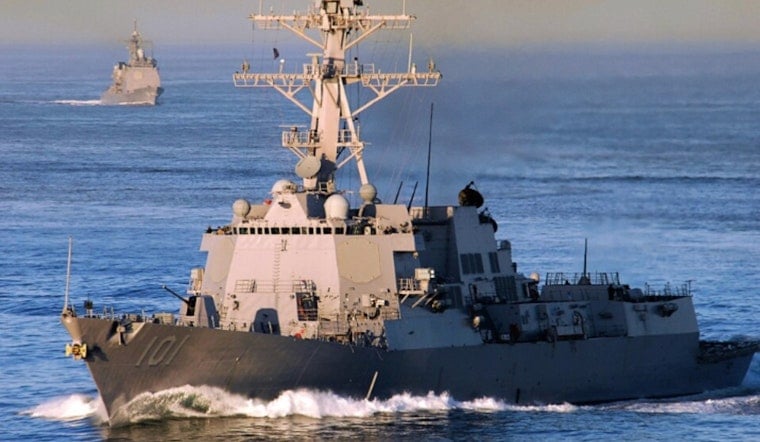
Three Iranian crude oil tankers were disabled or destroyed by U.S. forces on Saturday, September 5, after Iran's Revolutionary Guard Corps launched ballistic missiles toward an American aircraft carrier and destroyer, according to U.S. Central Command. No American servicemembers were injured and the U.S. warships were not hit, CENTCOM said, even as the strikes marked a sharp new phase in a Persian Gulf conflict that has already dragged into its seventh month.
U.S. Central Command identified the targeted vessels as the M/T Downy, permanently disabled off Kharg Island; the M/T Stark 1, permanently disabled near Jask; and the unladen M/T Kylo, also known as Noxen, which was completely destroyed in the Gulf of Oman after its crew was ordered to abandon ship, according to CBS News. As KVIA reports, U.S. forces destroyed one tanker and disabled two others in direct response to the missile attacks on the American ships.
Adm. Brad Cooper said the United States will defend American forces and may destroy Iran's limited and exposed oil fleet, per KVIA's reporting. He added that the U.S. will impose a higher economic cost on the IRGC by taking out the three tankers, which CENTCOM describes as part of a multibillion-dollar shadow network funding the Guard and its regional proxies. Iran, according to CENTCOM, has limited means to defend the three tankers.
Iran Confirms Strike Near Its Main Export Terminal
Iran's semi-official Tasnim News Agency reported that an oil tanker was hit six nautical miles off Kharg Island by four U.S. projectiles, with local officials confirming no casualties as the crew was evacuated, according to Tasnim. Kharg Island sits roughly 30 kilometers off Iran's coast in the northern Persian Gulf and has historically handled about 90 percent of Iran's crude oil exports, per The Times of Israel. That makes the anchorage a focal point of U.S. economic and naval pressure, with blockades targeting its export capacity since April.
Maritime observers released audio and video Saturday, September 5, showing U.S. military aircraft issuing VHF radio warnings to Iranian tanker crews before the missile strikes, giving personnel three minutes to clear the vessels, according to Iran International. The tactic reflects an apparent effort by U.S. forces to render shadow-network vessels inoperable while allowing crews to escape unharmed.
A New Doctrine Built on Direct Retaliation
Saturday's strikes were carried out under a newly authorized U.S. military “tanker for tanker” doctrine established in early September, which directs forces to target Iranian oil fleet vessels in direct response to Iranian attacks on commercial or naval shipping, according to Forbes. The policy is aimed at imposing direct economic costs on the IRGC.
In the days before the tanker strikes, CENTCOM executed coordinated raids against roughly 100 Iranian military targets along the Strait of Hormuz, including air defense batteries, radar sites, mine-laying vessels, and anti-ship missile platforms, according to Kurdistan24. That earlier campaign was intended to open safe passage for commercial shipping through the chokepoint.
Diplomacy Collapsed Before the Latest Escalation
Washington and Tehran had signed an interim agreement concerning the Strait of Hormuz on June 17, but implementation broke down over unresolved disputes involving security arrangements and naval blockades, according to Anadolu Ajansı. That breakdown preceded the resumption of military exchanges.
The Strait of Hormuz has been a recurring flashpoint since well before Friday's strikes. Hoodline reported in April that CENTCOM had sent destroyers into a Hormuz minefield, deploying the USS Frank E. Peterson and USS Michael Murphy alongside underwater drones to clear sea mines the IRGC had laid in the strait, mines that had previously stranded dozens of commercial tankers.
Shipping Toll and Rising Fuel Costs at Home
Commercial shipping faced attacks and seafarer casualties during the conflict. Commercial shipping volume through the strait has been disrupted by the conflict.
The economic fallout has reached American drivers directly. U.S. national average diesel prices surged to an all-time record high of $5.85 per gallon on September 4, while regular gasoline reached $4.15 per gallon, the highest Labor Day weekend prices ever recorded by AAA, according to the Associated Press. The period has also seen disruption around the Strait of Hormuz and high fuel prices.
Whether targeting Iran's remaining crude carriers will deter further IRGC strikes on shipping or invite a wider asymmetric response remains an open question hanging over the conflict. With the June navigation agreement in tatters and the tanker-for-tanker doctrine now in active use, the Gulf's commercial shipping lanes — and the fuel prices tied to them — look unlikely to stabilize soon.





