

























































UVA’s planned Center for the Arts will bring museum galleries, performance venues and creative programs together in a roughly 220,000-square-foot complex in the Emmet-Ivy Corridor. The university says it has secured $335 million in funding for the project through a record state appropriation and a historic family gift, with the five-story center targeted to open in 2030.
UVA Vice Provost for the Arts and Virginia Film Festival Executive Director Jody Kielbasa said the state appropriation of $205 million was the largest single appropriation in university history, according to Cville Right Now. Virginia lawmakers folded that money into the two-year, $205 billion state budget passed on June 29, 2026, after capital funding for the project had been delayed by a gubernatorial line-item veto the year before, as reported by The Cavalier Daily. Virginia state Senator Creigh Deeds backed the state funding push, per Cville Right Now's reporting.
Kielbasa also said the philanthropic side of the ledger set its own record: the largest gift ever made to a single capital project at UVA. That commitment traces back to Tessa and Richard Ader's $60 million lead gift in 2021, which grew to a cumulative $130 million after Tessa Ader's marital trust contributed an additional $70 million following her death in January 2026, according to the university's development office. Trustees Joseph Erdman, Brian Potts, and Charles D. Fox IV directed that remaining bequest.
A Building Designed to Solve a Storage Problem
The Fralin Museum of Art and the Kluge-Ruhe Aboriginal Art Collection currently occupy roughly 18,000 square feet combined, according to Cville Right Now’s reporting; the new plan gives them a shared 65,000-square-foot museum wing. UVA says roughly 97% of the Fralin and Kluge-Ruhe collections are currently in storage, and expanded galleries will allow more of the collections to be rotated in. Kluge-Ruhe holds more than 3,700 works and is the only museum in the country dedicated exclusively to Indigenous Australian art. The Kluge-Ruhe Aboriginal Art Collection describes its holdings as the most significant such collection outside Australia.
Indigenous Consultation and Collection Stewardship
Kluge-Ruhe says its approach recognizes Indigenous people as authorities on their art and culture and aims to amplify their voices. The collection also says Senior Collections Manager and Registrar Nicole Wade has worked on consultation and repatriation projects that returned secret and sacred items to Indigenous Australian communities, according to Kluge-Ruhe.
The roughly 220,000-square-foot, five-story complex is designed to meet LEED Silver environmental standards, according to VMDO Architects. Design work is split among three firms: Diamond Schmitt serves as lead and executive architect and designed the 1,200-seat performance hall, Selldorf Architects handled the fourth- and fifth-floor museum spaces, and local firm VMDO worked alongside UVA's Office of the Architect on the overall complex, per Diamond Schmitt.
A Concert Hall Named for the Aders, Steps From Freight Trains
The building's signature space, the 1,200-seat Tessa and Richard Ader Performing Arts Center, will sit alongside a 150-seat recital hall and an experimental art space, according to Cville Right Now. The center is expected to host Broadway dance shows, symphonies, and film screenings once it opens, and UVA says it engaged one of the world's top acoustical engineering firms to tune the halls. That engineering challenge carries extra weight given the site's location just 40 yards from active train tracks, per Cville Right Now's reporting.
Beyond the main hall, the design includes an experimental performance lab. Architecturally, the complex blends red brick, cast stone, and glass to echo UVA's Jeffersonian aesthetic, while the surrounding site adds a wetland creek and a pond amphitheater promenade, according to the university's Board of Visitors.
Part of a Larger Campus District
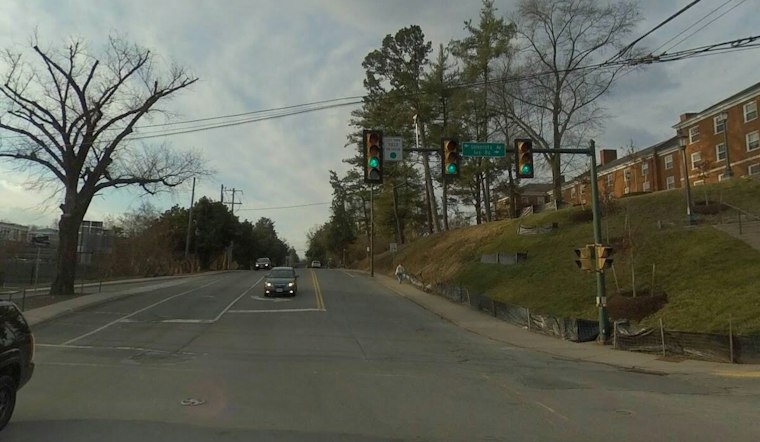
The Center for the Arts is planned for the northeast corner of UVA’s 14.5-acre Emmet-Ivy Corridor, a redevelopment area that includes the School of Data Science, which opened in spring 2024, the Karsh Institute of Democracy and the Virginia Guesthouse hotel. To accommodate visitor traffic, a new 1,030-space North Grounds Parking Garage with an integrated transit hub is expected to open in 2026, according to Information Charlottesville. Campus planners are also weighing pedestrian bridges to connect the arts grounds across the corridor.
Connecting the Corridor
UVA Facilities Management describes Phase 1 of its Ivy Corridor project as including storm-water and utility improvements, as well as pedestrian, bicycle and transit accommodations along both sides of Ivy Road. Those planned routes and improvements provide context for how the arts center fits into the wider corridor’s development.
UVA's Board of Visitors approved the schematic design in September 2025, ahead of the targeted 2030 opening. UVA President Scott Beardsley said on September 18 that the center will benefit the arts scene throughout Virginia and especially Charlottesville, a sentiment echoed in the university's funding announcement.
Decades of Advocacy and a Downtown Mall Balancing Act
Joseph Erdman, a 1956 graduate of UVA's College of Arts and Sciences, advocated for the arts at the university for decades before helping direct the Ader bequest as a trustee. The Joseph and Robert Cornell Memorial Foundation has separately supported the Fralin, the Charlottesville Symphony at the University of Virginia, the Virginia Theatre Festival, the President's Speaker Series for the Arts, University Singers, and the Virginia Film Festival. Tessa Ader herself established the Richard M. and Tessa G. Ader Endowed Fund for Music Education at UVA and created the Ader Emerging Artist Program at the Charlottesville Opera, which gives early-career opera singers professional experience.
Once the Center for the Arts opens, the Virginia Film Festival plans to operate at both the new campus venue and its longtime home at The Paramount, with the Downtown Mall remaining the festival's hub. That arrangement means Charlottesville's cultural map will effectively span two poles: the historic downtown theater district and a new campus arts corridor, both hosting pieces of the same annual festival.





