

























































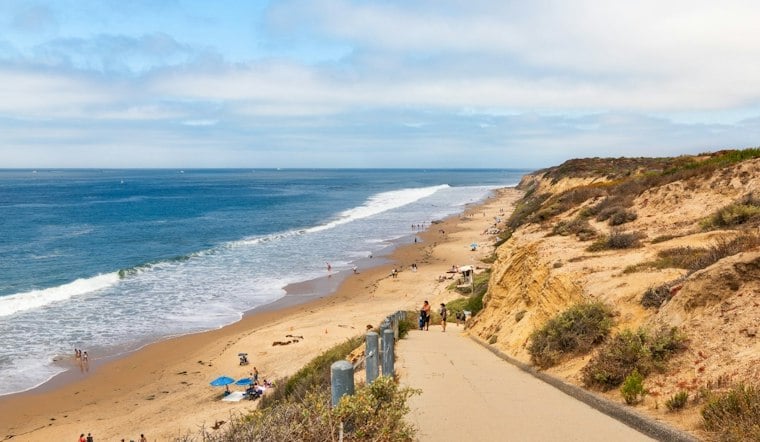
Jackie Aguilar was walking with her family along Crystal Cove Beach last Friday when they came across a sluggish, oddly colored snake stranded on the sand. Not realizing what they were dealing with, the family tried to help it back into the water. It wasn't until later that Aguilar looked it up and discovered it was likely one of the most venomous snakes in the world.
Aguilar identified the animal as a yellow-bellied sea snake through her own research, and told CBS LA that it was one of the most poisonous species she could find. Certified naturalist Chad Steffen said the animal pictured looks like a highly venomous yellow-bellied sea snake, though officials have not confirmed the identification. The species is uncommon in Southern California, and its sudden appearance at Crystal Cove has once again put the spotlight on the region's unusually warm waters this year.
Steffen said yellow-bellied sea snakes are not inclined to bite and are not aggressive, a detail that helps explain why the Aguilar family was able to approach the animal without incident. The snakes are notoriously clumsy and sluggish once out of water, which is part of why beachgoers sometimes mistake their helplessness for harmlessness. Despite their potent neurotoxic venom, the species poses little threat to casual beachgoers because their small mouths and short fangs make it difficult for them to bite a person unless the snake is directly picked up or handled, according to the Los Angeles Times. The Los Angeles Times reported that no one has died from the animal's bite.
A Snake Rarely Seen This Far North
Yellow-bellied sea snakes are normally found much farther south in the Pacific Ocean, and their presence off Orange County has historically lined up with unusual ocean warming. The last confirmed sighting in Orange County came in January 2018, when a 25-inch female was found near the 18th Street lifeguard tower in Newport Beach. That 2018 sighting was documented.
Before that, the pattern was tightly bound to El Niño winters. The very first confirmed sighting of the species in California came on November 23, 1972, on a beach at San Clemente during a strong El Niño event, according to California Herps. During the 2015-2016 El Niño winter, three of the snakes washed ashore in Southern California within a few months of each other — one at Silver Strand State Beach in Oxnard in October 2015, one at Huntington Beach that December, and one in San Diego County the following January. Some specimens were rescued or collected for study.
Warming Waters Bringing More Than Snakes
Steffen attributed the unusual coastal sightings to potential El Niño conditions, noting that many interesting marine sightings have occurred this year across the region. Southern California is experiencing a very warm water year, and the evidence has piled up well beyond one snake: a hammerhead shark was spotted swimming off Newport Beach, and fishermen reported catching massive bluefin tuna off the Southern California coast.
Scientists at the Natural History Museum of Los Angeles County warned on Wednesday that rising coastal water temperatures are pushing subtropical marine species further north into Southern California, pointing to recent local sightings of hammerhead sharks, mahi-mahi, and sea snakes as evidence, according to MyNewsLA.com. Warm ocean currents are allowing tropical marine life to travel well beyond its typical range off Baja California, the outlet reported. The outlet also reported that the museum asks people to photograph unusual fish or reptiles and send images and contact information to the museum.
Yellow-bellied sea snakes have their own strange survival quirks that make life on land especially dangerous for them. Unlike marine fish, they cannot drink seawater to hydrate, and instead survive by drinking thin layers of fresh rainwater that pool on the ocean surface after storms, according to BBC Wildlife Magazine. The species, known scientifically as Hydrophis platurus, has the widest geographic distribution of any snake on Earth, spanning the tropical Indian and Pacific oceans, per NatureServe Explorer. Its paddle-shaped tail is a distinctive feature, but the sources do not establish how this individual reached Orange County.
Second Strange Snake Encounter at the Same Beach
This isn't the only unusual snake incident reported at Crystal Cove this year. A viral video showed a rattlesnake at the beach, as Hoodline reported at the time. The rattlesnake sighting was a different incident from the pelagic sea snake stranding described here.
In the end, the snake that startled the Aguilar family swam back into the water on its own. Aguilar said she plans to stay out of the water for now, a caution that officials would likely echo even as they stress that the animals pose little danger to people who simply leave them alone.



