

























































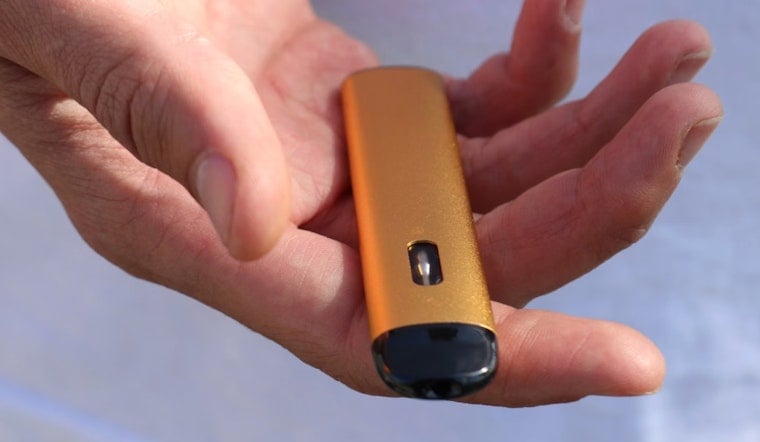
Volusia County school leaders are preparing to vote on updated discipline policies that would require students caught vaping to complete a 45-day education course rather than face automatic suspension, while also creating a tiered system of penalties for campus fights. The changes come after the district recorded an 80% jump in vaping referrals, and they would apply to a system that enrolled more than 56,000 students on the first day of the 2025–2026 school year.
The proposed changes are part of Volusia County's Code of Student Conduct and Discipline for the upcoming school year, according to WKMG. Vaping products, e-cigarettes, nicotine, tobacco and other drug products remain prohibited on school campuses, at school functions and on school transportation. Under the current policy, the Volusia Assistance Prevention Education Program, suspension and potentially expulsion are all listed as possible disciplinary consequences.
Under the proposed policy, a first vaping violation would require completion of a district-approved vape education course, and it could still result in in-school suspension, out-of-school suspension or placement in an alternative education setting. Students would have 45 days to complete the course. Those who refuse to participate, or who fail to finish within that window, would be assigned to alternative education or off-campus instruction for 45 days. A subsequent vaping violation would trigger that same 45-day alternative placement outright, and the report notes the proposed policy does not specifically list expulsion as a consequence for vaping.
Referrals Nearly Doubled in a Year
The scale of the problem shows up in the district's own numbers. Volusia County Schools recorded 289 vaping referrals during the first three months of 2023, a figure that jumped to 521 during the same stretch of 2024, per the district report cited by WKMG. Statewide, the Bureau of Tobacco Free Florida estimates about 1 in 4 Volusia County high school students use electronic cigarettes or vaping devices, alongside roughly 1 in 13 middle schoolers.
Those local numbers track with broader state trends: according to the Bureau of Tobacco Free Florida, one in three Florida high school students statewide have tried electronic cigarettes and one in four are current active users, even as traditional cigarette smoking among teens continues to decline. The Volusia Sheriff's Office re-established the D.A.R.E. substance abuse education program in district schools in August 2024, a move Sheriff Mike Chitwood made after early-2024 data showed the 80% spike in vape referrals.
Parents Split on Sending Kids Home
Reaction from families has been mixed. Sunnie Bennett, a parent, said she supports educating students about the long-term possible effects of starting vaping, backing the idea of requiring students to learn about the potential consequences rather than simply punishing them.
Greg Turcheta, a Volusia schools spokesman, said sending students home for vaping is not necessarily the best solution, a view that appears to align with the district's shift toward education-based consequences over automatic removal from campus.
New Tiers for Campus Fights
The proposal also restructures how the district classifies and penalizes fighting. A minor fight — defined as pushing or shoving, or a physical altercation without injury that stops after a verbal command — would be classified as a Level 2 offense. A first Level 2 offense could result in a required parent conference or three to five days of detention, while a second offense of the same kind could bring one to three days of in-school suspension.
A third offense for the same infraction would be escalated to a Level 3 offense, which covers major fights requiring physical intervention to stop or causing an injury serious enough to need first aid or medical attention. A Level 3 offense can result in suspension, one to five days of out-of-school suspension, placement in an alternative education program, or a recommendation for expulsion. More serious conduct, including battery, is classified as a Level 4 offense, which requires a recommendation for expulsion.
Where State Law and District Policy Meet
The proposed shift toward education courses over suspensions has roots in state law. Florida Statute § 386.212 makes vaping or smoking tobacco illegal within 1,000 feet of any K-12 school for anyone under 21, treating it as a civil infraction that can carry up to a $25 fine, 50 hours of community service, or completion of an approved anti-vaping program — and state law explicitly allows those school-approved programs to serve as an alternative to suspension or court fines. Separately, Florida Statute § 1006.07 requires local school boards to establish and enforce a formal Code of Student Conduct, which is the legal mandate behind the Volusia County School Board's annual conduct-policy votes.
Students who don't complete the district's vape education course, or who violate the policy again, would be assigned to one of the district's two dedicated alternative education facilities, Highbanks Learning Center or Riverview Learning Center, which are designed to keep students on coursework for 45-day placements in lieu of expulsion. The Florida Department of Education separately tracks vaping and battery incidents among 26 standardized categories of school misconduct through its School Environmental Safety Incident Reporting system, which compiles data annually across all 67 districts statewide.
The policy vote arrives as Volusia County Schools has posted some of its strongest academic marks in district history, earning back-to-back “A” district grades from the state in 2024–2025 and 2025–2026, and a 95.6% graduation rate for the Class of 2025 — a 1.9 percentage point increase over the prior year. The district has also been investing in campus security technology, including an AI-based firearm detection system called ZeroEyes that scans existing camera feeds at an annual cost of about $50,000. The Volusia County School Board is scheduled to vote on the proposed discipline-policy changes.


