

























































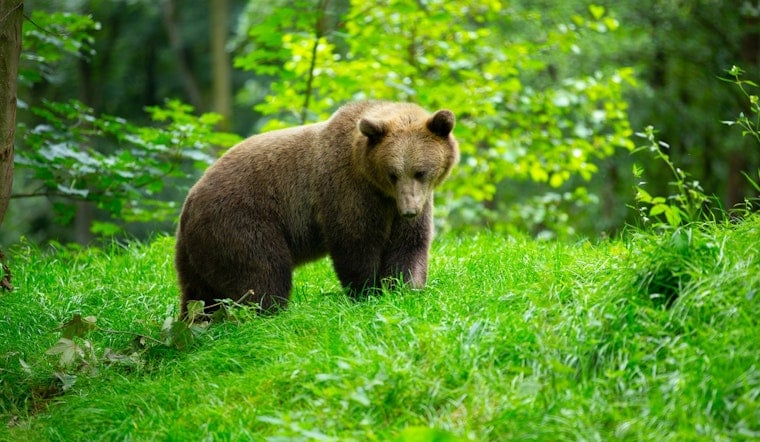
A 27-year-old Walla Walla man is recovering at home after surviving a brown bear attack so severe he recorded a goodbye message to his wife, believing he was going to die. Jadon Nicoara was caribou hunting with his cousin Daniel in the remote Alaskan tundra when a bear tackled him, crushing his foot, shattering his nasal and eye-socket bones, and biting into his face. He survived, kept his eyesight and all of his limbs, and is now scheduled for facial reconstruction surgery in the coming week.
According to KIRO 7 News Seattle, the attack happened about 100 miles south of Deadhorse, in territory near the Arctic Circle. Nicoara and his cousin heard movement and rustling in the brush before the animal charged. In the chaos, Nicoara suffered facial skin detachment and obscured vision, while Daniel was bitten on the legs, before both men managed to fire their weapons and drive the bear off, forcing it to flee the scene.
A Split-Second Fight for Survival
The encounter took place along the Colville River in Game Management Unit 26B, a stretch of tundra roughly 100 miles southwest of Deadhorse, according to KOMO News. It's a region hunters travel to specifically for the Central Arctic Caribou Herd, which the Alaska Department of Fish and Game estimated at roughly 35,000 animals in 2022, down from a peak of about 70,000 in 2010. Brown bears in this stretch of the North Slope represent North America's northernmost mainland population, and the Alaska Department of Fish and Game notes their numbers stay low compared to bears farther south because the arctic tundra simply doesn't offer much food.
Once the bear fled, emergency responders sent an SOS. In backcountry Alaska, satellite beacon activations route through international monitoring centers to the Alaska Rescue Coordination Center at Joint Base Elmendorf-Richardson and the Alaska State Troopers, who coordinate medical airlift evacuations in places where cell service simply does not exist. Responders airlifted Nicoara to a hospital in Anchorage before he was transferred more than 1,800 miles to Seattle for specialized medical care.
From the Tundra to Seattle's Trauma Ward
That 1,800-mile trip landed Nicoara at Harborview Medical Center, the only Level 1 adult and pediatric trauma and burn center serving the four-state WWAMI region of Washington, Alaska, Montana and Idaho, per UW Medicine. The hospital's craniofacial trauma department handles more than 1,000 facial trauma admissions a year, drawing on integrated teams of oral, plastic, otolaryngological and eye surgeons for complex reconstructions, according to research published by the National Institutes of Health. That is the team now preparing Nicoara's facial reconstruction surgery.
Nicoara sustained extensive injuries to his face and body, including a crushed foot and severe facial fractures, but he retained his eyesight and all of his limbs. His cousin Daniel was released from the hospital and is expected to make a full recovery. Nicoara said he is thankful to have his hands and to be able to recover, and he has said he plans to spend more time with his family — he has a wife and two daughters.
A Rare but Real Danger in Alaska's Wild Places
Alaska Department of Fish and Game officials reported that bear attacks of this nature are extremely rare. Statistics compiled by The Alaska Frontier put the state's annual toll at roughly 3.8 bear-related hospitalizations a year and about one fatal attack every two years, accounting for roughly 29% of all fatal bear attacks nationwide — a grim reminder that, even though maulings are uncommon given the number of hunters and hikers in the backcountry each year, the risk is never zero.
Because Nicoara and his cousin killed the bear in self-defense, Alaska's Defense of Life or Property regulation, 5 AAC 92.410, now requires them to salvage and surrender the complete hide with claws attached and the skull to the state, along with a detailed questionnaire due within 15 days. The rule exists specifically to prevent hunters from keeping trophy parts or profiting from a defense kill. Separately, state wildlife regulations bar hunters from shooting a bear under those same defense provisions simply to protect harvested game meat, unless that meat is strictly needed for immediate human survival — a distinction that matters because bear encounters often happen when the animals are drawn to freshly field-dressed carcasses.
For now, Nicoara continues his recovery at home, awaiting the surgery that will begin rebuilding his face. The moment that stays with him, he has said, is the message he recorded for his wife in the middle of the attack, made in the belief that he might not survive to see her again.




