

























































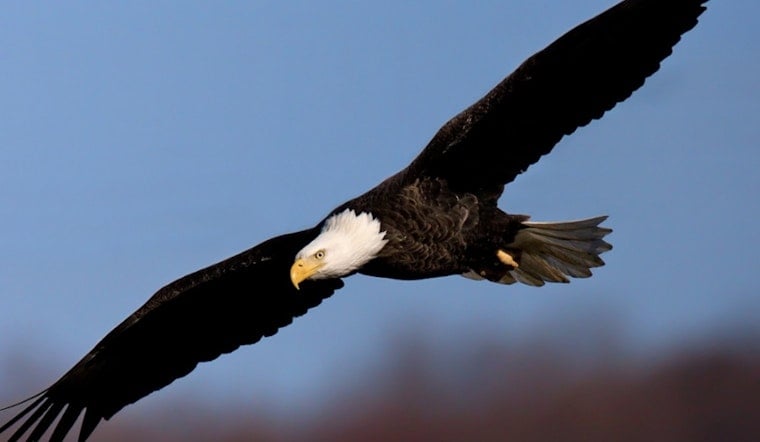
A bald eagle found grounded in a yard in Washington Boro, Pennsylvania was rescued with a drooping wing and an unusual case of green tail feathers, and rehabilitators soon discovered the bird was fighting two threats at once: a fractured shoulder bone and lead poisoning. The eagle is now undergoing chelation therapy and cage rest as staff try to nurse it back to health.
The rescue began when a Pennsylvania state game warden called an eagle capture and transport volunteer about a downed eagle in someone's yard, according to ABC27. Staff at Raven Ridge Wildlife Center, which operates in Washington Boro, observed the bird's right wing drooping and rushed it to Companion Animal Hospital for X-rays. Dr. Genova and the center's rehabilitator determined the eagle had a fractured coracoid, the bone that anchors a bird's wing to its breastbone.
A Shoulder Injury Tied to Roadside Scavenging
Coracoid fractures have been documented in bald eagles, according to Teton Raptor Center. Raven Ridge reported that these types of injuries can happen when eagles are struck by cars while seeking food alongside roads, but the available reports do not establish that this Washington Boro eagle followed that pattern. The center said the bird's rehabilitation will require a very long time, and it will perform follow-up X-rays in two weeks to check how the fracture is healing.
The eagle's green tail feathers were another finding alongside the broken bone. Per Raven Ridge Wildlife Center, green tail feathers can be caused by poisoning or emaciation. Veterinary experts explain that green feces can be associated with lead toxicity and liver damage, according to Today's Veterinary Practice.
Lead Poisoning Confirmed, Chelation Underway
Sure enough, the eagle tested positive for lead poisoning and is now being treated for it alongside the fracture. The bird has completed its first round of chelation therapy, a treatment that binds and removes lead from the bloodstream, and is eating on its own — both signs rehabilitators are watching closely as they weigh its odds of a full recovery.
Lead poisoning is grimly familiar territory for Raven Ridge. Back in February, center director Tracie Young said that out of every bald eagle the Lancaster County facility had treated over its 11-year history, all but two had tested positive for lead, as Hoodline previously reported. That same month, the center attempted emergency treatment on another grounded eagle rescued in York County by state game wardens, but that bird suffered severe seizures and died within 24 hours from lethal lead toxicity.
Why a Grain of Rice Can Kill an Eagle
The danger comes down to scale. A lead fragment as small as a grain of rice can be lethal to an adult bald eagle, according to the American Eagle Foundation. Eagles typically ingest that lead by scavenging gut piles or carcasses left behind by hunters using lead ammunition.
The scale of the problem stretches far beyond Lancaster County. A landmark eight-year study published in 2022 that analyzed eagles across 38 states found that 47% of bald eagles and 46% of golden eagles showed signs of chronic lead poisoning, with roughly a third suffering acute lead toxicity, the foundation reported. Separate research cited by Popular Science in 2024 found that lead toxicity suppresses nationwide bald eagle population growth by up to 4% annually, with Northeastern states experiencing slightly higher exposure rates than the national average.
A Recovery Story Still Vulnerable to an Old Threat
Pennsylvania's bald eagles are otherwise a conservation success story. The article does not provide the state's nesting-pair history, state or federal delisting dates, or details of the cited federal protections.
The available sources do not establish whether lead ammunition remains legal for big-game hunting in Pennsylvania, leaving voluntary outreach as a focus of efforts to address secondary poisoning in scavenging raptors. The article discusses switching to non-toxic alternatives such as copper, steel, bismuth, or tungsten, and cites the Pennsylvania Game Commission in connection with the issue. A WPSU report is also cited in connection with lead poisoning. The Washington Boro eagle's case adds to a string of recent Pennsylvania eagle injuries, including a juvenile eagle shot near Beaver Run Reservoir in Westmoreland County and a young eagle rescued after a likely train strike near New Brighton, both of which ultimately died. For now, Raven Ridge Wildlife Center says it remains hopeful this eagle can recover fully, though staff caution that healing from both a fractured coracoid and lead poisoning will take a very long time.




