
























































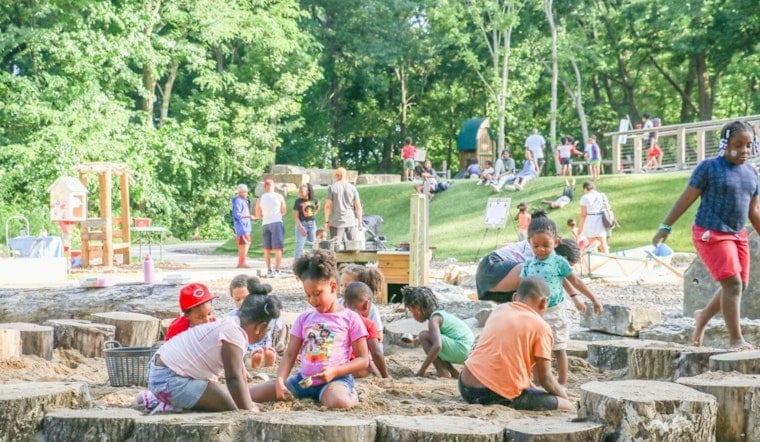
Inside Chickasaw Park in West Louisville, a new 10-acre play space asks children to learn history with their hands and feet, not just their eyes. Sankofa Sanctuary weaves a nature-based playground together with the stories of enslaved explorers, feminist scholars, and West African folklore, transforming a walk through the woods into a walk through Black history.
A Playground Built Around a Timeline
The sanctuary includes a timeline path that begins right after birth, guiding visitors through stages of life while touching on principles drawn from Kwanzaa's seven values, according to The Courier-Journal. One stop along that path centers on kujichagulia, the principle of self-determination, and it's here that visitors meet York. A vibrant boat is another feature in the play area.
Another play structure calls upon umoja, the principle of unity, reminding visitors that they are born to and belong to a people and a place. The sanctuary also includes spaces for learning. Anansi's swing, a custom web-like structure, pays homage to Anansi.
Quiet Corners Honoring Kentucky Voices
Not every part of the sanctuary is built for climbing. Bell hooks' nook invites visitors to enjoy a moment of tranquility while highlighting Gloria Jean Watkins, the Kentucky-born philosopher, author, educator and social critic who wrote under the pen name bell hooks. Watkins served as Distinguished Professor in Residence at Berea College until her death, and she wrote extensively about race, gender, class, and community. A lookout elsewhere in the park offers views of the Ohio River, giving families a quiet vantage point between the more active play areas.
The word Sankofa itself carries its own weight. It comes from the Twi language of Ghana's Akan people, rooted in the proverb “Se wo were fi na wosankofa a yenkyiri,” which translates to it is not taboo to go back and fetch what you forgot, according to Stockton University. Sankofa is traditionally depicted as a mythical bird looking backward to retrieve an egg off its back while stepping forward, a fitting emblem for a playground designed to carry children into the future while keeping history close.
Ground With Its Own History
Sankofa Sanctuary sits on native land within Chickasaw Park.
The park's broader revitalization got a boost in November 2025, when the Olmsted Parks Conservancy secured a $5 million donation dedicated to fully restoring the park's historic landscape, clay tennis courts, and public amenities, addressing years of deferred maintenance and shoreline erosion along the Ohio River. Sankofa Sanctuary itself opened on Juneteenth, establishing what organizers and partners designate as the nation's first nature-based Black history children's park. Funding for the playground came through Metro United Way, alongside contributions and technical assistance from the conservancy, Louisville Parks and Recreation, and Bernheim Arboretum and Research Forest, according to a Louisville Metro Government bulletin distributed through GovDelivery.
The Organization Behind the Vision
Play Cousins Collective, the local organization behind Sankofa Sanctuary, provides support and healing for Black children and families in Louisville. It was established as a Black-led movement supporting Black children and families. The playground is presented as more than recreation.
The sanctuary also includes a timeline path and grounds for exploration.
Local Artists Leave Their Mark
Beyond the historical figures woven into the play structures, the sanctuary also includes local artistic contributions, rounding out a park designed as much for reflection as for recreation.
The sanctuary's climbing features place historical figures alongside one another, another example of how Sankofa Sanctuary turns figures often left out of children's history books into characters kids can climb toward, swing past, and remember.





