

























































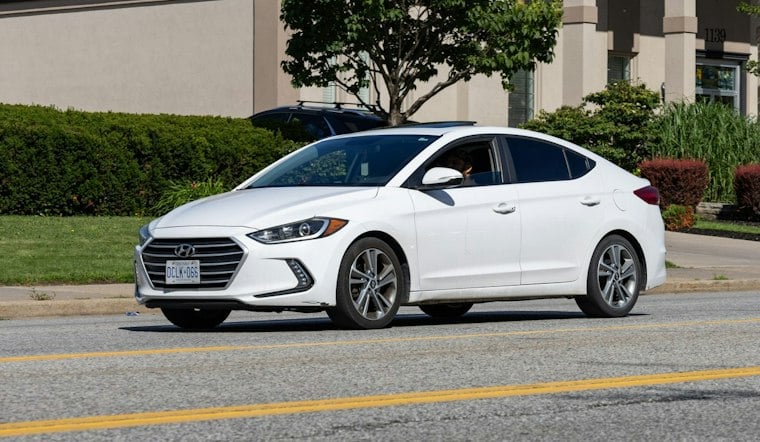
Hyundai’s Campaign Z05 is a limited paint-warranty extension, not a blanket repair program for every vehicle with peeling or bubbling paint. For eligible vehicles and paint codes, the campaign extends the standard three-year or 36,000-mile paint warranty to 10 years with unlimited miles, measured from the vehicle’s original retail delivery date or date of first use, according to Hyundai Motor America.
Eligibility depends on more than the symptom
The campaign applies to specified 2015-2023 model-year Elantra, Sonata, Tucson, Santa Fe, Santa Fe Hybrid and Palisade vehicles, but eligibility also depends on the vehicle identification number and factory paint code. Hyundai describes the covered condition as excessive peeling or bubbling of factory-applied paint on exterior metal body panels. Plastic parts, including bumpers and side mirrors, are excluded, as are collision-related paint repairs and vehicles with salvage titles, according to the automaker’s eligibility information.
Because the 10-year period starts with delivery or first use rather than the model year, mileage alone does not preserve coverage. An owner of an older eligible vehicle may reach the end of the extension in 2025 or 2026 even if the vehicle has been driven relatively little. Hyundai tells owners to use its Campaign Z05 VIN checker and to contact a dealer or Hyundai Customer Care about paint concerns.
A denied claim may reflect the program’s boundaries
Pamela Carlton’s experience, reported by WSB-TV, illustrates the distinction between a paint failure and campaign eligibility. WSB-TV reported that a dealer inspected Carlton’s blue 2019 Hyundai Elantra after paint peeled in multiple areas, but Hyundai declined to cover the repainting because that vehicle was not included in the extended program. The report does not establish whether every blue Elantra has the same condition or whether any other warranty or legal remedy applies.
That distinction leaves an important unresolved question for owners of nonwhite vehicles: a dealer may document peeling that resembles the condition described in Hyundai’s technical materials, but that documentation does not by itself add the vehicle or its paint color to Campaign Z05. Owners should obtain the VIN eligibility result, retain photographs and repair estimates, and ask the dealer to state in writing whether the denial is based on the paint code, the vehicle’s production details, the condition of the panel or an exclusion.
What Hyundai’s earlier technical bulletin required
A December 2022 Hyundai technical bulletin provides historical context but is not itself a recall or a substitute for the current campaign’s eligibility checker. Bulletin 22-BD-010H addressed certain white-painted 2017-2018 Elantra, Sonata and Santa Fe Sport vehicles manufactured by Hyundai Motor Manufacturing Alabama, where Hyundai said peeling or bubbling commonly appeared around the hood, fender and roof, according to the bulletin hosted by the National Highway Traffic Safety Administration.
The bulletin described the relevant failure as paint separating down to the primer or electrodeposition coating on metal panels. It required dealers to submit clear, close-up photographs of clean, dry affected areas before repair or goodwill assistance was authorized, and distinguished the condition from rock chips, scratches and other physical damage. The earlier extension provided different time limits for certain 2017 and 2018 vehicles, underscoring that paint coverage has varied by model year and program rather than operating as one universal Hyundai policy.
For a current claim, the practical starting point is therefore narrower than “the vehicle has peeling paint.” The owner must first confirm that the VIN and paint code qualify, then show that the affected area is a covered factory-painted metal panel and not excluded damage. Hyundai’s public materials do not promise coverage for every color, model, panel or repair history, so a dealer inspection and the campaign’s written eligibility result are central to determining what remains available.





