

























































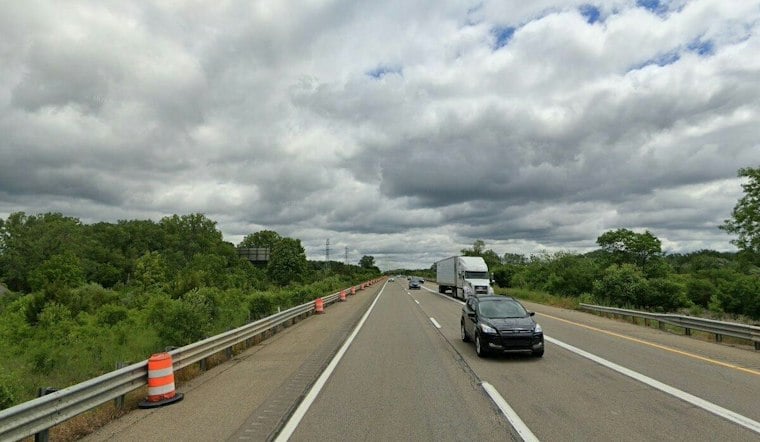
Commuters cruising along U.S. 23 and M-14 near Ann Arbor have gotten used to an unusual sight out their windows: a herd of roughly 75 to 80 bison grazing across a 90-acre pasture at the Domino's Farms complex in Ann Arbor Township. For many drivers, it's just a strange blur of shaggy brown backs against the Michigan sky. But the herd is far more than a roadside novelty.
According to Bridge Michigan, the pasture sits right at the interchange of the two highways, giving passing motorists a near-daily glimpse of the animals. While pass-by drivers often assume the bison are simply a quirky roadside display, the outlet reports they are actually a highly managed, award-winning show herd that has been maintained by the same manager since 1993. Bison themselves are considered one of North America's only remaining megafauna species, according to ClickOnDetroit, which recently spotlighted the herd's presence just outside Ann Arbor.
A Pizza Founder's Prairie-Style Vision
The herd traces back to 1993, when Domino's Pizza founder Tom Monaghan introduced the first two bison to the campus after experimenting with Texas Longhorn cattle, according to Concentrate Media. He ultimately chose bison to match the property's Prairie-style architecture, intentionally pairing the native species with architect Gunnar Birkerts' design as a nod to Michigan's historic 18th-century landscape, per the same account. The bison roam the grounds of Domino's Farms Office Park, a 300-acre corporate campus built around the Prairie House, a half-mile-long building Birkerts designed in 1985 in the Frank Lloyd Wright Prairie style, according to Wikipedia's entry on Domino's Farms. That sprawling office park now houses more than 50 corporate and healthcare tenants alongside its agricultural spaces, per Dwell.
Wild woodland bison were once native to southern Michigan and roamed the region naturally until around the 1790s, according to the University of Michigan Museum of Zoology, as cited by the Ann Arbor Observer. Settlers and overhunting extirpated the indigenous population from the Great Lakes region by the end of the 18th century, the Observer notes. Monaghan's decision to reintroduce bison to the property, then, doubled as a callback to a species that had actually once belonged there.
Three Decades of Hands-On Herd Management
Herd manager Todd Crocker has cared for the Domino's Farms bison since 1993, when he was hired at 18 years old and assigned to manage the original two animals, according to Bridge Michigan. Crocker learned bison husbandry on the job, the outlet reports, and grew the operation into a nationally recognized show herd over three decades. That work has paid off: the Domino's Farms herd is Michigan's most-awarded show bison herd, having earned 11 awards, including Reserve Champion Male and Producer of the Year, at the Eastern Bison Association's Show and Sale in March 2024, according to Concentrate Media.
Keeping a herd that large healthy takes constant intervention. To maintain genetic health and prevent inbreeding among the roughly 80 animals, staff refresh the herd annually by introducing new bloodlines and selling off most young calves, the Ann Arbor Observer reports. The population is carefully managed, with cows and calves making up the majority of the herd alongside a select few breeding bulls, per the same account.
A Separate Nonprofit Farm Sits Next Door
Visitors hoping to get hands-on with animals at Domino's Farms won't be petting the bison themselves. Adjacent to the bison pasture is The Petting Farm at Domino's Farms, an independent nonprofit established in 1984 that houses roughly 200 domestic and exotic farm animals, according to Michigan Enjoyer. While the bison are kept separately in their own 90-acre field, families can interact directly with the farm animals at that nonprofit operation, the outlet notes.
The bison's place in the national story runs deeper than one Michigan office park. North American bison populations plummeted from an estimated 30 million to 60 million animals down to fewer than 1,000 by 1890 due to commercial hunting and slaughter, according to the U.S. National Park Service, before private ranches and conservation groups spent over a century rebuilding the species' numbers. That legacy was formally recognized in Washington: President Barack Obama signed the bipartisan National Bison Legacy Act in May 2016, officially designating the American bison as the first official national mammal of the United States, the Park Service notes.
Seen in that light, the herd grazing beside U.S. 23 isn't just an eye-catching commute distraction. It's a small, carefully bred piece of a species that nearly vanished from the continent, tended daily on a corporate campus that was built, from the start, to make room for it.





