

























































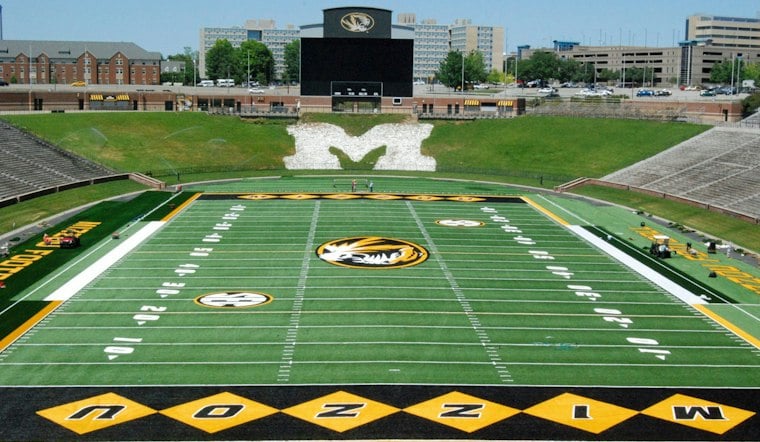
Missouri is adding a 1960 national championship claim to its football history, 66 years after Dan Devine’s Tigers completed an unbeaten season. The claim rests on two separate developments: a U.S. Senate resolution recognizing the team and Mizzou Athletics’ decision to adopt the Poling System’s designation. The 1960 team will be honored during halftime of Missouri’s Sept. 19 game against Troy, part of Memorial Stadium’s 100th anniversary celebration, according to ABC 17 News.
Sen. Eric Schmitt’s Senate Resolution 833 passed without objection and recognized Missouri’s undefeated regular season, Orange Bowl victory and championship claim, according to the Congressional Record. That action gives the claim federal recognition, but it does not create an NCAA championship. The NCAA says there is no FBS national championship sanctioned by the association, meaning pre-playoff titles can be tied to polls, ratings systems or other selectors rather than a single NCAA championship game.
A claim built on the era’s fragmented title system
Mizzou’s institutional claim is based on the Poling System, a mathematical ranking formula created by former Ohio Wesleyan player Richard Poling. The NCAA recognizes the Poling System as a national selector for seasons from 1924 through 1984, according to Sports Illustrated. That distinction matters: Missouri is claiming a championship awarded by a recognized historical selector, not asserting that the 1960 team won a modern playoff.
The situation reflects how college football titles were assigned before a unified postseason system. In 1960, the AP and UPI polls released their final rankings before the bowl games. Minnesota was crowned by those polls despite later losing to Washington in the Rose Bowl, according to Football Scoop. Other selectors produced different answers, leaving Missouri to join a group of programs with claims tied to separate systems.
Newsday identifies five 1960 claimants: Minnesota, Ole Miss, Washington, Iowa and Missouri. The competing designations came from the AP and UPI, the Football Writers Association of America, the Helms Athletic Foundation, Litkenhous Ratings and the Poling System, respectively, according to Newsday. Missouri’s claim therefore adds another selector’s conclusion to an already divided historical record rather than displacing a universally accepted champion.
What happened on the field
Missouri opened the 1960 season with an 8-0 record, reached No. 1 for the first time in program history and won the Big Eight championship. The Tigers defeated Penn State 21-8 and Oklahoma 41-19, while allowing 59 points during the season, according to the Congressional Record and ABC 17 News. They finished No. 5 in the final AP Poll.
The season’s official record changed after Kansas’s 23-7 victory in the finale was forfeited because of recruiting violations involving an ineligible player. Missouri’s record moved from 9-1 to 10-0, and the Tigers then defeated Navy 21-14 in the 1961 Orange Bowl. That produced an official 11-0 record and became central to the later championship argument.
The team’s legacy also includes the experiences of Norris Stevenson and Mel West, Missouri’s first and second Black football players. Both faced discrimination during the season and Orange Bowl trip, including being excluded from a team banquet and removed from a hotel pool, according to ABC 17 News. Their story was also documented in Brendon Steenbergen’s book Respectable Roughnecks: The True Story of a Forgotten Champion, as described by the Daniel Boone Regional Library.
A precedent for selector-based recognition
Missouri’s action has a modern precedent, though not an identical one. After the 2017 season, UCF claimed a national championship based on the Colley Matrix after finishing unbeaten but outside the College Football Playoff. The NCAA record book later listed that claim as an official note alongside Alabama’s recognized title, according to the Bradenton Herald. UCF’s case involved a contemporary team excluded from the playoff; Missouri’s involves a historical team from an era without a unified title game. The similarity is that both claims rely on a selector or ranking system rather than a championship awarded through the sport’s top postseason competition.
For Mizzou, the Sept. 19 ceremony will make the Poling designation part of the program’s official presentation of its history. It will not settle the broader debate over who was the single national champion in 1960. Instead, it will formalize Missouri’s position in a season when several organizations used different standards to define college football’s champion.





