

























































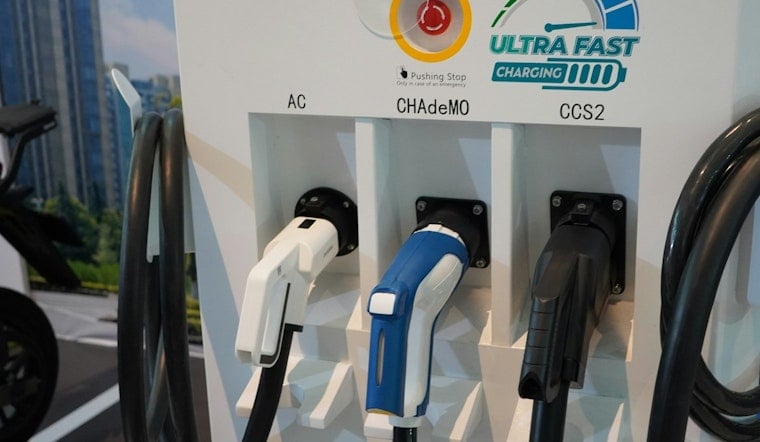
Wisconsin drivers in dozens of small towns and cities are about to get a lot closer to a fast charger. The state will build 42 new electric vehicle fast-charging stations using a $25 million federal grant, with planned sites stretching from a Kwik Trip near I-43 in Belgium to a Sunoco off US-14 in Fitchburg to Kwik Trip #307 near US-18 in Prairie du Chien.
The new stations bring Wisconsin's total federal award across all rounds of the National Electric Vehicle Infrastructure program to roughly $62 million, funding 120 fast-charging projects statewide, according to WTAQ. The Wisconsin Department of Transportation will administer the funds, and the project traces back to the federal Bipartisan Infrastructure Investment and Jobs Act, according to the Milwaukee Journal Sentinel.
The list of planned locations reads like a cross-section of Wisconsin itself. There's a Days Inn by Wyndham near US-45 in Eagle River costing $602,466, a Marketplace Foods near US-63 in Hayward priced at $488,770, and a Downtown Monroe site near WI-11 carrying a high price tag at $925,600. The single priciest project is Milwaukee's Walker's Point Plaza site near WI-32 at $930,849, while the Cenex station near US-10 in Reedsville is budgeted at $910,260. The West Bend Kwik Trip near WI-33 is projected to cost $418,365.
From Interstates to Small-Town Main Streets
From Interstates to Small-Town Main Streets The expansion marks a shift in strategy. The state has now certified that its primary Alternative Fuel Corridors — the major interstates — are fully built out with fast chargers spaced at 50-mile intervals, according to WTAQ's report. That milestone lets WisDOT expand funding beyond the completed Alternative Fuel Corridors. The list this round includes places like Coloma, Whitewater, and Random Lake.
According to the Public Service Commission of Wisconsin's "Planning Considerations for Electric Vehicles in Wisconsin" report, charging expansion involves electricity and infrastructure planning and can be evaluated with two free online self-service analysis tools.
Federal rules require each NEVI-funded site to include at least four network-connected Direct Current Fast Charging ports capable of simultaneously charging four vehicles, per WTAQ's reporting. That's a significant step up from a typical home charger, and it's meant to keep road-trip charging stops short regardless of what kind of EV a driver owns.
A Grant Program That Almost Got Frozen
Getting here wasn't simple. In 2025, the Trump administration tried to stop $14 million in federal funding that Wisconsin had already used for that year's charging stations, according to the Journal Sentinel. Wisconsin Attorney General Josh Kaul joined a multistate lawsuit over the freeze, and in June 2025 a federal judge issued an injunction blocking the executive order, unlocking more than $62 million in NEVI funds for the state, per the Wisconsin Department of Justice.
Governor Tony Evers criticized the Trump administration's handling of the EV charging program, saying, according to the Journal Sentinel's reporting, that Wisconsin fought to keep the federal investments in the state. Evers also said the project will help families save money on fuel, create jobs, support local economies and protect the planet, and separately pointed to the war in Iran as a factor driving up gas prices, per the same report.
Wisconsin changed its own laws during the rollout of the federal NEVI program.
Private Businesses Are Footing Part of the Bill
Under NEVI's formula, federal grants cover up to 80% of eligible construction costs, meaning recipient businesses like Kwik Trip, BP and Mobil, along with regional hotel chains, have to come up with at least a 20% match from non-federal sources, per Foley & Lardner's analysis. That's why the list of planned sites is dominated by convenience stores and hotel chains: an AmericInn by Wyndham in Boscobel near US-61 at $607,648, a Best Western Dodgeville Inn & Suites near US-18 at $591,022, a Hilton Garden Inn in Oconomowoc near I-94 at $618,678, and a Hop N Shop #19 in Waukesha near US-18 at $670,786, among dozens of others.
Kristina Boardman said the roughly 25 chargers already operational in Wisconsin have seen strong use, and that the expanding network will benefit both EV drivers and Wisconsin communities, according to the Journal Sentinel. Boardman's comments echo separate findings from the Badger Institute, which reported in May that only 21 NEVI-funded stations were operational statewide.
Demand Is Growing, Especially Around Madison
Wisconsin's registered fully electric vehicle fleet has grown to more than 43,200 vehicles as of September 2026, per WTAQ. The state installed 26 new charging stations in 2025 using $14 million in federal money, the Journal Sentinel reported. Even with that growth, the Badger Institute put Wisconsin at roughly 58 electric vehicles per 10,000 vehicles in 2024.
According to the Wisconsin Department of Transportation, statewide electric-vehicle registrations grew at a compound annual rate of 44.21% from 2018 to 2025, alongside steady growth in hybrid registrations.
Demand isn't spread evenly across the state. Dane County, home to Madison, accounts for nearly 25% of all registered EVs in Wisconsin despite holding only about 10% of the state's population, according to the Dane County Office of Energy & Climate Change. That imbalance led county officials to launch a separate $13.2 million federal “Charge Up Dane County” initiative, distinct from the statewide NEVI rounds. Madison itself landed one of the new 42 stations, a Woodman's site near US-12 priced at $396,800, the cheapest project on this round's list.
For now, the 42 projects remain planned rather than built, joining a pipeline of announced projects. Whether these particular chargers — spanning towns from Belmont to Sturgeon Bay to Salem Lakes — come online quickly remains to be seen.





