

























































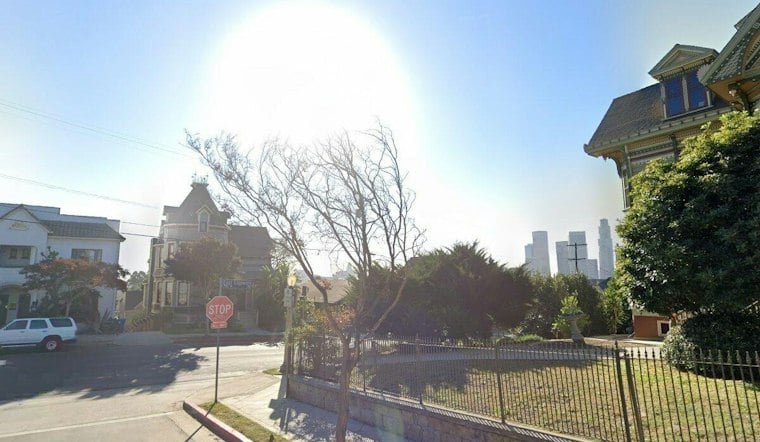
A developer wants to put up a five-story apartment building with zero parking spaces overlooking Echo Park, but the project has to clear a hurdle most new construction in Los Angeles never faces: winning approval from the city's oldest historic district. Chalon Group, LLC has proposed 25 one-bedroom apartments at 820 N. Laguna Avenue, a site that sits within the Angelino Heights Historic Preservation Overlay Zone.
The Los Angeles Department of City Planning has received an application for the project, according to a report from Urbanize LA. As described in the application, the building would rise five stories on the Laguna Avenue parcel, which overlooks Echo Park, and would be designed with a Mediterranean-style exterior by Carpira Design Group, the same firm behind a 16-unit building on E. Flower Avenue in Venice, according to The Real Deal.
None of the 25 planned apartments would come with an on-site parking space, a detail made possible by Assembly Bill 2097, which took effect statewide on January 1, 2023, and bars local governments from imposing minimum parking requirements on residential projects within a half-mile of a major transit stop, per the California Department of Housing and Community Development. That state law has already reshaped development patterns nearby: Urbanize LA's report notes the trend echoes what's happening a few blocks away, where developer Visionary Developments went vertical in August on The Court Residences, a seven-story, 189-unit affordable project on W. Court Street that also skips on-site parking, as Hoodline previously reported.
How Three Affordable Units Unlock a Bigger Building
The Laguna Avenue project's size hinges on three extremely low-income housing units included in the plans. Setting aside those units makes the project eligible for density bonus incentives, which permit a larger building than the site's underlying zoning would otherwise allow. Under California's State Density Bonus Law, expanded through legislation like AB 1287, developers who reserve extremely low-income units can receive up to a 50% density increase along with additional concessions from local zoning rules, according to guidance from Bittoni Architects.
The application also includes recreation rooms within the building, which could be converted into additional accessory dwelling units after construction is complete. California Government Code Section 66323 allows multifamily property owners to convert non-habitable interior spaces, such as recreation rooms and storage areas, into permitted ADUs for up to 25% of a building's primary unit count.
Clearing the Historic District
Because the site sits inside Angelino Heights, the project cannot rely on density bonus approvals alone. It also requires a Certificate of Compatibility for the historic district, a discretionary review triggered whenever new construction is proposed on a vacant lot or non-contributing site within a Historic Preservation Overlay Zone. Under Los Angeles Municipal Code Section 12.20.3, that process mandates a formal review and a public hearing with notice to neighboring property owners, according to guidance published by Ocean Permits.
Angelino Heights became Los Angeles' first HPOZ in 1983 and has operated under a Preservation Plan adopted on June 10, 2004, per Coastline 840. The district contains a heavy concentration of late 19th-century Victorian and early 20th-century Craftsman structures, and Certificates of Compatibility are evaluated against the district's architectural guidelines to ensure a new building's massing and facade style match that historic character.
Land-Use Consultants and a Tight Rental Market
Chalon Group is seeking entitlements for the project, which would need to navigate the city's land-use approval process.
The push for more units in Echo Park comes against a backdrop of steep housing costs, helping explain developer interest in smaller, transit-adjacent one-bedroom units.
The proposal also arrives amid a broader citywide push for new housing. As the 820 N. Laguna Avenue application moves through discretionary review, its fate will test how far state density and parking incentives can stretch inside one of the city's most tightly regulated historic neighborhoods.




