

























































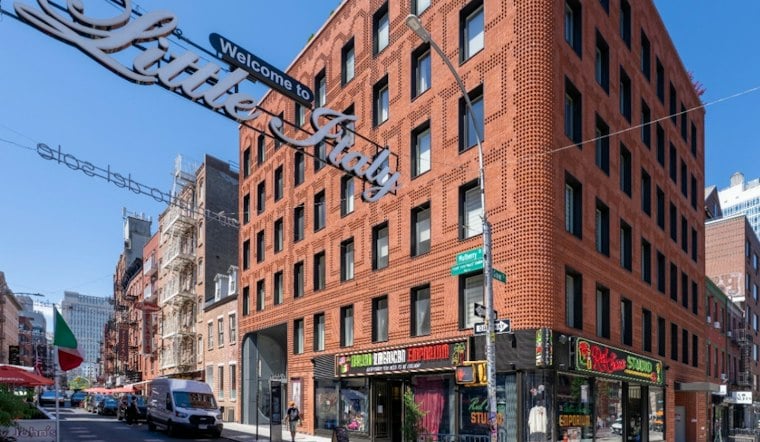
A hand-cranked barrel piano built in New York in 1899 is finally coming home. The Italian American Museum says Tony Gangi will present the 127-year-old Marino Persechini Barrel Piano for one night only, starting at 6 p.m. Friday at the museum's Mulberry Street location in the heart of Little Italy.
The instrument has not been back in the city since it was built and purchased there nearly 127 years ago, according to the Italian American Museum, which is hosting the event at 151 Mulberry Street. Gangi, proprietor of Great American Street Organ, is the piano's current owner and caretaker, and he and his wife, Suzanne, plan to walk visitors through its history during the presentation, as reported by the New York Post. The piano was built by Caesar Maserati, according to Il Dirigente, and was purchased in New York in 1899 before its original owner, street performer Marino Persechini, settled in the Boston area the following year.
Persechini went on to play the instrument on Boston streets beginning in 1900, retiring in 1974 at age 94, per the museum's account. That stretch of use, more than seven decades on the same instrument, is part of what makes Friday's appearance such a rare moment for New Yorkers who never got to hear the piano in its home city.
What the Piano Actually Does
The piece plays 10 different tunes and runs entirely on mechanical power. “There's nothing digital about it, there's nothing electrical about it, it is all just driven by the crank,” Gangi told NBC Boston. Beyond the keys, the instrument includes two drums, a cymbal and seven bells woven into its repertoire, according to the same Il Dirigente report.
Getting the piano back into playing shape took real work. An expert had to remove the barrel, clean off old grease and replace the pins, Gangi told NBC Boston. The museum describes it as an extensive restoration of the instrument's mechanical components, and the payoff Friday is hands-on: attendees will be able to hear the piano, examine its inner workings up close, and even turn the crank themselves, per the museum.
An Instrument Tied to Immigrant Life
Barrel organs and barrel pianos were once everywhere on New York's streets. By the mid-19th century, the mobile barrel organ had become the most commonly heard instrument on the city's pavements, according to the New York Almanack. Italian migrants were involved in producing these instruments from the very start of that history, the outlet notes, and crank instruments became closely associated with Italian immigrants who used them to collect money from passersby, per Il Dirigente. In New York, barrel-piano cylinders often carried Irish, Italian or German folk songs meant to appeal directly to immigrant listeners, according to the Metropolitan Museum of Art.
That street-corner economy didn't survive the mid-20th century. A 1935 city licensing decision under Mayor Fiorello La Guardia effectively ended it, and a considerable number of buskers lost their livelihood as their work was criminalized as begging, the New York Almanack reports. Barrel organs disappeared from the streets afterward, and hundreds of the instruments were destroyed, according to the same source. New York's Noise Abatement Bill became law in April 1936 following a broader campaign against urban noise and unlicensed street musicians, the Almanack adds.
A Rare Survivor on Display
Surviving barrel pianos like the Persechini instrument are scarce today, and new ones simply aren't being made in the United States. The Metropolitan Museum of Art holds its own example, a barrel piano built by Brooklyn's George Hicks around 1860, complete with costumed puppets and a figure holding a plate to collect coins, the museum notes, underscoring just how common these instruments once were in American cities before they largely vanished.
Gangi previously brought the Persechini piano back to Boston streets after what NBC Boston described as a 51-year absence, performing at Friends of Christopher Columbus Park before a planned return engagement at Armenian Heritage Park on The Greenway. Friday's New York appearance marks a different kind of milestone: the instrument's first time back in the city where it was built and sold more than a century ago, a homecoming not just for the piano itself but, as Gangi has framed it, for the history of an entire immigrant community.


