

























































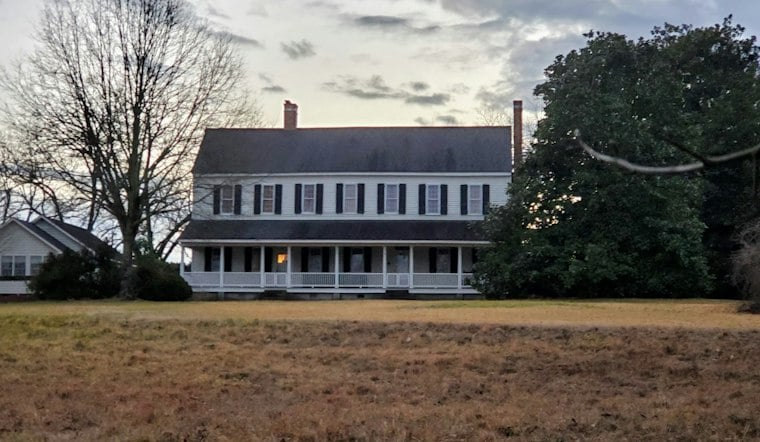
The circa-1835 Bates House and its nearly 11 surrounding acres off S.C. Highway 14 south of Greer are now permanently protected, the result of a conservation deal years in the making that brought together county officials, a state conservation fund, a private preservation group and the family that had owned the land for generations. Partners gathered Tuesday at the property, located at 3141 S.C. Highway 14 near the Pelham/Batesville Road intersection, to formally celebrate the preservation of the historic home and its grounds.
The property is now owned by Upstate Preservation Trust, which will manage the site going forward, according to the Greenville County Historic & Natural Resources Trust. Lindsey Strand, founder and chair of Upstate Preservation Trust, said opportunities like this one are rare, noting that the house is tied directly to the roots of Greenville County's textile industry. As reported by the Greenville Journal, Strand's organization will own and oversee the property's day-to-day care.
A Textile Pioneer's Homestead
William Bates, a Rhode Island native, built the two-story home in 1835 and went on to establish the Batesville Manufacturing Company, per the Greenville County Historic & Natural Resources Trust. The nearby community of Batesville takes its name from him. His son-in-law, Henry Hammett, later founded Piedmont Manufacturing Company, a venture that helped cement Greenville's standing as a major textile center, the Trust notes.
The circa-1835 house, along with a barn and spring on the property, are listed on the National Register of Historic Places. The National Register record identifies the William Bates House as a vernacular structure tied to Bates' role in developing South Carolina's Piedmont textile industry.
Funding Pieced Together From Multiple Sources
The preservation effort drew on a mix of public and philanthropic money. The Greenville County Historic & Natural Resources Trust committed $600,000 toward the project, $100,000 of which came as a gift from the New Leaf Fund at the Community Foundation of Greenville, leaving a net county investment of $500,000, according to the Trust's announcement. The South Carolina Conservation Bank, described as the Trust's longest-running funding partner, invested an additional $400,000.
The Ward family, which had owned and cared for the property for more than 50 years, agreed to sell at a significant discount from its appraised value, the Trust said. The Trust's release put that value at $1.17 million, while the Post and Courier had earlier referred to the proposed purchase as a $1 million sale; the dossier does not clarify how the two figures relate. Jim O'Connor, board chair of the Greenville County Historic & Natural Resources Trust, said the Ward family's willingness to sell at a reduced price made the purchase possible.
Decades of Conservation Work Across the County
The Greenville County Historic & Natural Resources Trust was created by Greenville County Council in December 2020. Since then, its board has approved 37 projects covering nearly 3,300 acres with a combined real estate value of $48.1 million, per the Trust. Rob Howell, a South Carolina Conservation Bank board member, said the Bates House project demonstrates how landowners, preservation organizations, local leaders and funding partners can unite around a shared goal.
A Possible Future Park, But No Timeline Yet
The Post and Courier reported that the preservation deal could eventually create the opportunity to establish a new public park on the site, potentially including access to the historic house and another building on the property. Any such plan would depend on whether surrounding landowners are willing to sell, and the newspaper's report indicated the timeline would be measured in years. No park has been approved, and no boundaries, construction schedule or funding plan have been established.
For now, the preservation marks the end of a process that protected a piece of Upstate history tied to the earliest days of South Carolina's textile economy. The collaboration among the Greenville County Historic & Natural Resources Trust, the South Carolina Conservation Bank, Upstate Preservation Trust and the Community Foundation of Greenville ensured the Bates House and its nearly 11 acres will remain intact rather than face redevelopment.


