

























































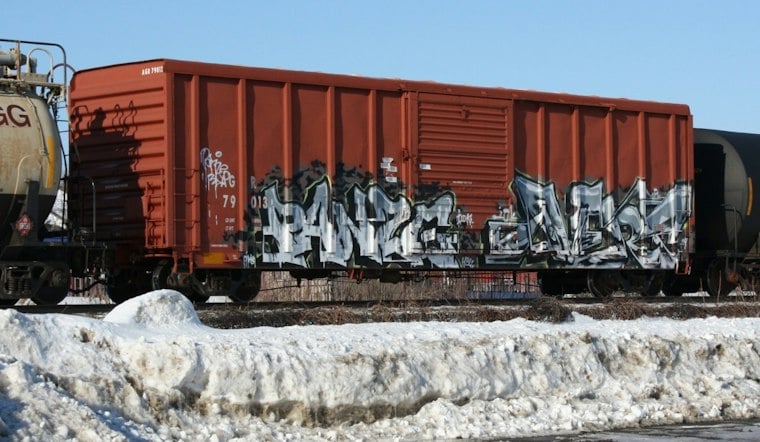
Rural Black Belt towns are set to receive a major infrastructure upgrade. U.S. Rep. Terri Sewell announced that $27 million in federal grant funding will go toward modernizing the Alabama & Gulf Coast Railway, with work set to rehabilitate 34 at-grade crossings, replace aging rail, ties, turnouts, and ballast, and install new trespassing signage along the route.
Sewell, who represents Alabama's 7th Congressional District, said she was thrilled to announce the funding, which comes through the federal Consolidated Rail Infrastructure and Safety Improvements program. As reported by the Black Belt News Network, the project covers track rehabilitation on both the Alabama & Gulf Coast Railway and the Eastern Alabama Railway, spanning rail lines in Alabama and Mississippi. The work will also modernize signals and communications and resurface track along the corridor.
The Alabama & Gulf Coast Railway is a Class II regional railroad, running more than 300 miles of track from Columbus, Mississippi, through western Alabama to Mobile and on to Pensacola, Florida, according to the Alabama Department of Transportation. The line serves as a vital freight backbone for rural western Alabama, carrying between 58,000 and 61,000 carloads of freight annually, with timber, pulp, paper, chemicals, and limestone making up its main commodity base, the department notes.
A Short-Line Network Tied to a Rail Giant
Both railroads receiving the upgrade are owned by Genesee & Wyoming Inc., which acquired them in 2012 through its purchase of RailAmerica, making it North America's largest short-line railroad operator. The Eastern Alabama Railway, the secondary corridor included in the award, runs a 27-mile short line between Talladega and Sylacauga in Talladega County, hauling mostly paper products, limestone, rock, and fertilizer, per Genesee & Wyoming. That line interchanges with Class I rail networks run by CSX and Norfolk Southern.
Sewell said the investment builds on $15.8 million in rail grants secured for the Black Belt in 2023. That earlier award, confirmed by the Federal Railroad Administration, funded track and bridge upgrades on the Eastern Alabama Railway and the Meridian & Bigbee Railroad, backed by a 51.1% non-federal match. Total CRISI rail awards for Alabama's 7th Congressional District that same month reached $23.8 million, which included $8 million granted to the City of Birmingham to address dangerous blocked railroad crossings in residential neighborhoods, according to the Birmingham Times.
Towns Named as Direct Beneficiaries
Sewell identified Monroeville, Pine Hill, Linden, Demopolis, Boligee, and Pickensville as communities expected to especially benefit from the upgraded rail service. The congresswoman said the project aims to provide safer and more efficient rail service while creating more job opportunities for Black Belt communities, framing the grant as part of the Bipartisan Infrastructure Law continuing to deliver for Alabama, a measure she voted for. She pledged to keep fighting to bring more opportunities to her district.
The CRISI program is federally authorized under 49 U.S.C. § 22907 and statutorily requires that at least 25% of total appropriated program funds go toward rural area projects, according to the Federal Railroad Administration. That statutory set-aside helps ensure economically distressed regions like the Black Belt maintain competitive freight connectivity even though the rail lines themselves are privately managed.
A Region With Deep Economic Need
The rail network serves rural counties including Wilcox, Perry, Dallas, and Sumter.
The push to modernize these short lines also has roots going back a decade. In July 2016, western Alabama civic leaders and Alabama & Gulf Coast Railway executives held a briefing to gather support for a proposed $16.1 million effort to upgrade tracks and 114 bridges so the line could handle standard 286,000-pound heavy freight railcars, up from an older 263,000-pound limit, as reported by the Greene County Democrat. Modern Class I railroads require that heavier capacity to move freight efficiently, underscoring why continued investment in these short lines has remained a priority for a decade.




