

























































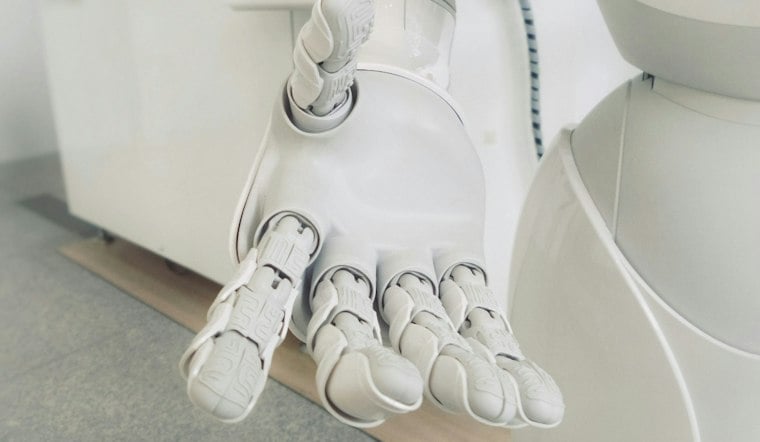
A life-sized, $89,000 humanoid robot spent an afternoon strolling through Brooklyn Bridge Park, singing to children, dancing with strangers and posing for photos as if it were just another tourist taking in the Manhattan skyline. Parkgoers barely blinked at the machine wandering among them near the waterfront between the Brooklyn and Manhattan bridges.
The robot was designed by Faraday Future, a California-based company, and was spotted mingling with people in the park, according to the New York Post. It was being operated with a small remote control by Hong Rao, Faraday Future's chief technology officer, as it walked around the park, sang to children and danced with people who approached it. About a dozen women visiting from Argentina stopped to pose for a photo with the machine, with the Manhattan skyline as a backdrop.
Per the chaperone overseeing the outing, the robot was being observed to learn interaction and nurturing skills for possible future use as a babysitter, teacher or companion. The robot itself remains in the learning and development stages, drawing on human interaction and real-world experience to improve its intelligence, movement and navigation, the New York Post reported.
A Growing Robotics Catalog With Six-Figure Price Tags
The park outing comes as Faraday Future ramps up its commercial robotics ambitions well beyond a single machine wandering Brooklyn. The company launched five new robot models in nine configurations last month, expanding its lineup to 11 models and 24 products, according to Forbes. The full-size FF Futurist Standard humanoid retails for $89,900, while a more advanced Futurist Ultra model runs $129,900, per the outlet's reporting.
Forbes also reported remarks from Faraday Future CEO YT Jia, who said humanoids will eventually take care of about half the tasks people want robots to do. The company has laid out a U.S. manufacturing roadmap that includes a robotics factory by the end of this year, a first device by February 2027, and Made-in-USA production by the fourth quarter of 2028, the same Forbes report notes.
Faraday Future's entry-level offering, the FF Nova, is described on the company's own site as a mini-sized embodied-AI humanoid robot aimed at developers and educators, according to Faraday Future Robotics. The platform supports reinforcement learning, simulation-to-real transfer, on-device inference and autonomous-intelligence development, the company says, and it expects Phase One Nova units to ship by the end of November, with the first wave of preorder units following around January 2027.
Not the First Robot to Mingle With Kids in the Park
This is not the first time a humanoid robot has turned up among families in the same Brooklyn park. Footage from March showed a Unitree G1 humanoid running and playing with children at Brooklyn Bridge Park, as reported by The Independent. It's a reminder that the waterfront green space has quietly become something of a proving ground for robot makers eager to see how machines fare around ordinary New Yorkers.
The broader research behind machines like Faraday Future's points to a field moving quickly toward robots that learn on the fly rather than follow fixed scripts. A 2024 paper in Frontiers in Robotics and AI proposed a system allowing humanoid robots to incrementally learn complex behaviors from natural-language interactions using large language models, and the researchers tested the approach both in simulation and in real-world demonstrations. That system was integrated into the cognitive architecture of the humanoid robot ARMAR-6, using human instructions, environmental observations and execution results to guide the robot's later actions, according to the same journal.
Robots, Trust and Lingering Public Anxiety
The sight of a machine singing to children and posing for selfies arrives alongside broader unease about where humanoid robotics is headed. AI robots more generally have been linked to war, sexual assaults and worker displacement, the New York Post noted in its report. Weeks earlier, a Nobel Prize-winning AI expert warned Congress that humans must learn to befriend increasingly conscious robots or risk extinction, according to the same outlet.
For now, the Brooklyn Bridge Park robot remains a curiosity rather than a product on store shelves, one still being walked, watched and refined by its own engineers. Whether it, or a machine like it, ever ends up supervising a child's homework or leading a classroom is a question the company has only begun to answer in public demonstrations like this one.





