

























































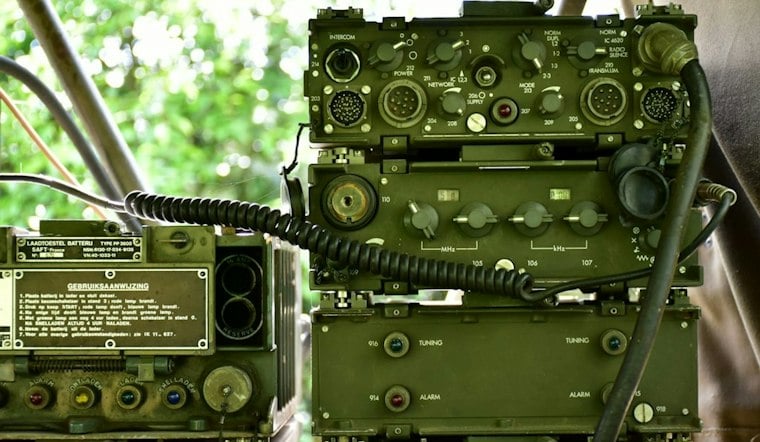
A nine-year-old Bay Village student named Paige just became a licensed amateur radio operator, passing the federal exam with a near-perfect score and earning her own government-issued call sign before most kids her age have finished long division. She took the Technician Class exam on September 27, correctly answering 33 of 35 questions, and the Federal Communications Commission issued her call sign two days later, on September 29.
Paige is a student at Westerly Elementary in Bay Village, a building that serves roughly 374 students across grades 3 and 4, according to the Bay Village City School District. Her achievement was first reported by Cleveland.com, which detailed her exam results and new status as a licensed operator. The federal licensing process has no age floor at all — the FCC awards amateur radio licenses strictly on exam performance, meaning a fourth grader can hold the same credential as a retiree, a structural quirk that explains how Paige could qualify for her own station identifier well before her tenth birthday.
A Score Well Above the Bar
To pass the entry-level Technician Class exam, candidates need at least 26 correct answers out of 35, a 74 percent threshold, with questions drawn from a nationwide pool maintained by volunteer examiner coordinators. Paige cleared that bar comfortably with her score of 33, a margin that reflects real command of the material rather than a narrow pass. The exam covers basic electronics, operating procedures, and safety regulations, and the modern question pool reflects decades of changes to the hobby, including the elimination of the Morse code testing requirement for all license classes back in 2007, per the Federal Communications Commission.
Her new call sign makes Paige the third licensed operator in her household, joining her father, who holds the call sign N8QAR, and her mother, who holds KN4DYZ. The “8” in her father's call sign places the family's home station in the 8th Call Area, the FCC's geographic designation covering Ohio, Michigan, and West Virginia, according to the ARRL Great Lakes Division. A call sign functions as a unique identifier for a transmitter station, the radio equivalent of a license plate that tells other operators exactly who is on the air.
Joining an Aging but Active Hobby
Amateur radio, commonly called ham radio, is the popular name for a service built around volunteer enthusiasts who communicate over specially assigned frequencies, pursuing goals that range from advancing radio communication to building emergency-response skills and fostering international goodwill. Operators are active in nearly every country, and in the United States, anyone seeking a license must pass a written exam before the FCC will issue one. Roughly 750,000 Americans are licensed amateurs nationwide, and in Ohio alone the FCC database counted 26,164 active license holders as of September 2026, including 11,549 at the Technician Class level, per the ARRL.
Yet the hobby skews heavily older. National survey data puts the total licensed U.S. operator count near 744,000 as of 2024, while the average age of ARRL members sits between 68 and 70 years old — making a nine-year-old newly minted operator a notable departure from the norm. To help close that generational gap, the ARRL's Youth Licensing Grant Program, started in April 2022, reimburses the $35 FCC application fee and caps exam session fees at $5 for applicants under 18.
What Her License Allows Her to Do
Paige's Technician Class license grants her full operating privileges on every amateur frequency above 30 megahertz, including the VHF and UHF bands used for handheld radios and local repeaters, along with some limited shortwave access. That spectrum is also the backbone of community emergency communications in Cuyahoga County, where volunteer groups like Cuyahoga County Amateur Radio Emergency Service and Cuyahoga County Skywarn relay real-time severe weather reports to the National Weather Service in Cleveland.
Those are exactly the kinds of projects Paige says she's looking forward to. She plans to make new friends over the airwaves, work alongside her parents on communication projects, and eventually serve with them as a radio volunteer. With three license holders now under one roof, the family has a ready-made path into that same volunteer emergency network that keeps the region's severe weather and public safety communications running.


