

























































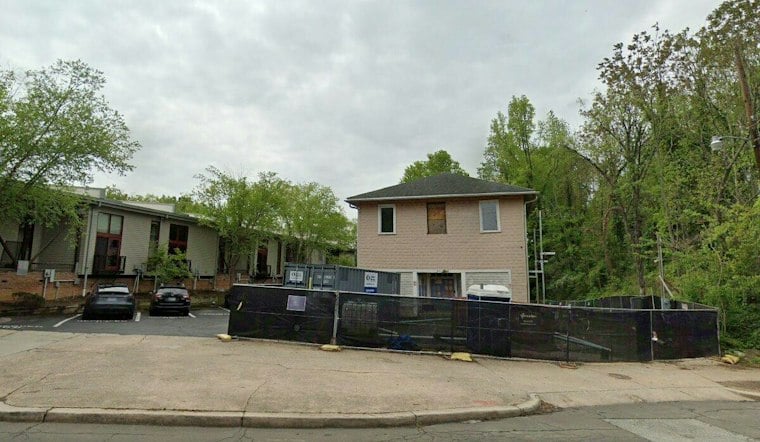
A building that once served Pearl Mill Village as a grocery is now a home for artists and exhibitions. Laura Ritchie and Shirlette Ammons bought the property at 703 W. Trinity Ave. in 2021, renovated it and established Boardinghouse Arts there, Axios reported. The building dates to 1924, when Joseph S. Woods and his wife, Lou Ella Woods, built it as Woods Grocery; it later became apartments. Open Durham says rooms may also have been rented above the store. Open Durham notes that Pearl Mill Village’s historic district is across the street.
Reuse, at different scales
Boardinghouse Arts is one small example of an old Durham property being adapted for creative use. A larger local precedent is Golden Belt, where a renovation begun in 2006 converted buildings in the former complex for artist studios, apartments, retail and offices; the work was completed in 2008, according to Golden Belt Arts. The projects differ in scale and history, so one does not establish a citywide trend. Together, they show two documented ways that existing buildings have been put to new uses in Durham.
At 703 W. Trinity, the former upstairs rooms are now private work studios, and the basement contains a soundproofed recording studio. The ground-floor gallery displays works from Ritchie and Ammons’s collections and those of 12 other local collectors, Axios reported. The venue also has a kitchen and outdoor gathering areas. Axios lists public hours as 11 a.m. to 5 p.m. Wednesday through Friday and 2 to 5 p.m. Saturday, with appointments available.
A separate gallery’s sustainability lesson
Ritchie’s earlier experience offers a relevant, but limited, comparison. She co-founded The Carrack Modern Art, a zero-commission Durham gallery that closed in September 2019 after operating costs reached about $80,000 a year and it could not find a sustainable way to continue, INDY Week reported. The Carrack’s closure is one example, not evidence that other Durham arts venues face the same circumstances. It does, however, put the practical challenge of sustaining arts spaces alongside the story of Boardinghouse Arts’ new use for a historic building.





