

























































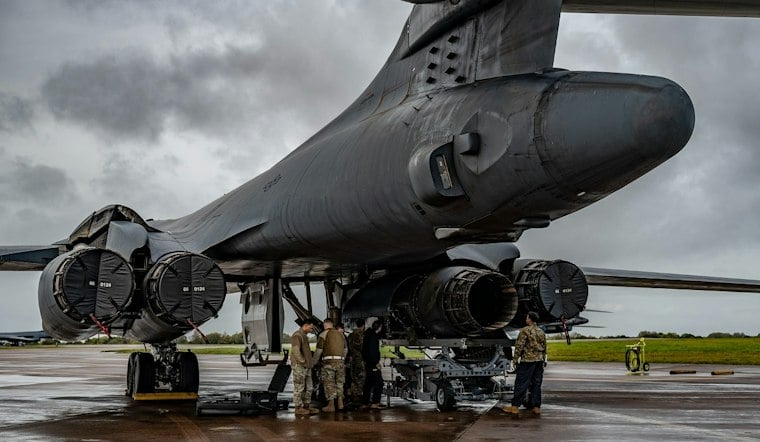
Every single U.S. bomber stationed at RAF Fairford in England is gone, pulled out in a rush over the weekend after American commanders received fresh warnings about an alleged Iran-backed plot targeting the base. All 12 B-1 bombers that had been flying out of the base are now redeploying to home stations in the United States, with at least three already touching down in South Dakota.
The Pentagon's European Command confirmed Sunday that the bombers had left England, though it declined to comment on any new warnings, according to The New York Times. The Times reported the withdrawal happened with unusual speed, noting such moves are rarely made so quickly from an allied air base in a peacetime country. Some planes and their flight crews reportedly left while aerial refueling aircraft were still being scrambled to get them across the Atlantic, even though some of those same bombers had only arrived at Fairford in the past week as part of a routine rotation of forces.
Spectrum News, citing a Pentagon official who spoke on condition of anonymity because they were not authorized to discuss sensitive military movements, reported that the bombers were redeployed to U.S. home bases. The same Spectrum News report, drawing on the Associated Press, described RAF Fairford as a U.S.-run military air base located roughly 100 miles, or 160 kilometers, west of London, and noted a military air tracking alliance had observed dozens of B-52 and B-1 bombers operating from the base before the pullout.
Arrests Near the Base and in London
The scramble to empty Fairford followed a British counter-terrorism investigation into an alleged planned terror attack at the base, as reported by The Guardian. Five British men were arrested near the base in late September on suspicion of preparing a terrorist act and explosives offenses, and were later released on bail, according to The National. A sixth man, a dual British-Iranian national, was separately arrested in central London in connection with the suspected plot and also released on bail, the outlet reported.
Investigators searching vehicles tied to the case did not find explosives. Police found a quantity of petrol in three vans linked to the five suspects, but no explosives, according to the Telegraph. The New York Times similarly reported that the vans contained no explosives, and that the five men were released on bail within a day of being taken into custody.
Tehran Denies Any Role
British authorities have linked the Fairford incident to Tehran, but Iran has denied any involvement, a denial that remains unresolved against the British assessment. Asked about the sudden bomber movements, the Pentagon said operational security precluded it from confirming the movement of its assets and forces in real time, per the Guardian's reporting.
RAF Fairford has a long history as a staging ground for American bombers during decades of Middle East conflicts, and the base has been used by U.S. forces to launch strikes against Iran since March, though outlets differ on the precise framing of that mission: the BBC described the base as having been used to launch attacks against Iran, while the Telegraph characterized the same bomber flights since March 1 as defensive missions aimed at destroying Iran's missile capabilities. Three U.S. B-52 bombers had landed at the base amid the broader conflict with Iran before this weekend's withdrawal, according to the BBC.
A Broader Military Buildup
The bomber withdrawal comes as the U.S. military maintains a sizable presence in the Middle East, with additional naval assets now heading that direction. The USS Theodore Roosevelt and the USS Malkin Island amphibious readiness group, carrying more than 7,000 sailors and 2,000 Marines, were reported heading for the Middle East region as of October 1, and a U.S. official said the deployment could put three aircraft carriers in the region by the end of October.
The New York Times noted that U.S. Air Force bombers routinely operate around the world to support global force readiness and operational requirements, a line officials have used to frame the Fairford withdrawal as part of normal military posture rather than a retreat under fire. For now, the open question of whether the bombers will return to RAF Fairford, and whether Tehran had any real hand in the alleged plot, remains unanswered as British investigators continue their work.



