

























































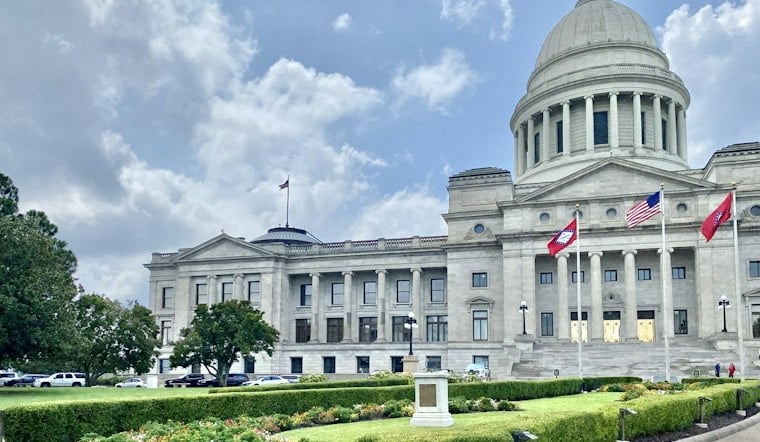
Arkansas lawmakers pressed state education officials Wednesday over whether the state's fast-growing school choice program is squeezing public school budgets, as new figures showed enrollment declines in 203 of the state's 265 public school districts. The questioning came as the Division of Elementary and Secondary Education asked for tens of millions more in state appropriations to cover both shrinking districts and an expanding Education Freedom Account program.
Several state lawmakers questioned Arkansas Department of Education officials about the effects of the state's universal school choice program on public school funding, according to The Arkansas Democrat-Gazette. Greg Rogers, the department's chief fiscal officer, told lawmakers that 203 of Arkansas's 265 public school districts saw enrollment declines, the paper reported. In response, the Division of Elementary and Secondary Education is proposing to request $52 million in declining-enrollment appropriation for fiscal 2028 and fiscal 2029, an increase of $28 million from the fiscal 2026 to fiscal 2027 request.
At the same time, the division is seeking an additional $70 million in appropriation for the Educational Freedom Account program, which would push its total state funding to $379.4 million. That figure echoes an amount the Arkansas Legislative Council already approved: in September, the council signed off on $70 million in reserve funds for the program, bringing total state funding for the 2026-27 school year to $379.4 million, the same outlet reported at the time. Arkansas is currently in fiscal 2027, which runs from July 1, 2026, to July 1, 2027.
EFA Enrollment Has More Than Tripled
The scale of the program's growth helps explain why lawmakers are asking questions. According to an Arkansas Legislative Council and Arkansas Department of Education EFA report, participation jumped from 14,256 students in 2024–25 to 44,524 in 2025–26, a 212 percent increase. That same report put 2025–26 public school enrollment at 465,421 students statewide, meaning EFA participants made up a small but rapidly growing slice of Arkansas's overall K-12 population.
The department now expects roughly 50,000 students to participate in the program during the current school year, per the September report in nwaonline.com. The average EFA generally costs the state $7,346 per student this year, up from $6,994 in 2025–26, the outlet noted — compared with $8,037 in state foundation funding per student that traditional public schools receive based on enrollment, according to The Arkansas Democrat-Gazette's reporting on Little Rock's district.
Who Is Actually Switching From Public Schools
Not every EFA recipient previously attended public school. The Arkansas Legislative Council and ADE's EFA report found that 10,358 of 40,117 participants with grade-level data — 25.82 percent — were identified as public-school switchers. A University of Arkansas report reached a similar conclusion, finding that only about one in four students who participated in Education Freedom Accounts in Arkansas last year switched from a public school, according to KUAF.
After applying the statutory declining-enrollment adjustment, the ADE's EFA report estimated public-school funding savings of $54.1 million to $61.9 million tied to those switchers, with a net state fiscal impact ranging from $245.7 million to $253.5 million once the broader program costs are factored in.
Little Rock's Decline Predates Universal Eligibility
The enrollment pressure is most visible in Little Rock, where the school district's enrollment dropped more than 21 percent from late 2013 to spring 2026. But that decline long predates the Educational Freedom Account program becoming available to all Arkansas students in 2025–26, the Democrat-Gazette reported separately. A report on the district attributed the drop partly to demographic shifts and falling birth rates in the city, while also citing competition from private schools, charter schools and homeschool options.
The Little Rock School District enrolled only 18,964 students in 2025–26, compared with roughly 25,700 students attending public or charter schools somewhere in Little Rock that year — and about 4,500 Little Rock students, around 15 percent, received Educational Freedom Accounts that same school year. The district's enrollment fell further for 2026–27, to a state-reported count of 18,416, more than 500 fewer students than the year before.
A Statewide Pattern Beyond One District
Little Rock is not alone in feeling the strain of shrinking enrollment. Statewide average daily membership fell 0.7 percentage points over the two school years preceding 2025, even as enrollment in open-enrollment public charter schools rose 16 percentage points over that same span, according to an Arkansas Legislative Council funding overview report. Among the state's 259 traditional public school districts and public charter school systems, 21 percent had average daily membership below 500 in 2025 — and nearly half of open-enrollment charter school systems, 48 percent, fell below that threshold the same year.
Taken together, the figures paint a picture of a public education funding system under growing pressure from multiple directions at once: demographic decline, competition from charters and private options, and a state-backed voucher-style program that has tripled in size in just two years. Lawmakers' questions Wednesday suggest that pressure is now squarely on the Legislature's radar as it weighs appropriations for the years ahead.





