

























































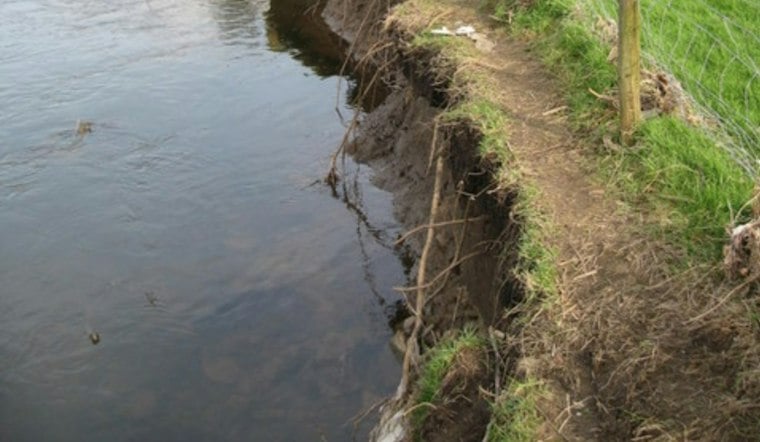
Arlington's creek erosion is a property problem and a funding challenge: fixing all the city's waterways could cost about $1.16 billion, while many damaged banks are on private land. Nearly 1,000 homeowners are dealing with erosion, with backyards shrinking and, in some cases, house foundations at risk.
The nearly 1,000-homeowner figure is an estimate from City Council member Mauricio Galante, who represents District 1 and told KERA in August that severe backyard erosion tied to creek runoff is affecting homeowners across the city. Galante has visited more than a dozen sites where residents are losing yards, according to the Fort Worth Report. Some residents have seen swimming pools disappear into the water; others worry about their house foundations.
The Scale—and Price—of the Creek Network
Arlington has roughly 140 miles of creeks and streams citywide, according to Public Works Assistant Director Amy Cannon, though the city counted 112 miles of natural waterways as of August. A city presentation cited by the Fort Worth Report classifies those banks on a spectrum of stability: 28 miles are considered stable, 28 miles moderately stable, 61 miles moderately unstable, and 23 miles highly unstable.
The price tags attached to each category are staggering. Stabilizing the highly unstable sections would cost about $534 million, while fixing the moderately unstable stretches would run about $548 million more. Shoring up the moderately stable banks adds another $74 million, and Cannon has said stabilizing every mile of Arlington's creeks could cost around $1.16 billion in total, the Fort Worth Report notes.
Who Is Responsible for Paying?
Of Arlington's 112-mile network, 43 miles are on public land and maintained by the city. The remaining creek stretches fall to property owners, who are responsible for their own maintenance and erosion costs, according to the Fort Worth Report.
Arlington residents pay a stormwater utility fee, and the City of Arlington discussed proposed fees in August 2025. The fee generates around $20 million a year, but the money typically goes to flood mitigation rather than erosion repair. Public Works Assistant Director Amy Cannon has said the city tries to help residents address erosion, but does not pay for the work itself. Property owners must hire an inspector and submit reports to the city, which works with them case by case on possible fixes, according to the Fort Worth Report.
What Council Records Show About Public Funding
Arlington has funded specific creek and waterway projects through its Storm Water Utility Fund, but the cited council records document project work rather than a citywide fee change or a standing program to pay for private-yard repairs. An August 22, 2017, City Council agenda authorized up to $103,632 for engineering services for Rush Creek at Indian Trail erosion improvements, according to the City of Arlington City Council agenda. A separate April 21, 2026, council agenda listed authorization of a not-to-exceed $184,940 engineering-services contract for Upper Johnson Creek dredging at Lakes at Matlock Linear Park, funded through the same utility fund, according to the City of Arlington City Council agenda.
The legal backdrop reinforces that divide. Under Section 11.021 of the Texas Water Code, all storm water, floodwater and rainwater flowing through natural streams and ravines is legally the property of the State of Texas, according to the Texas Department of Transportation. Separately, guidance cited by the City of Southlake notes the Texas Constitution bars cities from spending public stormwater funds on private property improvements unless a project serves a clear public purpose and keeps public control, which helps explain why Arlington's capital budget can't simply flow into private backyards.
Erosion Has Downstream Costs, Too
Erosion upstream doesn't just vanish once a bank collapses. That dirt becomes sediment that can reduce the depth of downstream creek beds, ponds or lakes, and the added sediment and water speed can accelerate erosion even further downstream, the Fort Worth Report explains.
Prestonwood Lake in west Arlington became a case study in that cycle. The lake filled with sediment from upstream erosion in 2018, and the city ultimately broke the Prestonwood Lake dam to reduce flooding risk, per the Fort Worth Report. District 2 council member Raul Gonzalez has said dredging a lake like Prestonwood could cost around $100,000 per home in a homeowners association, underscoring just how expensive remediation gets once sediment piles up.
Adnan Rajib, an engineer, hydrologist and director of UT Arlington's Hydrology & Hydroinformatics Innovation Lab, has pointed to development as a driver of the problem. Arlington's growth has created more impermeable surfaces, sending additional rainwater rushing into waterways, according to the Fort Worth Report.
Other Cities Have Tried Different Approaches
Arlington isn't the only Texas city wrestling with creek erosion on private land, and its neighbors have taken varied approaches. Garland and Plano run cost-sharing erosion programs, Dallas uses general obligation bonds to fund erosion projects, and McKinney may pay construction costs when a primary structure is at risk, according to the Fort Worth Report's survey of regional policy. Dallas and Grand Prairie also run voluntary buyout programs for erosion damage, though Grand Prairie is reportedly considering suspending its program over budget challenges.
Arlington, meanwhile, has largely prioritized erosion that threatens public infrastructure, similar to the approach other cities tend to favor, the Fort Worth Report notes. Since 2009, Arlington has spent around $29 million buying out 93 high-risk properties rather than fixing the creek banks beneath them.
The Funding Question Remains Open
Galante supports creating some mechanism to help affected neighborhoods fund erosion work, and residents have argued the city has an ethical obligation to act even if it may not have a strict legal responsibility to do so, per the Fort Worth Report. Any erosion project also faces practical delays, since creek-shape changes, design revisions, permitting, inspections and FEMA approval can all slow the work down.
City Manager Trey Yelverton has proposed a solution for creek-erosion funding and discussed fee options.
Any effort to address Arlington's creek erosion would take time and sustained funding. Even a dedicated program would have to contend with repair costs running into hundreds of millions of dollars across the city's waterways.





