

























































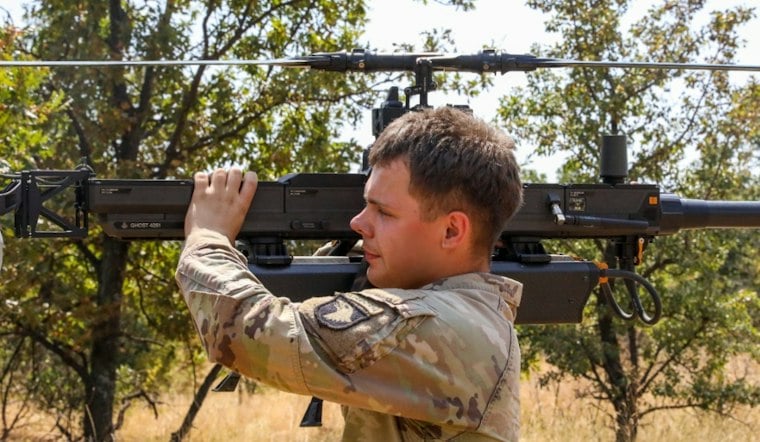
Twenty-one defense technology firms descended on a stretch of brutal desert roughly seven miles from the U.S.-Mexico border this fall, putting lasers, shotguns and autonomous machine guns to the test against commercial reconnaissance drones amid an increasing trend in detections. The exercise, known as Falcon Peak 26.2, ran from August 31 to September 25 at the Army's Yuma Proving Ground in Arizona, and it marks the latest sign that the Pentagon is treating cartel drone traffic as a problem urgent enough to warrant live-fire military testing on American soil.
A Desert Range Becomes a Testing Ground for Border Defense
According to Breaking Defense, the exercise organized the 21 participating firms across three experimental lanes: sensors, interceptors, and kinetic-ballistic defeat. The exercise focused on evaluating defenses against drone threats.
Military officials were careful to note that cartel-operated drones are not comparable to the sophisticated battlefield drones seen in Ukraine or the Middle East. Yuma Proving Ground was chosen in part because its conditions replicate those at the border.
Shotguns, Machine Guns, and a Battlefield Software Platform
Among the systems demonstrated at Falcon Peak were radars, interceptor drones and autonomous gun systems, per the Star's account of the exercise. One standout, according to DefenseScoop, was the Genesis Arms Gen-12 12-gauge shotgun. Low-collateral rounds designed to protect civilians and infrastructure were also evaluated; those rounds were made by Slow Shot. Helix Defense's STING is a 40mm grenade, not a shotgun round. Teledyne FLIR's Cerberus counter-drone radar and Allen Control Systems' Bullfrog kinetic interceptor were separate systems, while an Anduril Ghost drone also featured in the demonstrations, the Star reported.
For the first time, U.S. Northern Command integrated Anduril's autonomous command-and-control software platform, Lattice, to fuse multi-sensor data and direct counter-drone effectors across the desert terrain, DefenseScoop reported. The platform lets operators synthesize optical, infrared and radar detection data in real time — a capability the military is counting on as it tries to track a growing number of threats at once.
A $3 Laser Shot and a 75% Drop in Drone Traffic
While Falcon Peak tested new systems in Arizona, a different directed-energy weapon has already been put to work hundreds of miles away in Texas. In late August, Joint Task Force–Southern Border deployed the vehicle-mounted Army Multi-Purpose High Energy Laser, known as AMP-HEL, to the Rio Grande Valley. The 20-kilowatt system is mounted on tactical vehicles, CBS News reported.
The CBS News report said the laser system had disabled multiple drones. Electronic jamming can force drones to land or return to their operators. Separately, the Star reported that the U.S. military has downed 11 cartel drones using lasers since deploying the technology along the southern border in August 2026.
Hundreds of Drones Neutralized, Millions Spent
The scale of the broader counter-drone campaign is significant. Between January and September 2026, Joint Task Force–Southern Border neutralized approximately 300 cartel-linked drones, supported by more than $20 million in counter-unmanned aircraft systems hardware deployed across priority border sites by Joint Interagency Task Force 401, a principal organization for accelerating counter-drone delivery at scale, according to Debug.
Maj. Gen. Curtis Taylor said the military detected 378 drones in the previous 30 days, per Breaking Defense. Brian Filler said detections were increasing, per the Star's reporting. Filler added that the military was seeing largely commercial, off-the-shelf reconnaissance drones; drones have also been used in human-trafficking operations.
The Deadly Record South of the Border
The stakes of the broader cartel drone problem are starkest in Mexico itself. A February 2026 report by the DHS-funded National Counterterrorism Innovation, Technology, and Education Center documented 221 weaponized cartel drone attacks in Mexico between 2021 and 2025, resulting in 77 fatalities, according to research published in Small Wars Journal. The Jalisco New Generation Cartel accounted for nearly 20% of attributed strikes, the report found — a trajectory in which cartels moved from using drones primarily for surveillance to modifying commercial quadcopters with improvised explosive devices.
The threat also includes increasing drone detections along the U.S. side of the border.
A Company in the Counter-Drone Industry Goes Public
PowerUS, which sold an interceptor drone demonstrated at the exercise and merged with a company backed by sons of President Donald Trump, went public Thursday, according to the same Reuters reporting carried by the Star.
What Comes Next for Counter-Drone Defense
For now, the Arizona exercise and the Rio Grande Valley laser deployment are part of the military's response to increasing drone detections. How the systems will perform as counter-drone efforts expand remains to be seen.





