

























































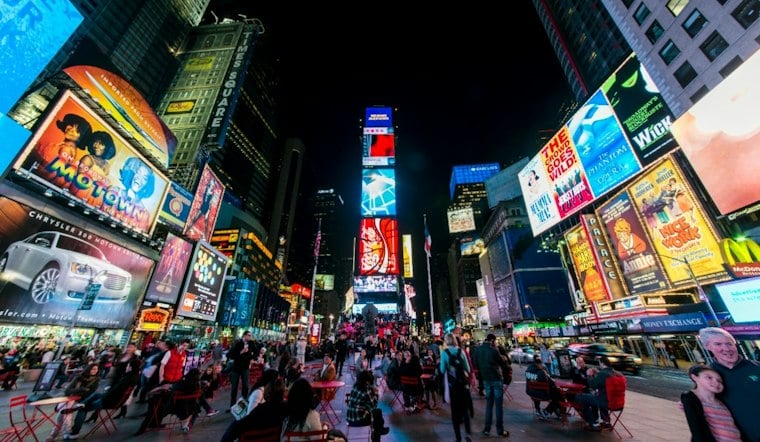
Next Tuesday evening, a performance artist known simply as Kinlaw will be lifted 150 feet into the air above Duffy Square, dangling from a construction crane in the heart of Times Square while a microphone broadcasts every strained breath to the crowd below. The one-night-only piece, called FALL RISK, begins at 8 pm on October 13 between 46th and 47th Streets, turning one of the busiest pedestrian crossroads in the country into the stage for a performance about aging, falling, and the fragile systems meant to catch us.
FALL RISK is presented by Times Square Arts, and according to Time Out, the piece uses a crane to lift and drop Kinlaw above the street while a microphone amplifies their breathing for anyone watching from the plaza. Kinlaw, a New York-based performance artist and composer, has described the piece as putting real conditions under real pressure in front of a live audience. The work is personal: it was inspired by Kinlaw's own experience caring for aging and disabled parents and navigating the insurance and financial systems that determine who gets access to care, per the same report.
From a Hudson Valley Sculpture Park to Midtown Manhattan
This is not FALL RISK's debut. The piece was originally commissioned by Art Omi Senior Curator Sara O'Keeffe and first performed in June 2025 in Ghent, New York, according to Times Square Arts. That inaugural staging relied on boom truck operator Mark Moeske and creative direction from Kathleen Dycaico. The October 13 performance marks both its New York City premiere and only its second presentation anywhere, elevating a rural sculpture-park experiment into one of the most-trafficked commercial intersections on Earth.
Kinlaw arrives in Times Square with a track record of putting their body on the line for art. Prior performances have included being strapped to a moving pickup truck as it sped through the Los Angeles River and scaling mechanical car lifts inside a New York City parking lot, according to Times Square Arts. That history of physically hazardous, durational work set the stage for a piece as technically demanding as FALL RISK, which involves 40,000 pounds of aluminum and steel suspended from a 150-foot crane arm built to carry Kinlaw's body and voice above the crowd.
A Scientific Approach to Sound Under Stress
The acoustic dimension of the performance traces back to Kinlaw's two years as an artist-in-residence at Nokia Bell Labs' Experiments in Art and Technology program, where they conducted psychoacoustical research inside an ultra-quiet anechoic chamber studying how the body processes silence, sound, and physical pressure, according to Bayonet Records. Kinlaw holds a Master of Fine Arts in Music/Sound from Bard College and has previously presented work at MoMA PS1, The New Museum, MOCA Los Angeles, and Pioneer Works, per Kinlaw's own professional record. That background in acoustics and bodily duress is what makes the amplified breathing central to FALL RISK rather than incidental to it.
Times Square has hosted suspended spectacle before. In November 1917, illusionist Harry Houdini performed a straitjacket escape while hanging 60 feet above the plaza from a subway construction crane, an event Times Square Arts cites as a direct historic precursor to Kinlaw's performance. More than a century later, the same stretch of pavement will again become a stage for a body suspended in the air, though this time the spectacle is meant to confront vulnerability rather than escape it.
The Weight Behind the Metaphor
FALL RISK's title points to a real and widening public health concern. Over 14 million older adults — more than 1 in 4 Americans aged 65 and older — report falling each year, making falls the leading cause of both fatal and nonfatal injuries for older adults in the United States, according to the Centers for Disease Control and Prevention. The financial toll compounds the physical one: a 2025 report by the National Council on Aging estimates that medical costs for non-fatal older adult falls total $80 billion annually nationwide, with Medicare covering roughly 67 percent and families absorbing the rest out of pocket.
Those numbers sit behind the crane and the microphone, grounding a piece that is as much about caregiving and institutional strain as it is about physical risk. Times Square Arts operates as the official public art program of the nonprofit Times Square Alliance, serving as the largest public platform in New York City dedicated to folding contemporary visual and performance art into commercial urban space. The plaza where Kinlaw will perform is rarely empty: Times Square averaged 221,457 daily pedestrians throughout 2025, according to its 2026 Annual Report, with foot traffic tracked continuously by 27 automated cameras mounted across seven buildings in the district.
When Kinlaw is lifted above Duffy Square next Tuesday night, that same relentless foot traffic will become an unwitting audience. The passing crowds, many simply cutting through Midtown on their way somewhere else, will become witnesses to a performance built around the idea that falling — physically, financially, and otherwise — is a risk none of us entirely escape.



