

























































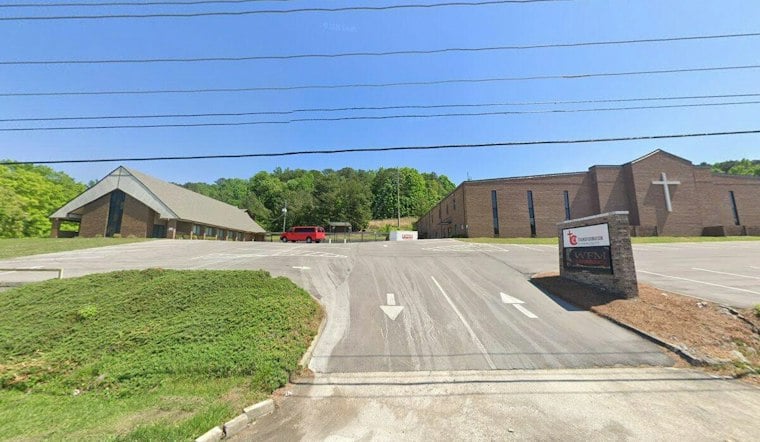
Asbury United Methodist Church has agreed to buy the historic Cahaba United Methodist Church property for $10, with plans to transform the shuttered church building into a food and clothing distribution center serving families across two counties by 2027. The building, located at 3580 Cahaba Valley Road near the intersection of Grants Mill Road, has sat closed since 2025. It includes a fellowship hall and a historic cemetery with roughly 90 marked graves behind it.
The planned purchase is from the North Alabama Conference of the United Methodist Church, according to AL.com. Senior pastor Mike Holly announced the deal Sunday, calling it “an exciting moment.” The renovated building will reopen next year as “The Village: A Community Missions Hub,” providing food, clothing supplies and other essential resources to families across Shelby and Jefferson counties.
A Congregation Rooted in 1896
The Cahaba congregation traces back to 1896, when it was founded as Cahaba Methodist Episcopal Church. The cemetery behind the building was established the same year and today holds about 90 marked graves along with numerous unmarked ones, according to Find a Grave. The building closed in 2025, the same report notes.
Asbury's connection to the site runs deeper than the recent sale. The congregation temporarily used the Cahaba building as a worship space back in 1986, when Asbury itself was just launching, according to the report. Now, four decades later, it will serve as Asbury's missions outpost. The fellowship hall at the back of the property will give Asbury room to expand its outreach work, the church says.
Expanding a Food Pantry Under Financial Pressure
Asbury already runs a food pantry and a sharing table that provides clothing, essentials and other necessities to families who come through its doors, and both will continue operating once they move to the new mission hub. Holly said the response to Asbury's sharing table “has been tremendous,” per the same report. The plan calls for the Village to be open five days a week beginning early in 2027.
The expansion comes as Asbury navigates its own budget gap. The church is roughly $600,000 behind its year-to-date budget, though Holly noted that Asbury typically receives about one-third of its annual budget in December and usually catches up by year's end. He said the church's first priority remains meeting its current financial commitments, and any year-end surplus will be directed toward the new mission hub.
A Decade-Long Partnership With Grace Klein Community
Grace Klein Community, which got its start at Asbury, will partner with the church to staff and operate the building each day, bringing additional resources and support to families who rely on it. The organization has partnered in mission with Asbury for more than a decade and has already established mission hubs in Bessemer, Hoover, Pelham and Clay. Asbury's volunteers and missions programs will have ample space to operate alongside Grace Klein's staff once the Village opens.
Grace Klein's broader footprint gives a sense of the scale this kind of operation can reach. In the first quarter of 2026, the organization distributed more than 66,000 food boxes and rescued over 776,000 pounds of food valued at more than $2.3 million, according to The Birmingham Times. The group has set a goal of rescuing 4 million pounds of food and mobilizing 1,000 service teams during 2026.
Grace Klein's other facilities illustrate what similar projects look like once built out, even though the Cahaba site's own buildout has not been detailed. Its Clay-area hub, a 20,000-square-foot facility on Old Springville Road, opened in June with food-rescue initiatives, a Community Outreach Hall, and furniture and clothing donations. A separate 24,000-square-foot facility on 13 acres in Pelham, unveiled in October 2025, was planned to include a food-preservation kitchen and a 24-hour food-rescue drop-off area, as reported by ABC 33/40. That facility's inaugural fundraising event raised more than $94,000 toward a $1.3 million property-purchase goal.




