

























































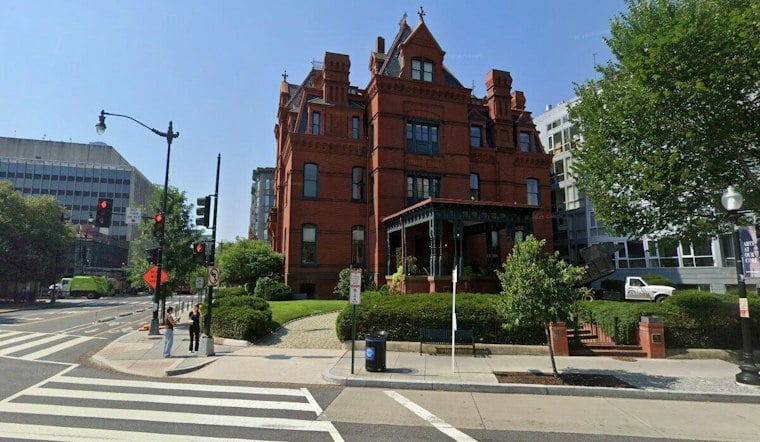
A 19th-century mansion that once anchored Dupont Circle's Gilded Age skyline has a new owner. Asia Society has acquired the historic Blaine Mansion at 2000 Massachusetts Avenue NW for $17.58 million, with plans to turn the roughly 15,000-square-foot property into the permanent Washington headquarters for its Policy Institute and Center for China Analysis.
The price tag comes from bizjournals.com, though a separate account from the South China Morning Post put the figure at US$17.5 million. Asia Society's own announcement confirms the deal was made possible by a lead gift from Stephen A. Schwarzman, giving the organization what it calls a new, permanent home in the nation's capital for its policy arm.
The Washington Business Journal described the property as having both commercial and residential space. According to the Asia Society's announcement, the building will house offices, state-of-the-art conference facilities and convening spaces to support its Washington operations going forward.
A Mansion Built for the Gilded Age
The Blaine Mansion takes its name from its first resident, 19th-century politician James G. Blaine, per Asia Society. A D.C. historic-sites record describes the house as the only surviving example of the large mansions that once ringed Dupont Circle during that era, a detail that underscores just how rare the building is within the neighborhood's current streetscape.
The two accounts diverge slightly on construction dates: Asia Society's announcement states the mansion was built in 1882-1883, while the D.C. Historic Preservation database lists construction from 1881 to 1882, with both crediting architect John Fraser. The property was added to the D.C. Inventory of Historic Sites on November 8, 1964, and sits within both the Dupont Circle and Massachusetts Avenue historic districts, according to the same preservation record. D.C.'s Historic Preservation Review Board also has a paper trail on the building: records from the D.C. Office of Planning show the board approved a revised design for an alteration and addition at the mansion in 2006, with minor comments, and later listed the project as a consent item that November.
From Private Estate to Policy Hub
Before Asia Society entered the picture, the mansion underwent extensive renovation and development under former U.S. Ambassador to Italy John R. Phillips and former journalist Linda Douglass, according to Asia Society's announcement. Asia Society plans to put an office in the Gilded Age property, as CoStar reported, and has said the mansion will house the Policy Institute's work while also serving as a base for its arts, culture and ideas programming in the city, per indiawest.com.
That dual mission reflects a broader shift at the organization. Asia Society has focused more on public policy in recent years, in addition to its traditional focus on arts, culture and education, the same South China Morning Post report notes. The group, founded in 1956 by John D. Rockefeller 3rd and describing itself as nonpartisan, has maintained a Washington office since 1970 and now operates 16 centers and offices worldwide, per indiawest.com's reporting.
A Pattern of Institutions Chasing Historic Addresses
A Pattern of Institutions Chasing Historic Addresses Asia Society is not the only institution snapping up a Massachusetts Avenue mansion. Just up the block, the Ministry of Foreign Affairs of the Czech Republic purchased the 140-year-old Samuel M. Bryan House at 2025 Massachusetts Avenue NW for $11.8 million in 2025, according to Bisnow. That house, built by architect W. Bruce Gray in 1885 and now totaling roughly 13,000 square feet after additions, had served as headquarters for the nonprofit Urban Alliance for 15 years before the sale; the Zients Family Foundation had bought it for $4 million back in 2010, Bisnow's deal sheet shows.
A separate Bisnow report found that nonprofit leasing volume across the D.C. metro totaled 1.3 million square feet in 2024, 18% below the historic average, a sign of broader caution among nonprofits even as a handful of well-funded institutions bet on prestige addresses along Embassy Row.





