

























































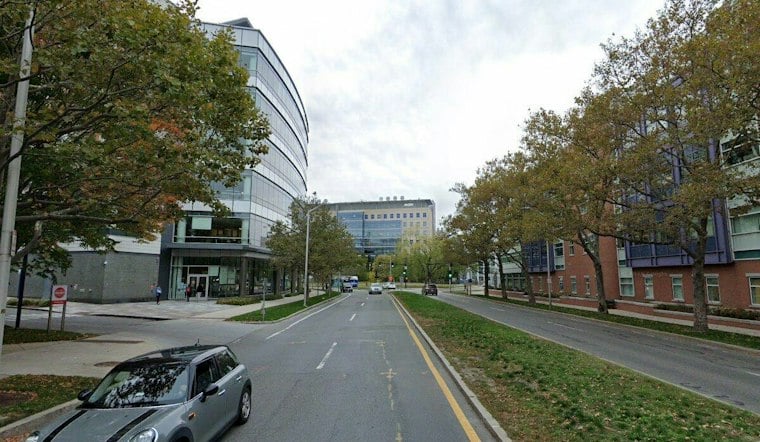
AstraZeneca is pouring more than $1 billion into Massachusetts, opening an 18-story, 570,000-square-foot research and development center in Cambridge's Kendall Square while planning to grow its state workforce by more than 50 percent in the coming years. The new facility includes 10 floors of laboratories built to chase treatments for cancer, chronic diseases, rare diseases, and cell therapies, with robotics, automation, and artificial intelligence woven into the labs themselves.
The investment is part of AstraZeneca's broader $50 billion U.S. investment plan, according to KSL News. The Cambridge center, along with a nearby genomic medicine site, will together house nearly 2,000 researchers and scientists, adding to a U.S. footprint that already spans 24 research, manufacturing, commercial, and corporate sites and employs more than 25,000 people nationwide, including a major research hub in Gaithersburg, Maryland.
A Building Years in the Making
The project at 290 Binney Street was developed by real estate investment trust BXP, also known as Boston Properties, which fully placed the facility into service in the second quarter of 2026 after pre-leasing the entire building to AstraZeneca, according to BXP. The site's path to completion wasn't entirely smooth: construction survived a court challenge in May 2024 when a Massachusetts Superior Court judge denied an injunction sought by Brammer Bio, a Thermo Fisher subsidiary that manufactures viral vectors nearby and alleged the construction interfered with its gene therapy operations, as reported by The Real Deal.
Development of the parcel was also folded into a coordinated Kendall Square redevelopment plan that required a new underground electrical substation built by Eversource to power the expanded commercial and residential district, per the City of Cambridge. That kind of infrastructure lift underscores just how dense the buildout around Kendall Square has become as drugmakers stack lab towers on top of housing and utility works.
Building On the Alexion Foundation
AstraZeneca's deepening Cambridge footprint builds on a foundation it laid in July 2021, when it completed a $39 billion acquisition of Boston-headquartered Alexion Pharmaceuticals, establishing Boston as the company's global headquarters for rare disease research, according to historical context from Global Genes. The new Binney Street labs also lean on proprietary “agentic AI” models developed by AstraZeneca's internal AI for Discovery team, designed to automate and accelerate drug target identification, the company's own careers listings indicate.
The Massachusetts commitment sits alongside a separate $3.5 billion pledge AstraZeneca made in November 2024 toward U.S. capital investments, including expanded specialty drug manufacturing in Coppell, Texas, and biologics manufacturing in Maryland. Hoodline previously covered pharma's DFW push, part of the same national wave of drugmakers, including Pfizer, Roche, and Eli Lilly, that are expanding U.S. footprints to strengthen supply chains and increase domestic manufacturing capacity, per KSL News.
State Incentives Meet a Soft Lab Market
AstraZeneca's buildout arrives even as Greater Boston's commercial lab market shows signs of strain. CBRE reported a 28.7 percent commercial lab vacancy rate across the region in the second quarter of 2026, a legacy of the post-pandemic building boom, though Cambridge itself still logged nearly 194,000 square feet of positive net lab absorption that same quarter, the firm's data shows.
Massachusetts has leaned hard into supporting the sector through policy. Governor Maura Healey signed the Mass Leads Act in November 2024, committing $1 billion over 10 years to the state's life sciences industry, reauthorizing the Massachusetts Life Sciences Initiative first established in 2008, and raising annual life sciences tax incentives from $30 million to $40 million, according to the Massachusetts Life Sciences Center. In September 2026, the agency awarded that $40 million in tax incentives across 33 life sciences companies statewide in an effort to generate more than 1,600 biopharma jobs, with recipients required to hit job-creation targets over three years.
That public backing helps explain why institutional tenants keep committing to build-to-suit towers in Kendall Square even as suburban lab space sits empty elsewhere in the region. AstraZeneca's $1 billion Massachusetts bet also feeds directly into its corporate “Ambition 2030” plan to reach $80 billion in total annual revenue by 2030, a goal anchored by the U.S. market, which already accounts for 44 percent of the company's total revenue.





