

























































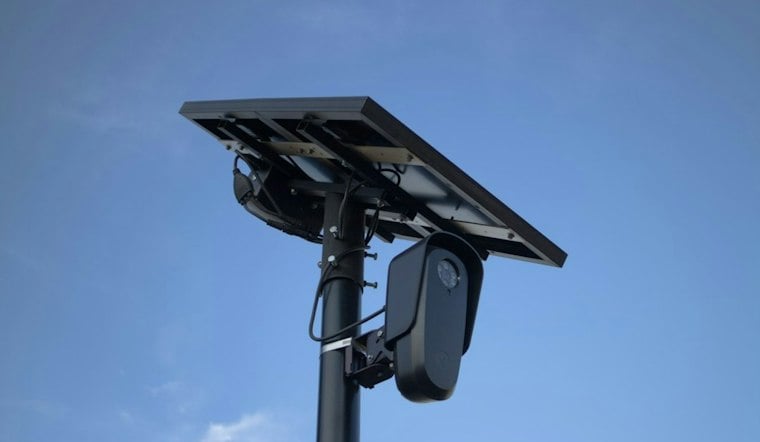
Auburn's City Council voted 5-0 Monday to delay a decision on whether to keep using the city's 12 Flock Safety license-plate reader cameras, choosing instead to gather more information and survey residents after weeks of public pushback over how the footage has been shared. The cameras have been running quietly since 2022, but a September town hall and a string of unanswered questions about data access have turned a routine surveillance tool into one of the city's most contentious issues.
The Contract and the Oversight Questions
Auburn’s 12 Flock cameras operate under a contract running through June 2028, and cost the city roughly $30,000 a year, according to the Sacramento Bee. More than 100 residents attended a Sept. 21 town hall, where many called for the program to end, CapRadio reported. The meeting was informational; it did not include a vote on the cameras or contract, according to CBS News Sacramento.
At Monday’s council meeting, resident Bella Dolan objected to what they described as systematic tracking of people’s movements on public roads without consent or a warrant, and questioned why Auburn needed information about drivers not suspected of a crime, the Sacramento Bee reported. Councilmember Sandra Amara argued the cameras could help police identify criminals and protect residents, while supporting stronger safeguards and oversight if the city keeps the system.
The Sharing Settings and Their Limits
A recent audit found that Auburn Flock data had been accessible in some cases to out-of-state and federal agencies; police said that access has since been shut off, the Sacramento Bee reported. Police Chief Bryan Morrison said the exposure resulted from old system settings and was inadvertent. The department discovered the setting through a public records request and then disabled it, CapRadio reported. As of Oct. 1, the department said it shared data with 274 agencies and received data from 197, including 180 reciprocal agreements. It said its current arrangements do not include federal or out-of-state agencies, according to the Sacramento Bee.
Auburn also shares plate data with the Northern California Regional Intelligence Center, which analyzes information across jurisdictions to identify potential threats and follows a 30-day retention policy, the Sacramento Bee reported. The police department says its system does not directly connect to DMV records, the FBI’s National Crime Information Center or California’s Automated Criminal History System. Katie Dauphinais said Flock permanently deletes vehicle data from its cloud system after 30 days, leaving it inaccessible to the company and Auburn police; Flock offered to provide council members with technical documentation supporting that claim.
The Council’s Next Steps
Councilmember Rachel Radell-Harris said she wanted to hear residents’ concerns while determining whether the views expressed at meetings reflected the wider community. The council plans to survey residents and further consider data-sharing policies. Mayor Kelley Davis also supported a survey before a decision. Bridget Powers said she had heard from camera supporters but had not yet met with opponents or had sufficient time to review police responses; Alice Dowdin Calvillo called the settings change unacceptable.
What Police Say the System Has Contributed—and What They Still Need to Measure
Morrison has described Flock as a tool for identifying vehicles connected to crimes, locating missing people and pursuing leads more quickly. He told CapRadio that the system had figured in roughly 230 investigations since Auburn adopted it. The department did not provide a complete account of how many cases led to arrests or other outcomes, the Sacramento Bee reported. Five administrators, including Morrison, are authorized to approve data sharing.
What a Plate-Reader Hit Can Establish
A U.S. Department of Homeland Security, National Urban Security Technology Laboratory market survey report cautions that ALPR data records a plate’s presence at a place and time; by itself, it does not identify the vehicle’s driver or occupants. The report says further analysis is needed to establish whether the plate is likely mounted on the vehicle to which it is registered—a relevant limitation when assessing investigative results and the department’s acknowledged difficulty tracking incorrect identifications.
Auburn requires users to record a reason and a case or incident number for each search, and the department says it audits searches every 30 days. Morrison has acknowledged the need for more formalized audits and updated policies, and said the department is working on a more rigorous process. The department also lacks an efficient way to measure incorrect plate or vehicle identifications and has asked Flock to add a tracking feature. For now, dispatchers and officers dismiss incorrect alerts verbally; the department is also evaluating a feature to suppress plates that repeatedly trigger false alerts. Separately, three Auburn cameras were stolen this year after being disabled and dumped in a canal, the Sacramento Bee reported.
A Citywide Policy Remains an Open Question
Auburn has no official city policy governing automated license plate readers; the police department’s policy serves as the default, according to a report on the council’s deliberations. Council members are considering a standalone policy covering permitted uses, data collection and storage, third-party sharing and oversight. They have also discussed a community advisory committee that would include residents if the city keeps the cameras. The council has questioned how to prevent software updates from changing sharing settings without notice. If Auburn ends the contract early, it would owe at least $6,000—$500 for each of its 12 cameras—though Flock has not confirmed a final termination figure.
Auburn is not the only California city reconsidering Flock cameras. Grass Valley suspended its program indefinitely over the summer, and Folsom officials said in September they planned to discontinue the technology while keeping other plate-reading tools, CapRadio reported. The Institute for Justice has tracked more than 250 communities that have canceled or declined to renew Flock contracts; the company says its network has grown to more than 120,000 cameras nationwide. California’s proposed SB 274 would have required new or updated ALPR vendor contracts, beginning Jan. 1, 2026, to block default access to national databases, limit retention to 60 days in most cases and impose stricter employee access controls. The bill failed on March 2, 2026, and was stricken from file, according to CalMatters’ Digital Democracy project. Auburn’s cameras remain in operation while the council awaits survey results and considers what safeguards, if any, should govern their continued use.





