

























































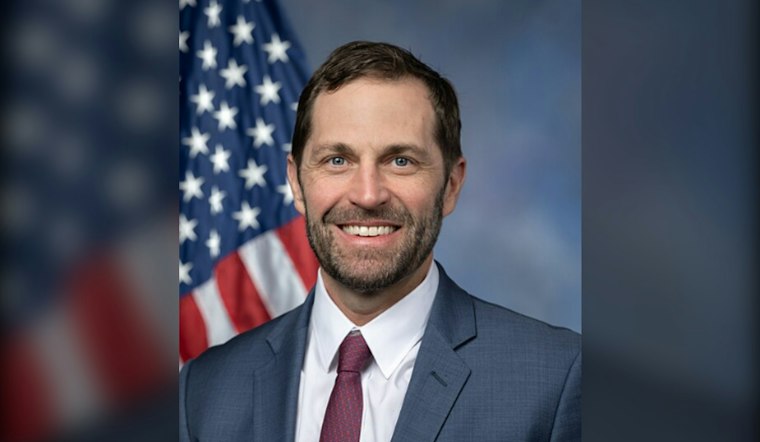
Rep. Jason Crow is seeking a fifth term representing Colorado's 6th Congressional District this November, and he's doing it with a campaign war chest that dwarfs his opposition many times over. As of September 2026, Crow held roughly $2.7 million in campaign cash on hand, while Republican challenger Jason Clark reported no campaign funds raised on his official committee filings.
That financial gap is just one reason national election handicappers consider Crow's seat all but locked up. Cook Political Report and Sabato's Crystal Ball both rate the district as Solid Democratic or Safe Democratic for 2026, with Cook assigning it a Partisan Voting Index of D+11, according to Ballotpedia. Crow has held the seat since 2018, when he defeated five-term Republican incumbent Mike Coffman with 54.1% of the vote to Coffman's 42.9%, ending nearly 35 years of GOP control in the suburban Denver seat.
Despite the odds, four candidates are challenging Crow on the November ballot, spanning the Republican, Libertarian, Unity Party, and independent lines, as Sentinel Colorado reports. Crow's most recent electoral performances suggest a steep climb for any of them: he won 58.97% of the vote against Republican John Fabbricatore in 2024, and 60.60% against Republican Steven Monahan in 2022.
A Republican Candidate's Legal Troubles
Republican nominee Jason Clark, a West Point graduate who grew up in Aurora and has worked as an entrepreneur, small business owner, and independent investment advisor, is campaigning on improving affordability, attracting jobs to Colorado, and reducing crime. But per the same Sentinel Colorado report, Clark's background includes a contested legal history: he was accused of sending threatening packages and letters to a former classmate's home, and that former classmate obtained a protective order against him, though the outcome of that case remains sealed. Clark has denied making threats. The same former classmate separately won a $100,000 judgment against Clark in Hawaii. Clark also had his investment license revoked and sued the state over that revocation in federal court, a case that was dismissed in 2024.
Libertarian candidate Patty McMahon brings a long government career to her campaign, having spent 35 years with the U.S. Equal Employment Opportunity Commission's Denver field office, where she served as outreach and education coordinator and later as a congressional liaison. A graduate of Metropolitan State University, McMahon has lived in the district for 26 years. Her priorities include curbing presidential executive power, opposing wars, improving fiscal oversight, and making education more accessible.
Independent and Unity Party Challengers
Unity Party candidate Meredith Ryan moved to Colorado and has worked as a paraeducator with Aurora Public Schools, after previous work in social services, elder care, and community-based programs. Her platform includes support for Medicare for All, defunding ICE, and promoting human rights and ethical government. Ryan has also pledged to reject funding from AIPAC, end weapons sales to Israel, and ban congressional stock trading.
Independent candidate Dr. Samir Witta, an oncologist who founded the Mountain Blue Cancer Care Center, officially qualified for the November 2026 ballot on July 27, 2026, after the Colorado Secretary of State's Elections Division validated 2,841 petition signatures collected across the district, according to Witta for Congress. Witta also founded Anthiogen, which assists with covering cancer patients' cost of care, along with Empower Her Color, which supports women of color facing healthcare challenges, and All the Children of Light, which provides aid to Syrian refugees. He says he's running as an independent specifically to avoid the influence of party leadership, special-interest groups, corporations, and mega-donors, and his priorities include congressional term limits, banning stock trading by lawmakers, increasing healthcare access, lowering drug prices, and capping rent and homeowners association fees.
Crow's Record on Local and National Issues
Crow, an Army veteran who served as a U.S. Army Ranger in the 82nd Airborne Division and 75th Ranger Regiment with combat tours in Iraq and Afghanistan, now serves as the Ranking Democrat on the House Armed Services Subcommittee on Intelligence and Special Operations, according to LegiStorm. He also serves on the House Intelligence Committee and has challenged the Trump administration, including pushing back on war in Iran.
Locally, Crow has called for more oversight of ICE detention facilities and supported state and local health officials investigating a confirmed tuberculosis case. That stance tracked with an unannounced oversight visit his staff conducted on September 11, 2026, to the GEO Group ICE processing center in Aurora following reports of a medical quarantine, during which they identified seven detainees under medical monitoring, as Hoodline previously reported. Crow has also pushed for $15.6 million in federal funding included in the House-passed Water Resources Development Act to upgrade storm sewers and reduce chronic flooding in northwest Aurora.
Crow's broader platform includes lowering healthcare, housing, and energy costs, reducing gun violence and passing gun safety laws, and supporting Buckley Space Force Base along with expanding Colorado's aerospace industry. GovTrack found Crow had the 15th most bipartisan bills among House members, and he has supported a ban on congressional stock trading while cosponsoring legislation to increase campaign finance transparency. Democracy Defenders Action has touted Crow for his anti-corruption efforts.
The 6th Congressional District covers eastern and southern Denver suburbs including Aurora, Centennial, and Littleton, encompassing 730,108 residents who are 98.5% urban, 22.1% Hispanic, 10.0% Black, and 6.0% Asian, with a median household income of $103,252 as of 2024, according to Wikipedia. With Crow's seat considered a safe bet by national observers, the race's real intrigue may lie less in the outcome and more in how four challengers with sharply different visions, from term limits to Medicare for All, try to break through in a district that has voted Democratic by wide margins since 2018.



