

























































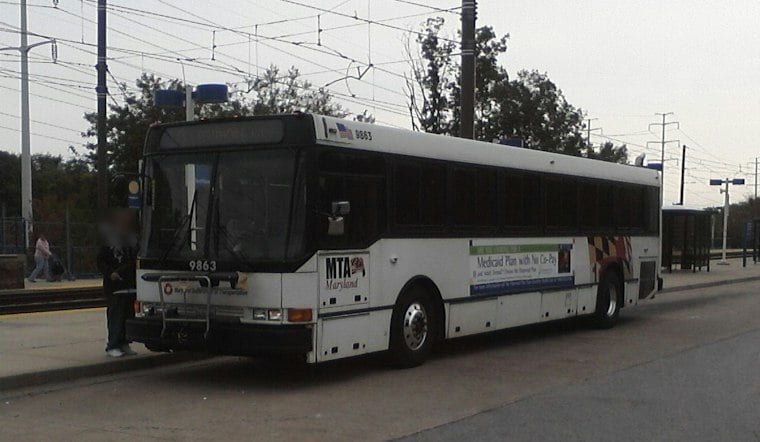
Baltimore riders are boarding buses, trains and light rail at a rate that places the region among the highest peer metros for transit ridership per capita, according to WBAL-TV's report on a new study from the Baltimore Metropolitan Council.
Baltimore Ranks Among Highest in Transit Ridership Per Capita
The Baltimore Metropolitan Council's state-of-the-region findings, detailed in a presentation posted by baltometro.org, compare the region with peer metros across a range of measures. As WBAL-TV reported, the council compared Baltimore against Detroit, Minneapolis-Saint Paul, Denver, Orlando, St. Louis, Pittsburgh, Indianapolis and Charlotte, among others, as part of its broader benchmarking effort.
The same report paints a picture of a metro that stands out demographically as well as in transit use. Baltimore ranked third among peers for diversity, with 47.6% of residents identifying as a race other than White alone, per baltometro.org. The region also placed fifth among peers for the share of adults holding a bachelor's degree or higher, at 45.3%, while coming in as the sixth-largest metro among the comparison group with 2,859,024 residents as of 2024.
Homeownership Holds Steady, Population Growth Lags
Homeownership in the Baltimore region ranked tenth among peers. That middle-of-the-pack standing contrasts with the region's population trajectory: Baltimore's population grew just 2.0% since 2018, ranking 19th out of 21 peers, according to the same baltometro.org report.
The region's job mix also reflects a long-running shift away from manufacturing. Education and health services now make up 26.9% of Baltimore's employment, the second-highest share among peers, while manufacturing accounts for just 5.1% of jobs, ranking 19th, baltometro.org's data shows.
Fare Revenue Falls Even as Ridership Climbs
While the regional ranking highlights transit's relative strength in Baltimore compared with other metros, ridership on the Maryland Transit Administration's own system remains well below where it stood before the pandemic. More than 70 million passengers boarded MTA buses, trains and light rail in fiscal 2025, bringing ridership back to about 75% of its pre-pandemic level, according to Fox Baltimore. That is a sharp rebound from the roughly 42 million boardings recorded in fiscal 2021, though still short of the more than 94 million boardings MTA logged in fiscal 2019, the last full fiscal year before the pandemic.
The financial picture tells a more complicated story than the ridership recovery alone suggests. Passenger fares covered just 5% of Baltimore-area transit operating costs in fiscal 2025, down from 29% in fiscal 2019, the station's report found. MTA's operating allowance is projected to reach nearly $1.4 billion in fiscal 2027, compared with an $849.3 million budget in fiscal 2019, per the same account.
Job Access by Transit Has Slipped Over the Past Decade
Even with Baltimore's strong ridership numbers relative to its peers, getting to work by transit has become harder over time for the typical resident. A typical Baltimorean can reach just 7.5% of the region's jobs within an hour using public transportation, down from 8.5% in the previous report card and 11% in the inaugural 2015 report card, according to the Central Maryland Transportation Alliance. By comparison, Portland had the highest share among peer regions for jobs accessible by transit within an hour, at almost 12%, the alliance's report card notes.
Roughly 87% of commuters in the Baltimore region drive alone, the alliance found, underscoring the region's continued reliance on cars despite its strong showing in the transit-ridership rankings. The alliance's report card compares the Baltimore metro with 16 other U.S. metro regions with populations between 2 million and 4 million.
A separate analysis, the Peer Regions Transit Report produced through marc.org, compares Baltimore's regional transit system with peer systems on funding, ridership, service area and density, drawing most of its data from the National Transit Database, the five-year American Community Survey and a custom survey of participating transit providers.


