

























































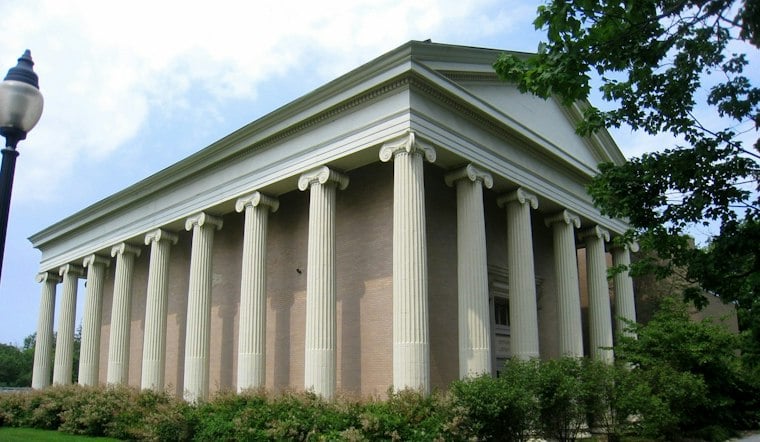
Bard College has opened the Ralph Ellison Center on its Annandale-on-Hudson campus, where Ellison taught American and Russian literature from 1958 to 1961, according to Associated Press. The opening also marks a significant change in stewardship: the Ralph and Fanny Ellison Charitable Trust transferred to Bard copyrights, intellectual-property rights and royalty claims tied to Ellison’s work, including his 1952 novel Invisible Man.
Bard says the transfer covers all copyrights, intellectual-property rights and claims to royalties associated with Ellison’s writing. The college plans to digitize Ellison’s archive, which remains housed at the Library of Congress, as part of the center’s effort to make the work more accessible to scholars and the public, according to Bard College.
What the Library of Congress Holds
The Library of Congress finding aid describes the Ralph Ellison Papers as 74,800 items in 314 containers plus 25 oversize containers, totaling 143 linear feet. According to the Library of Congress, the papers are open to research, though fragile original materials in a closed series cannot be handled; photocopies are available.
A Literary Estate in Transition
The Ralph and Fanny Ellison Charitable Trust plans to wind down and close, according to WSLS. John Callahan, literary executor of Ellison’s estate, has helped guide the legacy’s next chapter, The New York Times reported.
Invisible Man, the only novel Ellison published during his lifetime, won the 1953 National Book Award for fiction, making him the first Black author to receive the honor, according to the Times. The novel follows a Black protagonist who faces ostracization after moving from the Jim Crow South to Harlem. It is also part of Bard’s first-year curriculum, WSLS reported.
Ellison’s Path to Bard
Ellison was born March 1, 1913, in Oklahoma City, and studied music at Alabama’s Tuskegee Normal and Industrial Institute, now Tuskegee University, according to Associated Press. He died of pancreatic cancer at his Harlem home in 1994. His other published work includes the essay collection Shadow and Act and the posthumously released novel Juneteenth.
Bard’s plans include a yearlong commemoration of Invisible Man’s 75th anniversary in 2027. The center will also hold the Ralph Ellison Lectures, a biannual series featuring distinguished scholars and a partner historically Black college or university, and offer regrants for scholarly work with the archive and training in archival practices, according to the college’s announcement.
Connecting Scholarship and Community
The center will support an artist-in-residence, a writer-in-residence and a group of Ellison Student Scholars each year; all will receive stipends, Bard says. Students from Bard and partner historically Black colleges and universities can also apply for an internship that began in summer 2026. Accounts differ on its length: Bard describes an intensive, paid two-week program, while WSLS reports a 10-week internship involving archival work and independent research.
Bard also intends to develop a community-based curriculum with its Institute for Writing & Thinking. WSLS reported that the curriculum could reach Bard High School Early College, the Bard Prison Initiative, the college’s microcolleges and 66 public libraries in the Hudson Valley Public Library System.
The center’s stated aim extends beyond preserving Ellison’s legacy on campus. WSLS reported that organizers envision a community gathering place—an intellectual salon shaped by Ellison’s work and ideas.



