

























































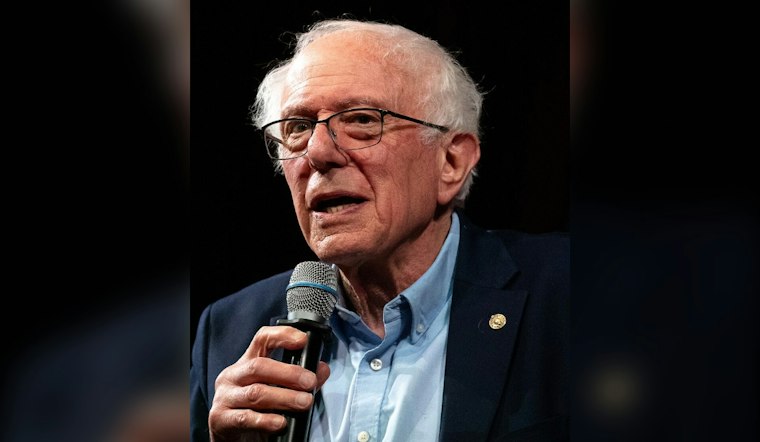
Sen. Bernie Sanders took the stage at the Novo in downtown Los Angeles on Monday to rally support for California's billionaire tax, calling Proposition 40 the most important ballot measure in the country while union members elsewhere in the state chanted against it. The measure, which would impose a one-time 5% tax on the wealth of billionaires who lived in California on January 1, 2026, has become one of the most expensive and divisive fights on November's ballot, splitting labor unions that usually stand shoulder to shoulder.
Sanders, the independent senator from Vermont, told the crowd that the economy and government should work for everyone rather than only the top 1 percent, according to the Los Angeles Times. He name-checked three of California's best-known billionaires — Tesla and SpaceX founder Elon Musk, Meta's Mark Zuckerberg and Google co-founder Sergey Brin — as examples of the wealth the measure targets. He was joined onstage by Rep. Ro Khanna, the Democrat from Fremont, while rapper Common called for billionaires to pay up and artist Shepard Fairey unveiled banners supporting the campaign, the newspaper reported.
A Backstop Against Federal Healthcare Cuts
Proposition 40 was crafted by a healthcare union, and supporters frame it explicitly as a response to federal healthcare funding cuts approved by congressional Republicans and signed by President Trump — cuts they warn could cause millions of Californians to lose coverage and trigger hospital closures around the state. SEIU-United Healthcare Workers West is spearheading the measure, arguing the tax is necessary to offset those cuts, according to ABC7 News.
Datosha Williams, who has an 8-year-old asthmatic son, said Proposition 40 is a backstop to the federal cuts and fears her coworkers could lose their jobs if healthcare funding keeps shrinking. Ninety percent of the tax's revenue would fund healthcare, with the remaining 10% available for education, food assistance and administration, per the station's report.
Ironworkers and Building Trades Say No
Not far away, a labor opposition rally unfolded at the Ironworkers Training Center in La Palma, where union workers chanted “No on 40.” Xochitl Medrano, political director for the District Council of the Ironworkers of the State of California and Vicinity, opposed the measure, and labor leaders there argued Proposition 40 contains a loophole that could let state lawmakers eventually tax savings accounts, retirement accounts and home equity belonging to all Californians — a claim the measure's supporters dispute.
Andrew Gonzales, council representative for the Los Angeles and Orange Counties Building and Construction Trades Council, said Proposition 40 is not the right vehicle for making the wealthy pay their fair share or for creating a low-cost, high-quality health insurance plan. Opposition to the measure also includes the California Teachers Association, California Professional Firefighters and the State Building and Construction Trades Council of California, unions that often align with organized labor on other issues, per ABC7.
Money Pours In From Both Sides
The Los Angeles Times reported that the measure drew more than $300 million in campaign contributions, nearly all against it. Ballot measures are not subject to caps on campaign donations, which helps explain the scale of the spending on both sides.
Opponents, including the California Chamber of Commerce, describe the wealth tax as a flawed experiment that could push companies and rich people to leave the state, and they point to wealthy Californians who have reportedly moved out of state because of the proposal, a shift they say has already affected the state budget. The measure has also scrambled typical political alliances: the California Democratic Party endorsed it, while Gov. Gavin Newsom opposes it, the Times reported.
Voters Narrowly Split as Election Nears
Polling shows the race tightening in the opposition's favor. A UC Berkeley Institute of Governmental Studies poll co-sponsored by the Los Angeles Times found 45% of likely voters supporting Proposition 40 in late September, with 42% opposed and 13% undecided — down from 48% support and 41% opposition six weeks earlier. Proposition 40 shares the November 3 ballot with Propositions 41 and 42, either of which would nullify the billionaire tax if it receives more votes.
Estimates of the tax's fiscal impact vary widely depending on who is counting. Academics who helped develop the measure estimate it would bring in roughly $100 billion, while a group of right-leaning scholars at the Hoover Institution argue it could instead cost the state $25 billion if billionaires leave, according to the Sacramento Bee. The nonpartisan Legislative Analyst's Office has said California probably would collect tens of billions of dollars from the tax, though the exact amount is difficult to predict.





