

























































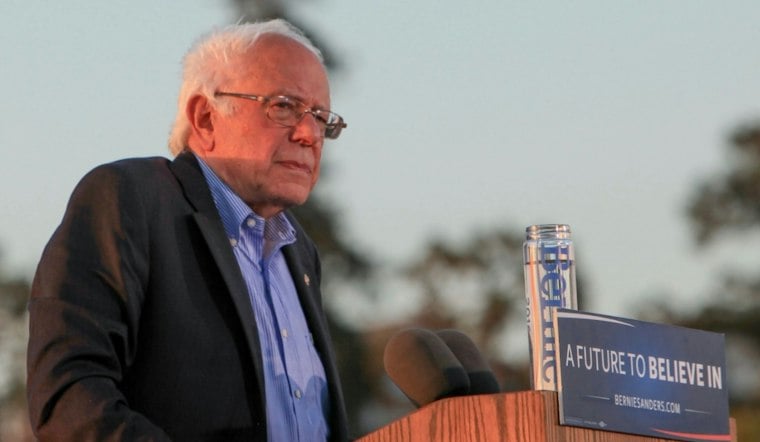
Bernie Sanders has transferred $1 million of his own campaign money to Michigan Democratic Senate nominee Abdul El-Sayed after learning that AIPAC planned to spend as much as $9 million to defeat him. The move, made on Wednesday, comes as the pro-Israel lobbying group ramps up its involvement in what has already become the most expensive Senate race in Michigan history.
Sanders said he transferred the money and reached out to fellow progressives because the scale of AIPAC's planned spending struck him as unacceptable. According to The New York Times, Sanders said, “we are also reaching out to other individuals to try to raise money because this is just outrageous.” The Vermont independent, 85, urged progressive allies to counter AIPAC's spending directly, framing the push as a defense of El-Sayed's candidacy against a well-funded outside effort.
Sanders's operation collected promises and pledges totaling $300,000 from a dozen other Democrats, four of whom were Senators Martin Heinrich of New Mexico, Tina Smith of Minnesota, Chris Van Hollen of Maryland and Jeff Merkley of Oregon, per the same account. Sanders acknowledged the combined total still falls far short of AIPAC and billionaire-funded super PAC spending, but said it represented a way to support democracy and El-Sayed's bid. The $1 million transfer builds on an earlier $250,000 Sanders gave to the Abdul for Michigan Victory Fund in the first week of October — a joint effort of El-Sayed's campaign, the Democratic Senatorial Campaign Committee and the Michigan Democratic State Central Committee.
A Historic Candidacy Under Financial Siege
El-Sayed would become the first Muslim senator in American history if he wins in November, a milestone that has helped draw national attention — and national money — into the race. The Hill reports that The New York Times, citing two sources, said AIPAC had recently begun funneling cash into a super PAC backing Republican nominee Mike Rogers, with the group aiming to possibly spend millions more, according to The Hill. El-Sayed has publicly opposed U.S. aid to Israel, a position the outlet notes has made him a target for pro-Israel advocacy groups throughout the campaign.
Separately, Yahoo News reported that Sanders and more than a dozen other members of Congress were contributing $1.3 million in total to El-Sayed's campaign, a sum that included Sanders's $1 million transfer, his earlier $250,000 donation, and nearly $600,000 raised from other lawmakers, as detailed by Yahoo News. The outlet also noted that as of the end of September, El-Sayed had out-raised Rogers by a wide margin, pulling in just over $45 million in receipts compared with Rogers's more than $20 million, citing Federal Election Commission data.
Sanders himself is sitting on substantial resources of his own. His campaign had $22.4 million in its coffers entering October, a figure the New York Times notes ranks among the largest campaign funds held by any sitting senator.
AIPAC's Spending Push Against El-Sayed
AIPAC's involvement in Michigan did not begin this month. NBC News reported that its United Democracy Project super PAC spent $95,000 on mailers opposing El-Sayed, targeting roughly 130,000 Jewish voters, according to NBC News. That sum was described as just a fraction of the $33 million the same group had already spent opposing El-Sayed and supporting rival Haley Stevens during the Democratic primary.
The primary fight itself set records for AIPAC's involvement in a single race. The Associated Press reported that AIPAC and affiliated groups spent close to $30 million backing Stevens, their largest-ever investment in a single contest, while outside organizations poured close to $50 million total into her candidacy, including roughly $12 million from a group called A Stronger Michigan, according to The Associated Press. El-Sayed went on to win the nomination anyway, setting up the current general-election clash with Rogers.
Record Fundraising, Record Spending
El-Sayed's fundraising has continued to outpace Rogers's by wide margins, though exact figures vary slightly between reports. Bridge Michigan reported that El-Sayed raised $30.7 million in the most recent quarter, three times the $9.7 million brought in by Rogers, a gap detailed by Bridge Michigan. Al Jazeera, reporting on the same quarter, put the figures slightly differently — $30.6 million for El-Sayed against $9.6 million for Rogers.
Bridge Michigan described the overall contest as far and away the most expensive election in Michigan history, with more than $270 million in disclosed spending to date, while Al Jazeera's accounting placed the race's total spending above $268 million as of October 15. More than 800 contributors gave the maximum $3,500 general-election donation to El-Sayed's campaign or a related joint fundraising account, the outlet's report noted, while small-dollar donors giving less than $200 accounted for roughly $11.2 million, more than a third of his overall haul.
Despite out-raising Rogers, El-Sayed entered the latest reporting period with less cash on hand — $3.8 million in reserves compared with Rogers's $6.5 million, the report found. Rogers's fundraising gap was partly offset by a super PAC called the Great Lakes Conservatives Fund, which raised $9.1 million to support him, while the Fighting for Michigan PAC spent about $1.5 million backing El-Sayed over the same period. Outside groups overall have spent nearly $95 million boosting Rogers in the general election, compared with $42 million for El-Sayed, according to the same Bridge Michigan analysis.
A Tight Race With Recent Precedent
El-Sayed currently leads Rogers by 2.6 percentage points in the RealClearPolitics average of high-quality polls, per Al Jazeera's report. The margin echoes Michigan's last Senate contest, when Elissa Slotkin defeated Rogers by fewer than 20,000 votes in 2024, a race the Associated Press cited as evidence of how competitive statewide contests in Michigan have become.
The Federal Election Commission's own data on the race carries caveats. Its totals are drawn from quarterly, monthly and semi-annual filings and do not include 24- and 48-hour reports of independent expenditures, meaning the full scope of outside spending in the race's final stretch may not yet be reflected in public records.





