

























































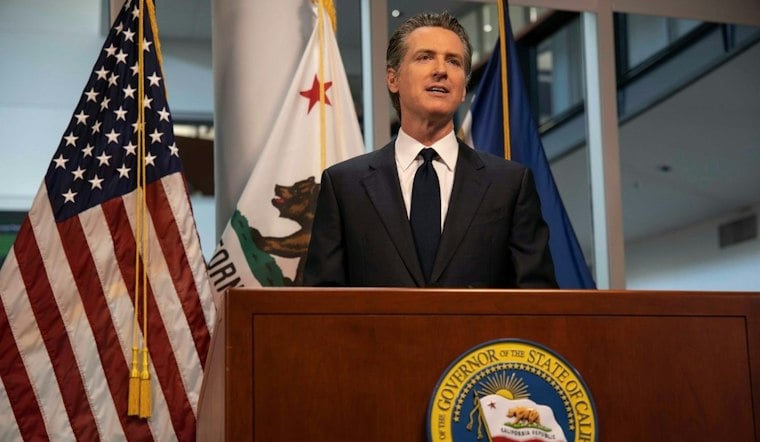
Backers of California's Proposition 40, the one-time 5% wealth tax on billionaires, are taking their fight far beyond the state's borders this weekend, launching television and digital ads in early presidential primary states that accuse Gov. Gavin Newsom of trying to sabotage the measure to protect his wealthy allies. The campaign lands just 11 days before California voters decide the measure's fate on November 3.
A 30-Second Ad With Newsom's Name on It
According to the Los Angeles Times, the 30-second ad features a narrator who says California Democrats champion a one-time billionaire tax to preserve health care coverage for millions, then accuses Newsom of betraying supporters by trying to sabotage it. The narrator also claims that billionaires opposing Proposition 40 gave millions of dollars to Newsom, and the ad criticizes the governor for turning his back on working Californians, per the same report.
The spot names four wealthy figures directly: Stewart Resnick, who owns businesses including POM Wonderful, Fiji Water and Justin Vineyards; crypto executive Chris Larsen; former Google leader Eric Schmidt; and venture capitalist Michael Moritz. All four have backed Newsom's political ambitions, the Los Angeles Times reports, and the ad uses their names to argue the governor is more aligned with billionaires than with the voters he represents.
Who's Paying for It
The ad buy is being primarily funded by the Service Employees International Union–United Healthcare Workers West, the same union that crafted Proposition 40, along with Saikat Chakrabarti, a climate change advocate and political advisor who made part of his wealth as a founding engineer at Stripe, and Ross Boucher, who worked as an early engineer at the same company. Per the Los Angeles Times, the buy is described by its backers as six figures and capable of growing. The ads are expected to air in South Carolina, Nevada, New Mexico, Virginia and New Hampshire — all states tied to the early presidential nominating calendar.
The timing is pointed. Newsom just stumped for Democratic candidates in New Hampshire this month, part of what the Los Angeles Times describes as a continuation of his reconnaissance tour through swing states ahead of a possible 2028 presidential run. That trip followed earlier visits to South Carolina in September and Nevada in July, and came after Newsom raised a half a million dollars for New Hampshire Democrats this election cycle, the paper reports.
What Proposition 40 Would Actually Do
Proposition 40 would impose a one-time 5% wealth tax on California residents with a net worth above $1 billion, according to CNBC. Under the measure's text, the tax applies to individuals with assets valued over $1 billion who were California residents as of January 1, 2026, per KQED's voter guide. That same guide reports that 90% of the revenue would go toward health care services, with the remaining 10% earmarked for food assistance and education-related programs.
Estimates of how much the tax would actually raise vary widely depending on who is doing the counting. Proposition 40's sponsor projects it would raise roughly $100 billion over five years, according to CalMatters, while the official fiscal summary more cautiously describes a temporary revenue increase of tens of billions of dollars spread over several years, and warns of a possible ongoing decrease of less than $1 billion per year in income-tax revenue from billionaires. A Hoover Institution study cited by CNBC put the figure at closer to $30 billion in new revenue once billionaire migration and potential constitutional challenges are factored in — a sharp contrast to proponents' roughly $100 billion estimate. Estimates of how many billionaires actually live in California also differ, ranging from roughly 200 to 250 residents depending on the count.
Newsom's Opposition and the Democratic Split
Newsom has emerged as a prominent opponent of Proposition 40, though he is not fundraising or taking a lead role in messaging against it, according to Politico. The governor personally lobbied the initiative's backers to withdraw the one-time levy, warning that the proposal had already begun driving ultrawealthy residents and their businesses out of state, Politico reports. He has argued that state-by-state wealth taxes could push wealthy residents to leave California, and says he instead supports wealth taxes enacted nationally rather than by individual states — a distinction that matters given that California's budget is heavily dependent on its wealthiest residents.
The measure has cleaved California's Democratic coalition, per Politico's reporting. The California Democratic Party has endorsed Proposition 40, as has Sen. Bernie Sanders, even as Newsom stands opposed. Politico frames the measure as an early test of Newsom's political standing and economic vision ahead of a likely presidential bid: if it passes, he risks looking disconnected from populist fury over inequality and the health care cuts signed by President Trump in 2025 after approval by congressional Republicans; if it fails, Democratic rivals on the left could point to the defeat as a sign he is overly attuned to anti-tax tech billionaires.
Polling suggests voters themselves remain closely divided. A September UC Berkeley IGS poll found 45% of likely voters said they would vote yes on Proposition 40, while 42% said no, according to CNBC — even as prediction markets placed its chance of passage below 30%. With the vote now 11 days away, the new ad campaign is a bet by the measure's backers that making Newsom's billionaire allies the face of the opposition, in front of primary-state audiences, could move the needle both on Proposition 40 and on how Democrats elsewhere view the governor's next move.


