

























































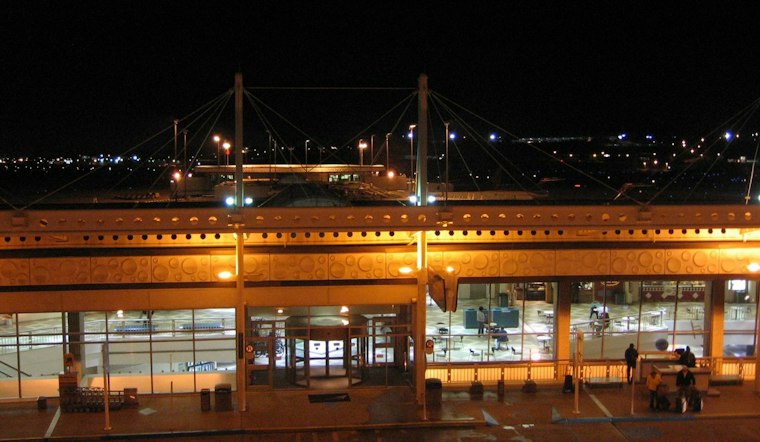
A veteran Birmingham-area pilot says a laser beam left him seeing only glass while landing at night. Birmingham-Shuttlesworth International Airport was associated with 39 laser strikes in 2025 — the airport's highest annual count in the available records. Alabama has already logged 49 statewide laser-strike reports through August 2026, even as the national numbers continue a multi-year decline.
Jeff Cotton, vice president of aviation at Southern Sky Aviation, has been a pilot for four decades and has flown jets out of Birmingham for about 20 years, according to WBMA. Cotton says he has been struck by a laser only once in 15 years, but the moment stuck with him: a beam hit his eyes while he was landing in Birmingham at night, and afterward all he could see was glass. Another pilot had to land the aircraft while Cotton was affected.
Cotton filed reports with the FAA and FBI after the incident, but he says nothing ever came of it, because it's difficult to catch someone who targets an aircraft with a laser from the ground. “It's not a prank,” Cotton said, warning that laser strikes are especially dangerous during takeoff and landing and can seriously affect flight safety. He added that people depend on pilots to transport them safely, and laser strikes interfere with that responsibility. Pilots talk about the hazard constantly, he said — he hears reports of laser strikes come across the radio about once a month.
Birmingham Carries an Outsized Share of Alabama's Reports
Birmingham accounts for a significant share of Alabama's reported laser strikes, the station's report notes. Birmingham-Shuttlesworth International Airport was tied to 18 laser-strike reports through August 2026, while Huntsville airports were associated with 11 and Mobile airports with 10. Statewide, Alabama's 49 reports through August placed it well behind the nation's most-affected states; per the Federal Aviation Administration, California logged 614 pilot-reported strikes from January through July 2026, followed by Texas with 445, Florida with 232, Illinois with 224, and Tennessee with 202.
The FAA notes that its figures reflect pilot-reported laser strikes associated with airports and don't necessarily capture every incident that happened on airport property or within city limits, and the same report cautions that statewide numbers can fluctuate year to year. Even so, the reports help investigators identify where and when strikes are happening, and the FAA encourages anyone who witnesses a laser strike to report it to both the agency and local law enforcement.
National Numbers Are Falling, But Not Fast Enough for Federal Regulators
Nationally, pilots reported 13,304 laser strikes in 2023, the all-time high, before the total began dropping for three straight years. According to the Federal Aviation Administration, the country logged 12,840 reported incidents in 2024, a 3 percent drop from 2023, and 10,994 in 2025, a 14 percent decline from 2024. So far in 2026, pilots have reported 4,470 strikes across the United States. The FAA has said outreach and training with local, state, and federal law enforcement helped drive the national decline.
Despite the downward trend, federal officials continue to treat laser strikes as a serious safety threat rather than harmless mischief. The agency has warned that holiday laser-light displays can create their own hazards for pilots, and it notes that concentrated laser beams can travel much farther than people may realize, distracting or temporarily blinding flight crews. More than 90 percent of pilot-reported strikes involve green light, according to the FAA. Laser Pointer Safety, citing FAA hazard models, reports that a standard 1-watt green handheld laser can cause flash blindness and severe glare up to 2.5 nautical miles away and create distracting cockpit illumination as far as 25.5 nautical miles out.
Steep Penalties, but Catching Offenders Remains Difficult
The physical toll on pilots has been documented for more than a decade. The FAA has recorded 322 pilot injuries from laser strikes since it began tracking them in 2010, according to WBMA's report.
Shining a laser at an aircraft is a federal crime. The FAA can fine a person up to $11,000 per violation, per the station's reporting. Separately, federal criminal penalties can include up to five years in prison and a $250,000 fine, in addition to any state and local penalties.
In Alabama, an individual pleaded guilty to aiming a laser at a police helicopter, according to the U.S. Department of Transportation Office of Inspector General. Similar federal cases have surfaced elsewhere in recent months, including a Molalla man who avoided prison after blinding a chopper.
For now, Cotton's case remains an example of the gap between the severity of the law and the difficulty of enforcement on the ground. Even with federal felony charges, FBI rewards, and steep FAA fines on the books, he says investigators were never able to identify who pointed the laser that blinded him over Birmingham that night.





