

























































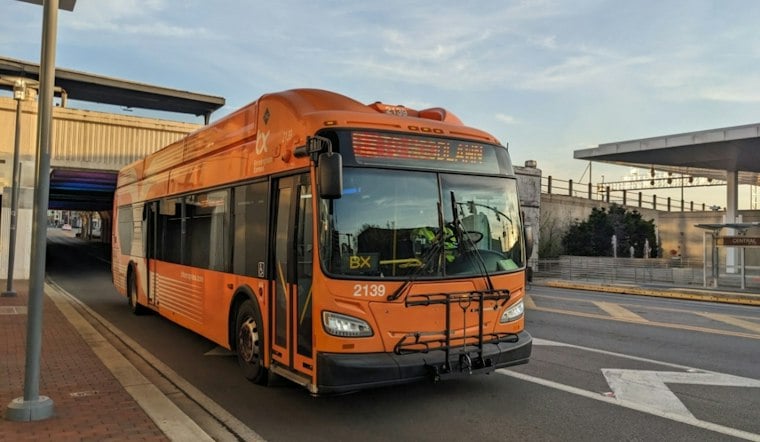
The Birmingham-Jefferson County Transit Authority was awarded $25 million from the U.S. Department of Transportation in July 2025 to build a new maintenance and operations facility, with U.S. Rep. Terri Sewell presenting a ceremonial check to the agency in September 2026. The money is meant to back cleaner-energy technology and a fleet modernization effort already underway at the agency that runs MAX Transit buses across Birmingham and Jefferson County.
BJCTA, as reported by WVTM Channel 13, said the grant will fund construction of a new operations and maintenance facility supporting services across Birmingham and Jefferson County. According to maxtransit.org, the agency plans to use the funding to incorporate advanced technologies and cleaner-energy solutions into its operations and fleet, including support for compressed natural gas vehicles and new infrastructure for electric vehicles.
The agency framed the project as part of a broader push toward reducing emissions and building what it called a resilient, future-ready transportation system, per the same maxtransit.org announcement. The federal money is also described as support for BJCTA's continued modernization of its transit infrastructure and its evolving fleet, designed to strengthen day-to-day operations as the agency incorporates cleaner-energy technologies.
Who Showed Up for the Check Presentation
Sewell, who represents Alabama's 7th Congressional District, presented the $25 million ceremonial check to BJCTA in September 2026, the same maxtransit.org release notes. Charlotte Shaw, BJCTA's CEO and executive director, took part in the presentation. Shaw became the agency's chief executive in 2021 after being recruited from the Atlanta transit agency, according to insideclimatenews.org.
BJCTA operates MAX Transit, which offers fixed routes, bus rapid transit and the MAX On-Demand microtransit service, per the maxtransit.org announcement. An estimated 6,400 people across Birmingham use MAX Transit every day, according to cbs42.com. Shannon Delcambre is listed as an assignment manager tied to the story, per WVTM Channel 13's reporting.
Construction Still a Ways Off
Despite the fanfare around Wednesday's check presentation, WVTM Channel 13 reported that construction of the new facility is still a little ways off. Shaw said a new CNG station will help the agency meet its daily service obligation, the station noted, though the exact timeline for breaking ground has not been detailed.
This isn't BJCTA's first brush with federal transit funding. The agency has received other grants previously, including a separate $1 million award through the U.S. DOT's Innovative Finance and Asset Concession program, for which BJCTA was selected as one of just 45 recipients nationwide out of more than 100 applicants, according to maxtransit.org's announcements page. Back in 2022, Rep. Sewell's office said BJCTA was slated to receive $13,654,636 to build a maintenance facility and purchase compressed natural gas, hydrogen fuel-cell and battery-electric buses and charging equipment, per sewell.house.gov. The available evidence does not establish whether that 2022 funding and the newly announced $25 million grant represent separate projects or overlapping phases of the same broader facility plan.
A Pattern of Federal Help, Little State Support
The new grant fits a broader pattern in Alabama, where public transit has leaned heavily on federal dollars rather than state money. Alabama is alone among states in providing essentially no support to public transit, according to the Federal Transit Administration data cited by insideclimatenews.org. That same reporting noted that federal support helped Birmingham roll out a new bus rapid transit system in the period before the article published.
MAX Transit has also been building out CNG infrastructure elsewhere in the system. The agency broke ground in June on a separate CNG fueling station at 973 Forestdale Blvd., a project maxtransit.org said will help MAX Transit expand its use of cleaner transportation technology while strengthening the infrastructure needed for reliable service. That same release said CNG will help reduce harmful emissions and support efforts to improve local air quality — the same rationale now attached to the newly funded $25 million maintenance and operations facility.


