

























































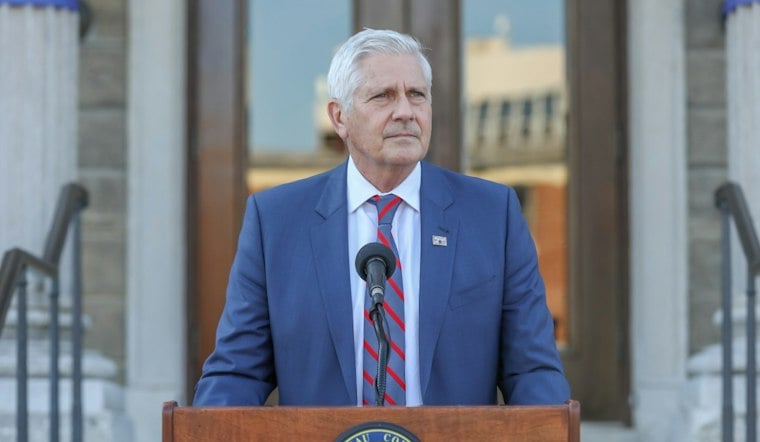
Republican gubernatorial candidate Bruce Blakeman stood in Chappaqua this week and promised that if he unseats Governor Kathy Hochul, his first act in office would be signing an executive order declaring New York no longer a sanctuary state. He made the pledge alongside Tom and Jessica Gorman, the parents of 18-year-old Loyola University student Sheridan Gorman, who was fatally shot while walking with friends in Chicago.
The Nassau County Executive used the gathering to blast Hochul for what he described as blocking local police and sheriffs from working with federal immigration agents, saying he personally had to tell Nassau County police and sheriffs they could no longer cooperate with ICE because of her policies, according to the New York Post. U.S. Representative Mike Lawler joined him, pointing to the recent arrest of 50-year-old Juan Guambana in Ossining as proof the state's restrictions endanger residents. Guambana was accused of standing on a Chappaqua home's roof with his pants down and recording a woman through her bathroom window, per the report, and detectives arrested him on October 1.
A Stakeout, Felony Counts, and a Deportation History
Guambana was charged with six felony counts of unlawful surveillance, per a News 12 report cited in the Post's account, and the paper notes he was deported in 2020 before returning to the United States in 2021. A separate account from Daily Voice reports that New Castle Police caught him after a stakeout and that he was arraigned and released on his own recognizance, with a court date set for November 5.
Lawler also highlighted 24-year-old Diego Rodriguez-Ordonez, who was arrested twice within 18 hours on September 29 in Putnam County. The Post reports he was accused of robbing a Kent gas station and assaulting a clerk, per the Putnam County Sheriff's Office, and was separately arrested after allegedly forcibly touching a woman on a Metro-North train at the Southeast station. Mid Hudson News reports that deputies subdued Rodriguez-Ordonez with a Taser near the Southeast train yard after he allegedly resisted arrest, and that Assemblyman Matt Slater noted he had accumulated 16 arrests and eight criminal convictions following his 2018 deportation.
Gorman's Death Anchors the Political Argument
The Chicago case driving much of the rhetoric involves Jose Medina-Medina, a 25-year-old Venezuelan national facing first-degree murder charges in Sheridan Gorman's death near Tobey Prinz Beach pier on March 19, according to FOX 32 Chicago. ICE subsequently lodged an immigration detainer against him, and the station notes Medina-Medina had previously been arrested and released twice in Chicago in 2023 for shoplifting before the fatal shooting. Hoodline previously covered the case and the political fallout in Rogers Park Fury Over Pier Slaying.
At the Chappaqua event, Jessica Gorman said she attended because she cared about other people's children, according to the Post. The Department of Homeland Security has tallied that New York released nearly 7,000 immigrants in the country illegally who had criminal records despite ICE requests to hold them, per the DHS figures cited in the report. Lawler said Republicans would keep returning to the issue because Hochul had not resolved it, and the group renewed its demand for an end to the state's restrictions on local law-enforcement partnerships with ICE.
The Local Cops, Local Crimes Act and the Legal Fallout
Those restrictions stem from Hochul's Local Cops, Local Crimes Act, which took effect in August 2026 and banned formal agreements allowing local officers to perform immigration-enforcement duties for ICE. Fifteen New York sheriffs have sued over the law, arguing it interferes with their authority to make public-safety decisions, while Hochul has said the state will still help ICE pursue people accused of violent or serious crimes.
The law builds on sanctuary protections dating back to September 2017, when then-Governor Andrew Cuomo signed Executive Order 170, generally barring state agencies and law enforcement from inquiring about or disclosing immigration status for civil enforcement, according to documentation from the New York State Senate. That order was supplemented in 2018 by a companion measure restricting civil immigration arrests inside state-owned facilities without a judicial warrant.
Enforcement of the new law has already produced direct confrontations. Attorney General Letitia James issued subpoenas in August to law enforcement agencies in Nassau, Rensselaer, Broome, and Steuben counties for failing to confirm plans to dissolve their 287(g) agreements with ICE, as reported by WXXI News. Days later, Blakeman announced that Nassau County had dissolved its own 287(g) agreement and ended special co-designations for police detectives to comply with state law, even as he publicly opposed the mandate, per Patch's reporting. Hochul and James also filed a lawsuit against the Rensselaer County Sheriff's Office for refusing to dissolve its agreement, according to the New York State Attorney General's Office, while the 15 sheriffs' federal lawsuit challenging the state's authority remains pending.
A Campaign Clash With a Wide Money Gap
The dueling legal fights are unfolding as New York's broader fight with Washington continues; the Governor's Office announced in June that the state had filed its own federal lawsuit to defend the Local Cops, Local Crimes Act and other immigration measures after federal officials threatened legal action and surged ICE agents into the state. That clash, combined with the Chappaqua arrests and the Gorman case, has made sanctuary policy a central flashpoint heading into Election Day.
Public polling has so far favored Hochul. A Siena College survey from early August found her leading Blakeman by 10 percentage points, 49 percent to 39 percent, according to the East Hampton Star. CBS News reported that Hochul also holds a steep financial advantage entering the race's final four weeks, with more than $33 million available across her campaign and state party accounts compared with Blakeman's $178,000 in cash on hand — a gap that may help explain why his campaign has leaned so heavily on high-visibility events like the one in Chappaqua.



