

























































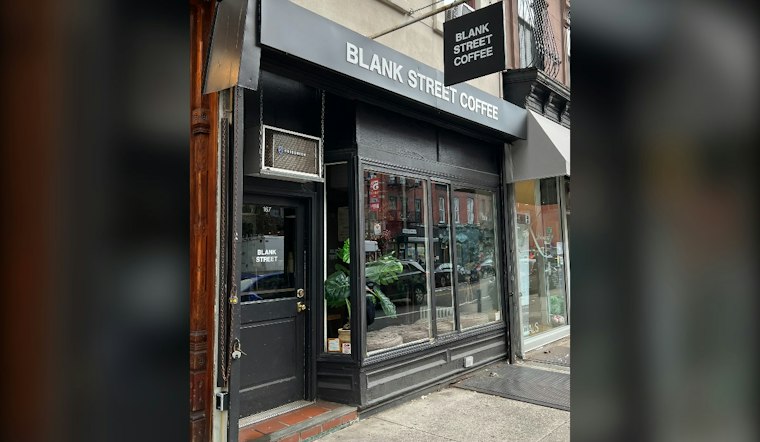
A rapidly growing, venture-backed coffee chain from Brooklyn is preparing to move into the long-vacant former Starbucks at 1588 N. Milwaukee Ave. in Wicker Park, bringing a new round of national-chain scrutiny to one of the neighborhood's most contested corners. Blank Street Coffee, known for its matcha drinks and automated espresso machines, is readying the Six Corners storefront that has sat empty for roughly the past year.
The planned opening was first reported by Crain’s Chicago Business on September 30, before Block Club Chicago followed on October 1, noting that Blank Street did not respond to requests for comment about an opening timeline or other details. The space overlooks the busy North/Damen/Milwaukee intersection, a commercial crossroads that has repeatedly found itself at the center of Chicago's debate over chains versus independent retail. Blank Street was founded in Brooklyn in 2020 and has since expanded to dozens of locations on the East Coast and in the United Kingdom, according to the outlet's reporting.
The company's growth has been fueled by serious capital. Blank Street raised more than $100 million in venture funding, Axios reported, and according to Daily Coffee News, that included a $105 million financing round in August 2026 — $75 million in new equity led by General Atlantic plus $30 million in secondary stock sales — pushing the company's valuation to roughly $650 million. That war chest has powered an aggressive push into West Coast and Midwestern markets alike.
From a Coffee Cart to a 100-Store Chain
Blank Street's rise traces back to a single battery-powered, mobile coffee cart in Williamsburg, launched by former venture capitalists Issam Freiha and Vinay Menda, who previously ran Reshape Ventures, per Forbes. By August 2026, the chain had grown to more than 100 locations worldwide, including hubs in New York, Boston, Washington D.C. and Los Angeles, the same Daily Coffee News report found, with the Los Angeles debut marking its West Coast entry shortly before the Chicago expansion.
Much of that scale is possible because of the chain's hardware. Blank Street relies on super-automatic Swiss Eversys espresso machines capable of brewing up to 700 drinks per hour, letting it run smaller storefronts with fewer staff per shift, the same Daily Coffee News reporting notes. That automated model, as a case study on the company's operations describes it, keeps labor footprints low while allowing rapid scaling into dense urban corridors. Its current U.S. menu includes a shaken vanilla bean matcha drink and a cinnamon bun latte, per Block Club Chicago's reporting.
The chain's growth hasn't come without labor friction. In June 2024, Blank Street baristas in New York City ratified their first union contract with United Food and Commercial Workers Local 1500, covering more than 100 workers across nearly 20 Manhattan and Brooklyn locations, according to More Perfect Union. Workers organized to secure hourly wage floors and workplace protections at the venture-backed company.
A Storefront With a Combative History
The space Blank Street is moving into carries its own history of chain-versus-neighborhood tension. Starbucks occupied the 1588 N. Milwaukee Ave. storefront for years before revamping it in 2017 into Chicago's first Starbucks Reserve Bar, expanding into an adjacent shoe store to roughly double its footprint to about 2,700 square feet, according to DNAinfo's reporting at the time. Before that renovation, the space was a compact 600-square-foot storefront.
Even further back, when Starbucks first opened at that address in 2002 — replacing the independent local shop Cafe Cafeina — neighborhood activists protested national chain encroachment in Wicker Park by shattering the store's windows, DNAinfo reported. It's a documented flashpoint in a decades-long fight over corporate retail's place in a neighborhood that has long branded itself around its arts-driven identity.
That history came full circle in September 2025, when Starbucks announced a nationwide corporate restructuring that closed roughly 1% of its North American footprint. The closures included fewer than 12 Illinois stores, among them the Wicker Park location — one of about 20 Chicago stores Starbucks decided to shutter, as detailed by Time Out. The storefront has sat empty since.
Another Chain Enters a Neighborhood Already on Edge
Blank Street's arrival follows close on the heels of another out-of-town, private-equity-backed newcomer. Call Your Mother Deli, based in Washington, D.C. and backed by a private equity company, opened in Wicker Park earlier in 2026, and Hoodline's earlier coverage detailed how its arrival reignited debate over the neighborhood's character. Wikipedia notes that Call Your Mother sold a majority stake to Invus in 2025 specifically to finance its expansion beyond D.C.
That debate hasn't cooled. By mid-2026, Chicago media were highlighting growing local frustration over out-of-town, private-equity and venture-backed food chains securing prime retail spaces in gentrified neighborhoods like Wicker Park, according to Axios. Blank Street's move into Six Corners lands squarely inside that pattern.
Independent operators also face a broader landscape of restaurant shutdowns amid high operating costs and financial constraints. Whether Blank Street's opening at Six Corners draws the same backlash that met Starbucks in 2002 — or simply another round of Wicker Park's recurring chain debate — remains to be seen once the coffee shop actually opens its doors.





