

























































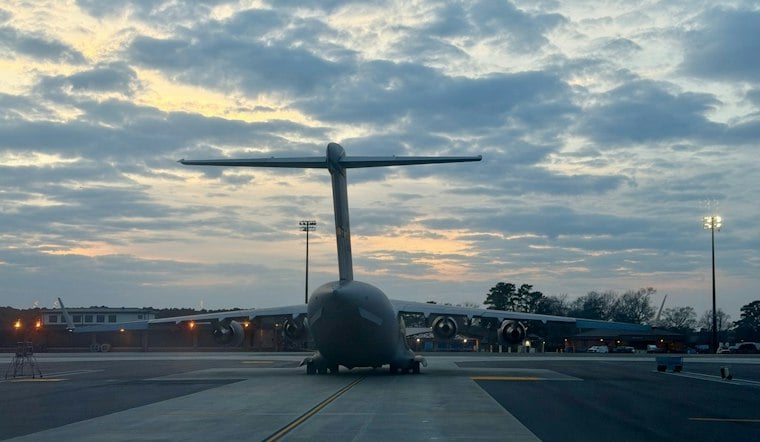
Boeing technicians at Port San Antonio have started bolting SpaceX's military-grade satellite internet system onto Air Force C-17 Globemaster cargo jets, with nine aircraft already finished and more on the way. Two contracts worth a combined $13.5 million cover the work of integrating the system, known as Starshield, and installing equipment on 19 of the massive cargo planes by March.
What Starshield Brings to the Cargo Fleet
Starshield is described as the government and defense version of Starlink satellite internet, according to the San Antonio Express-News. On the C-17s, the system will provide a satellite link to keep jets connected and able to share mission data, giving crews a more reliable way to stay networked while flying cargo and troops around the world. The Air Force has said work has been completed on nine of the jets so far, and it expects follow-on deals to eventually equip all 222 of its Globemasters with the technology.
The installation work is happening at a facility with deep roots in military aviation. Boeing's San Antonio site, established in 1998 as a maintenance and modification center for large aircraft, includes more than 1.6 million square feet of enclosed area and 940,000 square feet of hangar space, according to Port San Antonio. The company's Global Services and Support business unit there operates one of the largest military aircraft maintenance, repair and overhaul facilities in the world at Kelly Field, with maintenance and modification programs that include the C-17 Globemaster III specifically.
A Supplier From Sparks, Nevada
According to the Air Force, Sierra Nevada Corp. of Sparks, Nevada, supplies both the Starshield and ATOMS equipment and installation kits used in the upgrades, the Express-News reported. The Starshield work ties into a broader Air Force push the service calls the Airlift/Tanker Open Mission Systems communications suite, which is designed to run on Starshield connectivity. That effort builds on testing seen elsewhere in the mobility fleet: at Stewart Air National Guard Base, the 105th Airlift Wing's C-17 Combined Test Force has been tasked with operational and developmental testing of new technologies for the aircraft, and StarShield systems are among the projects listed for evaluation there, per a release from DVIDS.
The push to network mobility aircraft is not limited to the C-17. The Air Force has been trying to more deeply integrate new communications and networking capabilities onto the KC-135 tanker fleet and other aircraft across its broader mobility force, according to reporting from The War Zone. That outlet notes Sierra Nevada's ATOMS system is a Starshield-based beyond-line-of-sight satellite communications system already being installed on a handful of KC-135, C-17, KC-46 and C-130 aircraft, and that the Air Force's Mobility Guardian 2025 exercise demonstrated the setup's ability to manage data and communications across those platforms and ground nodes.
Boeing's Bigger Stake in Keeping C-17s Flying
The San Antonio Starshield contracts sit alongside a much larger relationship between Boeing and the C-17 fleet. The company holds a $9.5 billion deal to handle heavy maintenance on the C-17 fleet, work also performed at Port San Antonio, the Express-News reported. A Boeing spokesperson said the Starshield efforts support the C-17 fleet and help it meet warfighters' evolving needs, according to the same report.
Elsewhere, Boeing has separately secured a $2.26 billion contract modification for C-17 sustainment, according to GovConWire, which notes that award builds on a potential $23.76 billion contract the Air Force awarded Boeing back in September 2021.
Starshield's Expanding Military Footprint
The C-17 work is one piece of a much larger Pentagon investment in Starshield. At least $6 billion in Pentagon spending is tied to the network, including $4.2 billion in Space Force contracts for the Golden Dome missile defense system, the Express-News reported. Beyond aircraft, the Pentagon is also installing the technology on some executive jets, Navy ships and drone boats.
That expansion reflects a shift in SpaceX's role within the defense industry. The company is no longer simply the Pentagon's dominant launch provider but is also becoming a central supplier of the satellite networks and communications infrastructure underpinning the military's next-generation missile defense architecture, according to SpaceNews. The Air Force Research Laboratory's Global Lightning program, which started in 2018, has tested Hybrid SATCOM systems on more than ten aircraft types, according to Simple Flying, which also reported that a Boeing KC-135R Stratotanker was photographed at RAF Mildenhall in June with a new dorsal antenna believed to be a Starshield terminal.
For Port San Antonio, the work adds another layer to a facility already central to keeping the Air Force's aging cargo fleet airborne. With nine jets already converted and ten more due by March, the Starshield rollout marks an early step toward the service's stated goal of networking its entire 222-strong Globemaster fleet.





