

























































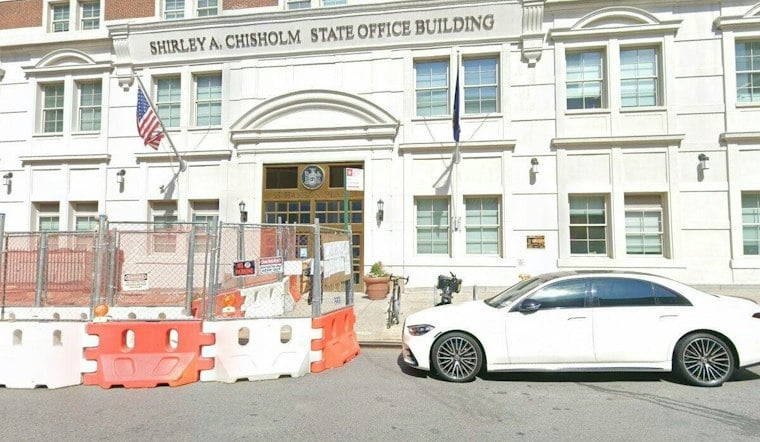
More than 100 home care workers gathered outside the Shirley A. Chisholm State Office Building in Brooklyn on Oct. 22, demanding the state enforce labor protections they say have left hundreds of wage cases stuck in limbo for years. Many in the crowd were women, largely Chinese, Hispanic and African American, who say they've spent years working 24-hour shifts while being paid for only a fraction of that time.
The protest, first reported by amNewYork, drew home care aides who say employers routinely paid them for just 11 hours of work despite requiring them to be present for a full 24-hour shift. Protesters have filed hundreds of unfair wage complaints with the New York State Department of Labor, and according to amNewYork's reporting, some workers have won their cases but still struggled to collect the money, while many others have waited years without any decision at all.
At the center of the dispute is New York's so-called 13-hour rule, which allows home care agencies to pay aides for only 13 hours of a 24-hour shift, provided the worker receives eight hours of sleep time, including at least five uninterrupted hours, plus three hours of meal breaks. Workers can claim full pay for the entire 24-hour shift if they don't get those five uninterrupted sleep hours, a standard reaffirmed by a 2019 ruling that organizers say agencies and the state have failed to enforce.
Workers Describe Years Without Full Pay
Ilene Brooks told amNewYork she filed a wage theft complaint almost a year and a half before the rally after working 24-hour shifts for five years at Ellison Home Care. The Department of Labor found she was owed $150,000, she said, but she still hasn't received the money even though her complaint was upheld. A separate account from work-bites.com likewise reported that the Labor Department acknowledged Brooks was owed $150,000 after her five years of round-the-clock shifts for Ellison.
Other workers described similarly long tenures and similarly long waits. Chen Xuezhen said she worked 24-hour shifts for 10 years with Royal Care and that the shifts destroyed her health, according to amNewYork's reporting. Sileni Martinez said 26 years of 24-hour shifts at BHRAGS and First Chinese took a toll on both her health and her family. Fengjin Zhu, who spent 11 years in home care including four years on 24-hour shifts, said she developed difficulty walking, foot pain and inadequate sleep as a result.
Zhu's case illustrates how uneven the payouts can be even after a ruling. The Department of Labor ordered her employer to pay $17,000 in owed wages, she said, but the employer began paying in monthly installments of just $400. According to Zhu, August installment payments were cut in half and September's payment never arrived at all. The department ordered other workers' employers to pay more than $100,000 in owed wages, Zhu said, underscoring the wide range of amounts at stake across cases.
Union Arbitration Versus State Enforcement
Chen Guizhu said she worked 24-hour shifts for the Chinese-American Planning Council since 2006, and that after she submitted nighttime duty logs and demanded her wages, the organization threatened her with jail and ultimately fired her, per amNewYork's account. Her case echoes a separate class-action fight: Documented reported that lead plaintiff Gui Zhu Chen said she worked 24-hour shifts with no sleep or breaks for the same organization between 2013 and 2019 while being paid for only 13 hours per shift.
That broader legal fight has produced a court order requiring the Labor Department to reopen closed wage-theft cases, though accounts of its scope differ. Documented described the New York Supreme Court's Jan. 2 ruling as requiring the department to reopen hundreds of closed cases, while amNewYork characterized the same ruling as covering a class of at least 150 home care aides. The Labor Department is appealing that ruling in a higher court, amNewYork reported.
Organizers say the department has also pushed some unionized workers toward arbitration rather than direct enforcement. Department of Labor representatives told organizers on Oct. 21 that unionized workers would have to pursue their claims through arbitration, according to amNewYork. Yueheng Zhang said arbitration amounts to the department passing off responsibility, but also said the department indicated it had completed investigations into many cases and would begin issuing compliance orders to employers.
Governor's Record and a Stalled City Bill
Zishun Ning, who chanted “No more 24, no more 24” at the rally, urged Governor Kathy Hochul to enforce the labor law, saying it currently is not being enforced even as some cases begin receiving backpay. A spokesman for the governor, Luke Fanous, said Hochul is committed to ensuring workers receive the wages they're owed. Per amNewYork, the governor's office points to $13 billion in minimum home care aide wage increases secured since 2023, along with legislation proposed last month to ensure the minimum wage continues rising with inflation.
New York's 2023 executive budget included a $7.7 billion investment in the home care industry, according to In These Times. Even so, some advocates argue that 24-hour shifts remain necessary to provide continuous care for extremely ill and disabled New Yorkers, which is part of why some home care companies use 12-hour split shifts while others continue paying for only 13 hours of a 24-hour shift, as amNewYork reported.
A separate push at the City Council, known as the No More 24 Act, would prohibit home care employers from assigning shifts totaling more than 12 hours in any 24-hour period, according to the New York City Council. As of August, the measure remained stalled in the Committee on Civil Service and Labor after opposition from the Legal Aid Society, Hochul and Mayor Zohran Mamdani, per Nonprofit Quarterly. District Council 37 opposed an outright ban in part because it estimated the city would need an additional $460 million in funding to cover related costs, the outlet reported.
The fight in Brooklyn is playing out against a backdrop of legal precedent that already favors workers on paper. A 2019 New York Court of Appeals ruling, cited in state Department of Labor guidance, requires agencies to pay workers for every hour of a 24-hour shift whenever the required sleep and meal conditions go unmet. For the women who rallied outside the Chisholm building, the question isn't what the law says — it's whether anyone will make their employers follow it.





