

























































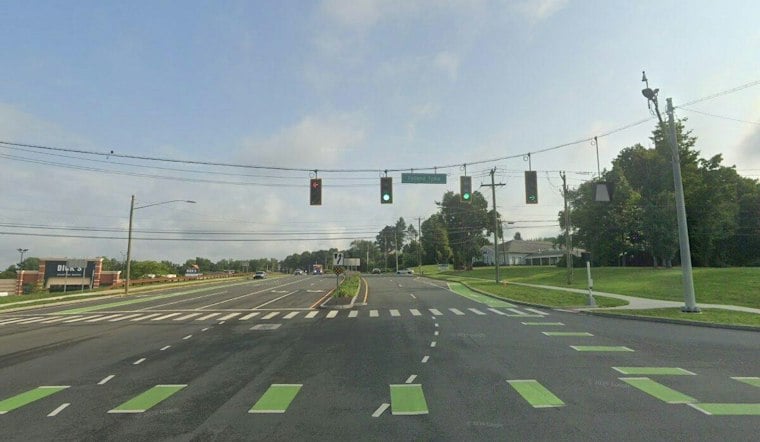
Buckland Street, the stretch of pavement running past the Shoppes at Buckland Hills and the cluster of restaurants, retail plazas and a movie theater that surround it, has recorded 1,144 crashes since 2016 — more than any other road in Manchester. The corridor's four busiest intersections also top the town's list for frequent wrecks, making the Buckland Hills retail district both the town's commercial engine and its most dangerous stretch of asphalt.
The figures come from the Connecticut Crash Data Repository, which compiles crash reports collected by state and local police from two sources — the Department of Public Safety and the Connecticut Department of Transportation. As CT Insider reports, Manchester Police Chief William Darby said the crash totals largely track with where traffic volume is heaviest in town, not necessarily where roads are most poorly designed.
Along Buckland Street itself, three intersections stand out for frequent collisions: Buckland Street and Pleasant Valley Road, Buckland Street and Pavilions Drive, and Buckland Hills Drive at Buckland Street. A fourth, the intersection of Buckland Street and Adams Street at Tolland Turnpike, has logged 215 crashes since 2016 on its own. Darby has described Buckland Hills as a large retail district carrying very high traffic volumes, and he noted that roads with frequent crashes also tend to be the ones carrying the most vehicles.
Tolland Turnpike and Other Manchester Hotspots
Buckland Street isn't alone in the rankings. Tolland Turnpike has seen 806 crashes over the past 10 years, followed by Middle Turnpike West with 643, Main Street with 605, Adams Street with 502, Buckland Hills Drive with 374 and Pleasant Valley Road with 310. Darby said Main Street, Middle Turnpike and Broad Street serve as primary routes for most people passing through Manchester, which helps explain their elevated crash counts.
Beyond Buckland Hills, the intersection of Oakland and Woodbridge streets has also seen a high number of crashes, as have the Woodland Street and Middle Turnpike West intersections along Broad Street. Darby said the town often directs enforcement funding toward these crash-prone locations, and Manchester has used Department of Transportation grant funding for distracted-driving and DUI enforcement in trouble spots.
Main Street Redesign Clears a Legal Hurdle
Manchester has multiple road projects in motion that could eventually reshape some of these numbers, starting with a long-debated overhaul of Main Street downtown. Darby said the town plans to change Main Street to improve both pedestrian and vehicular safety, and the proposed changes include two roundabouts — one at the intersection of Main Street and Center Street — along with a bike lane, a road diet that would cut travel lanes from four to two, and altered on-street parking.
That plan has faced legal pushback. Manchester residents filed a lawsuit opposing the proposed changes, but the Superior Court for the Hartford judicial district ruled on September 11 that the ordinance is lawful, according to CT Insider's reporting on the litigation. The court stopped short of forcing the Board of Directors to put the matter before voters in a special election. Weeks later, on October 26, the Board of Directors adopted a separate ordinance requiring Main Street to remain at least 44 feet wide.
Enforcement Cameras Still Awaiting a Vote
Manchester's Board of Directors has also signaled it intends to move forward with automatic red-light and speed-enforcement cameras, though the ordinance that would actually authorize them still needs a board vote. In April, the board approved a measure letting Town Manager Steve Stephanou draft that ordinance. Darby has recommended Buckland Hills as a trial area for the cameras, but the town has not chosen specific locations, and officials are separately considering school-bus cameras that would fine drivers who illegally pass stopped buses.
If the board eventually passes the camera ordinance, Darby estimated it would take six months to a year to secure state approval and get the devices installed. The push for camera enforcement sits in a gray area under state law: according to a report from the Connecticut General Assembly's Office of Legislative Research, state law neither prohibits nor explicitly authorizes radar and camera technology for speed enforcement, and the office has suggested that specific statutory authority would likely be preferable if local police intend to use it widely.
Tolland Turnpike Rebuild Still Years Off
Separately, Manchester is moving ahead with a reconstruction of Tolland Turnpike between Chapel Road and Buckland Street, a stretch that overlaps with some of the town's highest-crash territory. The Board of Directors allocated a $6.7 million grant in state and federal funding toward the project, which CT Insider reported is expected to cost $7.2 million total, with the remaining $500,000 coming from a local match tied to a bond referendum voters approved in November 2023. Construction was anticipated to begin in late 2026 or early 2027, following design and permitting work that started in summer 2025.
The crash repository itself comes with caveats about completeness. Property-damage-only crash data is backlogged by roughly three months, and fatal crash reports can take three to six months or longer to finalize while investigations wrap up, according to the Connecticut Crash Data Repository. New entries are added to the system nightly, and the database allows users to filter by date, route, collision type and injury severity to track patterns like the ones emerging around Buckland Hills.



