

























































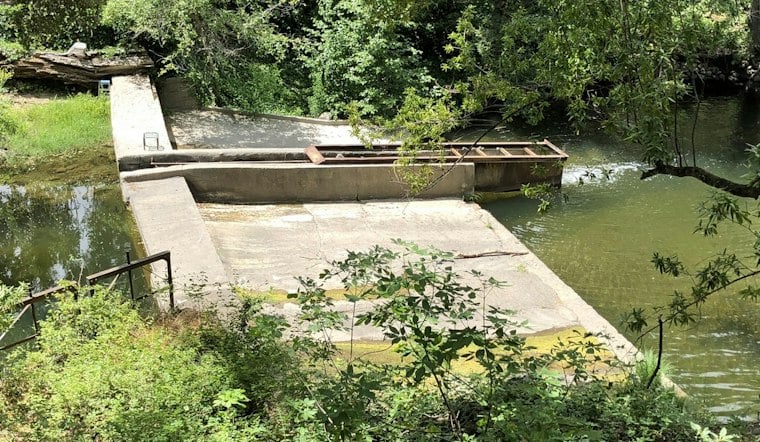
Caltrain crews finished shoring up the banks of San Francisquito Creek ahead of schedule to protect a heavily used railroad bridge and the Alma Street bicycle bridge.
The announcement came via Caltrain's official account
, which said the completed project reduces erosion and strengthens the creek banks supporting both the rail bridge and the pedestrian and bicycle crossing. Caltrain owns and maintains the railroad bridge, which is near Menlo Park and Palo Alto, according to
Caltrain documentation
.
Emergency bank stabilization in 2023 preceded the permanent fix completed this fall.
What the Construction Actually Involved
Crews reinforced roughly 130 linear feet of the creek's northern bank, work that also protected a Menlo Park storm drain outfall near the bridges, per Caltrain's project documentation. Plans included temporary shoring and river diversion.
The Menlo Park storm drain outfall itself was replaced with a new backflow prevention device, and crews carried out riparian habitat restoration by removing invasive vegetation and planting native species along the bank.
A Tree Older Than the City It Named
Standing beside the railroad bridge is El Palo Alto, the coast redwood that gave the city of Palo Alto its name. The tree is estimated to be more than 1,080 years old and stands 110 feet tall along the creek bank, according to InMenlo's historical account.
El Palo Alto once had twin trunks, but it lost one before 1883; the exact date is unknown. Early retaining-wall efforts along the bank date as far back as 1883 and 1904. The same InMenlo account notes that coal soot from early steam engines and lowered water tables also weakened the tree's upper canopy over the decades.
Funding Split Across Three Government Partners
The San Francisquito Creek Bank Stabilization Project is a partnership between Caltrain and the cities of Menlo Park and Palo Alto, carrying a total budget of $14 million. Palo Alto and Menlo Park were each expected to pay about $1.1 million toward the effort. The Peninsula Corridor Joint Powers Board, which owns and operates Caltrain, approved a $2,379,910 construction contract with Hanford Applied Restoration & Conservation in March 2026 and set a total baseline budget of $13.986 million, according to Caltrain's board documentation.
The project has $3.842 million in programmed state funding.
Part of a Bigger Flood-Control Picture
A February 1998 flood damaged roughly 1,700 properties across Palo Alto, Menlo Park and East Palo Alto, according to the San Francisquito Creek Joint Powers Authority. The authority coordinates flood reduction across county lines.
That same regional push is visible elsewhere along the creek. Palo Alto broke ground in May on a $16.12 million Newell Road Bridge replacement as part of the authority's Reach 2 flood protection plan. In August, the Santa Clara Valley Water District board voted to discuss taking a bigger leadership role in creek flood control after neighborhood groups pushed for faster upstream improvements, according to the Palo Alto Daily Post.
Why the Timing Matters
Caltrain's capital delivery program framed the completed creek work as a significant milestone, strengthening critical infrastructure ahead of winter.
Caltrain secured environmental permits for the stabilization work. Caltrain runs service along the Peninsula corridor.




