

























































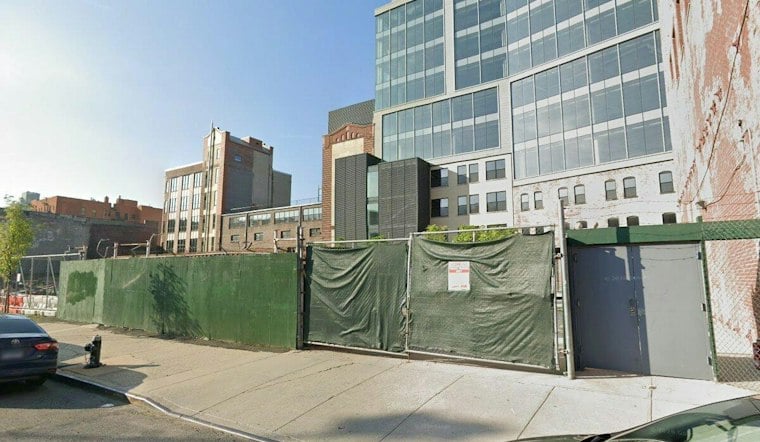
The University of Cambridge is setting up shop in West Harlem. Cambridge Enterprise, the university's innovation arm, has launched its first-ever international startup hub inside the Innovation Triangle, placing five Cambridge-linked companies into lab and office space at Janus Property Company's Factory District.
The initiative, called the New York Leap, is described by Cambridge Enterprise as “the first international landing spot” in its broader Leaps program, according to Cambridge Enterprise. The university's own materials note that the New York push follows “our inaugural Leap in London,” positioning West Harlem as the next step after the UK. As first reported by Crain's New York Business, the university selected West Harlem specifically for this expansion.
The hub is built in collaboration with Janus Property Company and functions as a temporary landing spot for Cambridge-connected portfolio companies, founders and technology ventures operating within what Cambridge Enterprise calls the Innovation Triangle West Harlem. The arrangement is meant to give those ventures short-term soft-landing support along with access to New York's capital markets, talent pool, industry networks and research partners, per the same university source.
Five Companies, Five Different Scientific Bets
The inaugural cohort landing in West Harlem includes five Cambridge Enterprise portfolio companies, according to ConnectCRE: Verinnogen, Streamtrix, Aila Biotech, Senesys.Bio and Wave Photonics. Collectively, the group's work spans brain cancer, multiple sclerosis and central nervous system therapeutics, aging-related disease, tumor measurement and integrated photonics, the outlet reports. All five will be based inside Janus Property Company's West Harlem Factory District, where they'll use dedicated lab and office space, the report notes.
ConnectCRE's reporting frames the move as Cambridge Enterprise — the commercialization arm of the University of Cambridge — choosing the Factory District as the first U.S. outpost for its still-new Leap program. The site sits within a stretch of West Harlem that has increasingly branded itself around life sciences and advanced manufacturing infrastructure.
Part of a Bigger Playbook Launched in London First
The New York Leap isn't Cambridge Enterprise's first attempt at planting a flag outside Cambridge itself. The broader Leaps initiative launched with London chosen as its very first landing spot, intended to embed Cambridge-based companies in complementary ecosystems so selected founders could access new markets, talent and investment, per Cambridge Enterprise. That London Leap had room for three companies and launched alongside Phoenix Court, Balderton Capital and the BioInnovation Institute Foundation.
Cambridge Enterprise separately opened its first-ever London office in King's Cross in June 2025, a move the university said was meant to help bridge the Cambridge and London innovation ecosystems by increasing access to investors, skilled talent and new partnerships, according to Cambridge Network. That same report notes Cambridge-founded technology companies raised $2.2 billion in 2024 — double what they raised in 2023 and above the previous record of $2 billion set in 2021 — while Cambridge itself spun out 26 new companies that year, with the East of England capturing 35% of all UK spinout investment. ConnectCRE's reporting characterizes the West Harlem cohort as the second Leap group overall, following the one in London.
Who Else Is in the Room in West Harlem
The New York Leap arrives with a list of partners Cambridge Enterprise says will support the program's companies, including Harlem Biospace, Gotham Foundry, Columbia School of Engineering, Columbia Business School, the New York Structural Biology Centre, Chan Zuckerberg Biohub and the CUNY Advanced Science Research Centre. Harlem Biospace already has a physical presence nearby: Empire State Development announced in September 2024 the opening of Harlem Biospace @ Mink, a graduation incubator inside the restored Mink Building at 1361 Amsterdam Avenue, described in that announcement as a $9 million facility, according to Empire State Development.
That same agency oversees the Harlem Community Development Corporation, a subsidiary created in 1995 to serve the greater Harlem community — spanning Central Harlem, El Barrio/East Harlem, Washington Heights and West Harlem, per Empire State Development's own description of the entity.
Why New York, and Why Now
New York City has been building out life sciences infrastructure for years, and the numbers help explain the city's pitch to outside institutions like Cambridge. City life sciences institutions pulled in $2.0 billion in annual National Institutes of Health awards back in 2020, and private venture capital funding for the sector jumped 400 percent between 2016 and 2018, according to the New York City Economic Development Corporation. The agency also says the city now has the largest biotech workforce in the country, supported by six incubators for early-stage companies, with the industry contributing $3.1 billion to the city's gross metropolitan product and adding more than 50 companies annually on average since 2016.
New York has also backed that growth with public money: the city's EDC points to a $1 billion initiative aimed at cementing its position as a life sciences leader, including $20 million earmarked for building a diverse talent pipeline. Separately, LifeSci NYC describes itself as a more-than-$1 billion effort to create 40,000 new jobs in the sector, and notes that NYCEDC and Empire State Development partnered with NewYorkBIO to launch New York Bio Connect as a hub for the city's health and life sciences industry.
What the New York Leap will ultimately cost, how long the five companies will stay, or how many jobs the hub might generate in West Harlem hasn't been disclosed in available materials from either Cambridge Enterprise or Janus Property Company. For now, the arrangement stands as Cambridge's first attempt to plant its research-commercialization model directly inside a U.S. neighborhood already courting the same kind of biotech investment the university is chasing.





